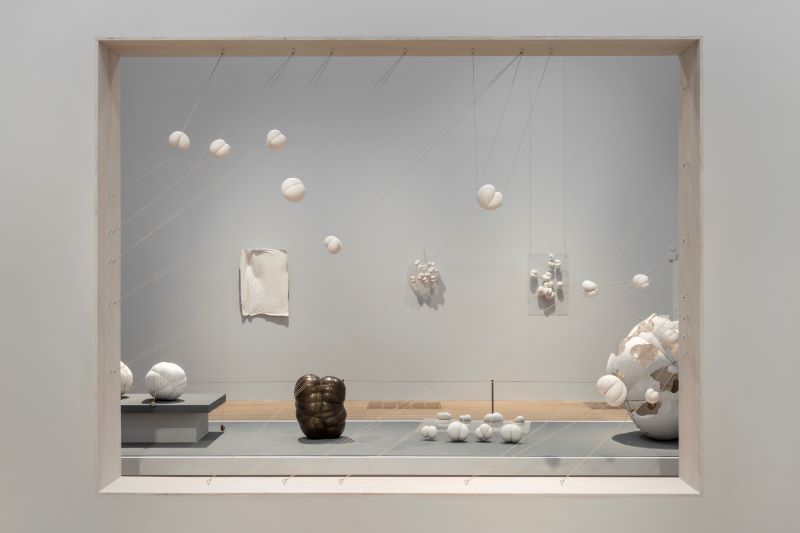
How often are we offered the opportunity to appreciate work by Slovakian artists? Virtually never is the answer. And seeing Maria Bartuszová’s work for the first time is a revelation. Not only because she was an outstanding woman sculptor in times when the field was dominated by men, but also because she constantly pushed the boundaries of what sculpture could be and how it could speak to us in entirely new ways.
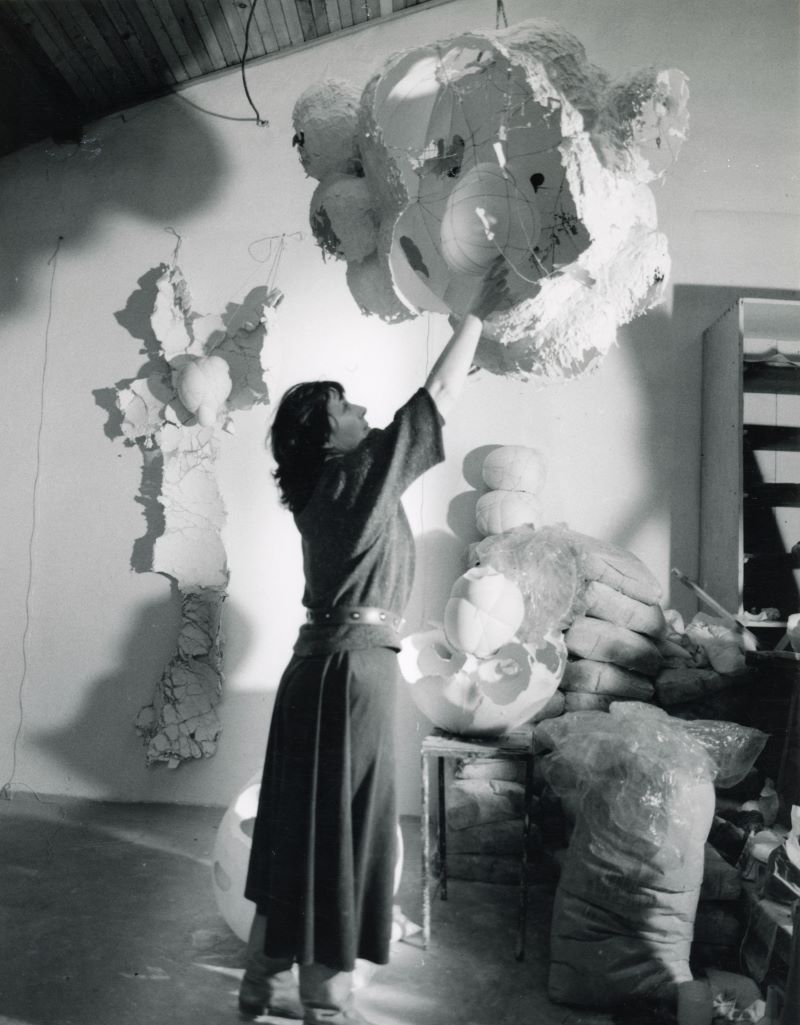
Many of her works are variations on the egg – in its most fragile and also most solid form. More than just an oval solid, she allows us to see it in formation, bursting open, sometimes incredibly fragile, at others rock hard.
She invented a way of making abstract shapes by pouring plaster into rubber balloons, then molding them through pressure and tension. She called this way of allowing shapes to form organically through their own weight “gravistimulation”. Taking this idea further, she blew air into balloons and poured plaster over them, creating “a tiny void full of a tiny infinite universe”.
But these are not simply intriguing techniques. In Bartuszová’s hands they become works of beauty.
I can’t put it better than critic Jan Verwoert:
“What may strike you first when you encounter Maria Bartuszová’s sculptures is this: her work does not just speak about the body as a motif. It talks to the body, through the body. Corporeality is its medium, its voice. Her sculptures work on the level of body talk. They do not speak to the eyes only. Even if you don’t touch them, they touch on something inside you that lies beyond visual memory.“
Maria Bartuszová will not be a familiar artist to most people in the UK. And yet, as her current show at Tate Modern reveals, she completely deserves to be. Born in former Czechoslovakia in 1936, she is one of the most inventive and meaningful sculptors /makers of her generation.
Like Barbara Hepworth, Bartuszová found inspiration in natural forms, something that she took in new directions and with entirely new techniques. Despite being relatively isolated, her work has an affinity with other European artists such as the infinite forms of Constantin Brancusi, the slashed canvases of Lucio Fontana and the bursting spheres of Arnaldo Pomodoro.
Marie Klimešová’s insightful essay in the exhibition book explains the political transformations that formed the background to Bartuszová’s life. After the Khrushchev thaw and the years up to the Prague spring of 1968, a new generation of artists in the Czechoslovak Republic began to express themselves, in particular a notable group of artist-women, contemporaries of Bartuszová, including the remarkable Eva Kmentová.
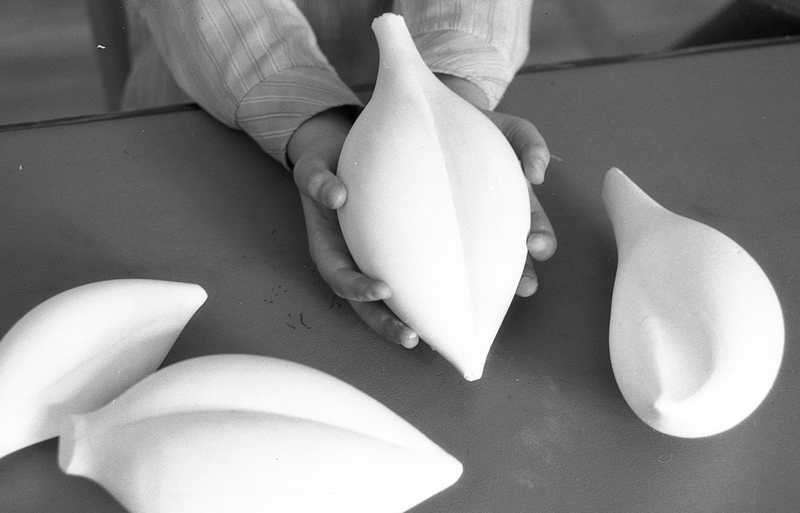
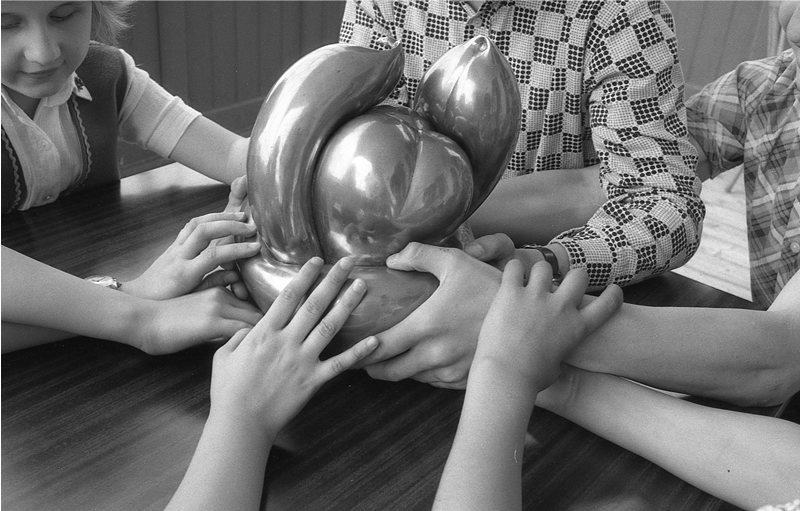
Deeply moving photographs by Gabriel Kladek document workshops for blind and partially sighted children in Levoča, Czechoslovakia (now Slovakia), handling Bartuszová’s sculptures, held in 1976 and 1983. They recall educational methods developed in the Zagorsk school by Soviet psychologist Alexander Meshcheryakov*.

Congrats to Tate Modern director Frances Morris and her curatorial team for introducing this fascinating woman with a wonderful selection of work in plaster, bronze casts and aluminium reliefs. Thanks also to Helen Rhys of Tate Modern press office for help with this blog.
Maria Bartuszová is at Tate Modern until 25 June.
* Maxim Morosov introduces “A Contribution to a Conversation About Meshcheryakov” online event: Thursday, 2 March 2023 17:30-18:45. For more information email: ilyenkov2020@gmail.com