“Caravaggio, through action, knew how to portray the deepest facets of the human soul, from innocence to violence, from hope to despair… they can bring to a standstill this hastening of time in which we live.”
I met the author of these words, Thomas Clement Salomon, director of Rome’s Gallerie Nazionali Barberini and Corsini, in the gardens of the Barberini palace, past the crowds queuing to see Caravaggio 2025.
Hidden from the street, the “giardino secreto” at the back of the palace was a revelation as it has been recently restored with generous plantings. The palace itself was designed by three of Rome’s greatest Baroque architects, and is decorated inside with magnificent, frescoed ceilings. Its rear façade shone cream and gold in the May sunshine as we sat down for a coffee in Le Serre (The Greenhouses) café.
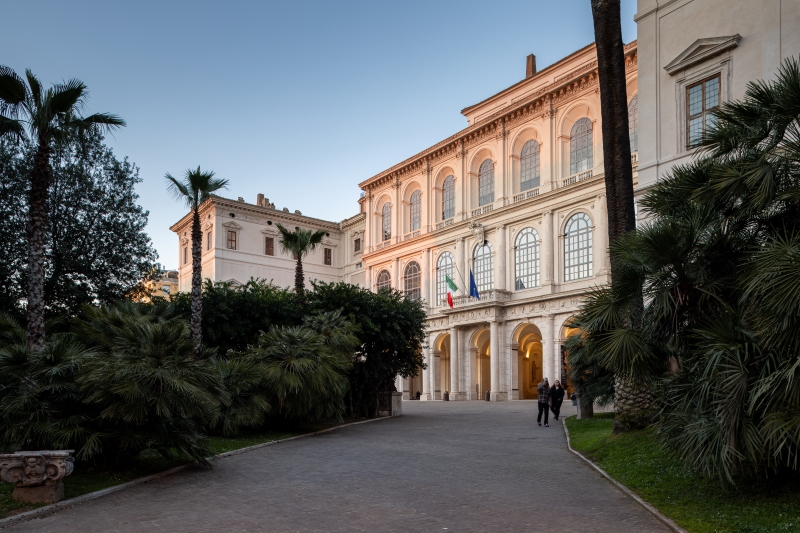
“It’s been an enormous job with thousands of institutional requests”, says Salomon, “but we are delighted to see the museum so alive. That’s our mission. We didn’t have that many visitors in recent years, so it’s crucial to position ourselves as what we are: the small national gallery of Rome, which has one of the most important Caravaggesque collections in the world. Some 350,000 visitors have come to see the present show in the first three months.”
“Another Caravaggio show?”, I asked a bit cheekily. “Yes, for many reasons”, came the reply. “We have achieved many aims. We have 24 paintings, which for Caravaggio, is an enormous number. And there is a 25th off site, at the Casino Ludovisi.
“Normally “, Salomon says, “an exhibition will have maybe eight, ten or twelve autograph works, and then other ‘Caravaggesque’ artists. But we decided to present only Caravaggios, only masterpieces, with some new discoveries of course.”
Inside the galleries, sensitive but spectacular lighting along with controlled admission shape a contemplative atmosphere. Against burgundy, deep red and soft chocolatey walls, the creamy flesh tones are startlingly sensuous. We experience an artist, not obsessed with self-expression, but with a “sense of the tragic dimensions of life”, as Keith Christiansen writes in the exhibition book.
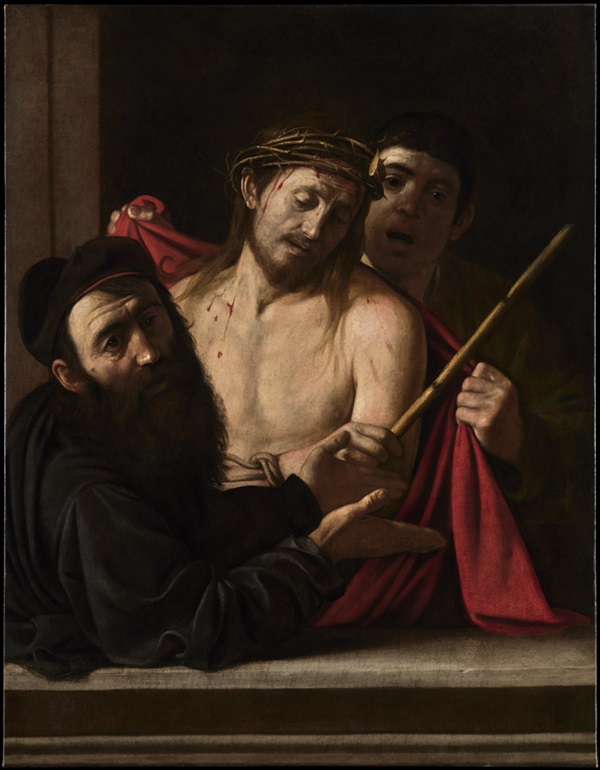
The new discoveries include the tragic Ecce Homo from Madrid.
“It was in the apartment of a lady who decided to move house and sell it. A Madrid auction house bought it for 1,500 euros not realising who it was by,” says Salomon.
Now it can be viewed, he explains, alongside the famous David with the head of Goliath, from Rome’s Galleria Borghese. David, far from triumphant in his victory over the giant, looks sad and pensive. Goliath’s severed head bears the artist’s own likeness. It’s thought that by portraying himself a devastated “pentito”, the artist hoped to be pardoned for killing Ranuccio Tommasoni.
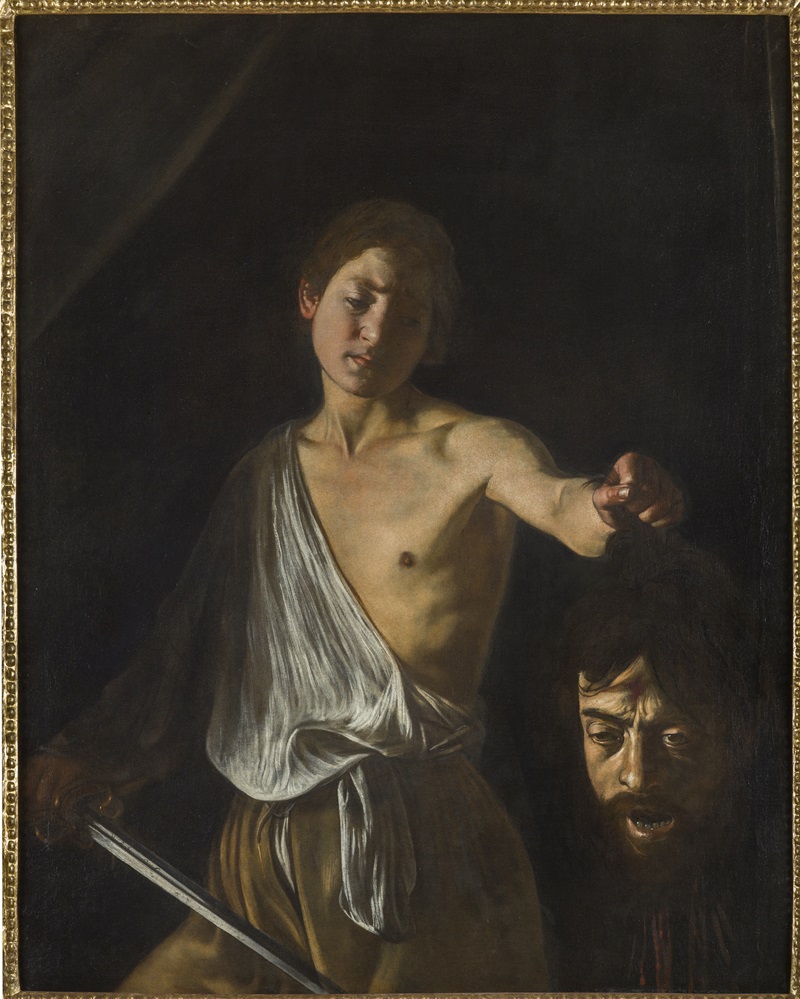
Galleria Borghese, Roma photo: M. Coen © Galleria Borghese
In Ecce Homo Pontius Pilate stands before the pale and naked Christ, bleeding from the crown of thorns. Behind, in the shadows, half-draping Christ with a red cloth, is Caravaggio himself. Pontius Pilate’s mournful gesture suggests “What can I do? This is not down to me”, while the face behind expresses dismayed shock.
Salomon explains how the show is a homecoming for many works first created in Rome: “We have the portrait of Maffeo Barberini on public display for the first time. Portraits by Caravaggio are extremely rare – there are only four or five that we are certain by him. We have brought together paintings from around the world which were originally in the Barberini’s own collections: The Cardsharps from the Kimbell Art Museum in Fort Worth, The Musicians from the Metropolitan in New York, and most of all Saint Catherine from the Thyssen-Bornemisza in Madrid.
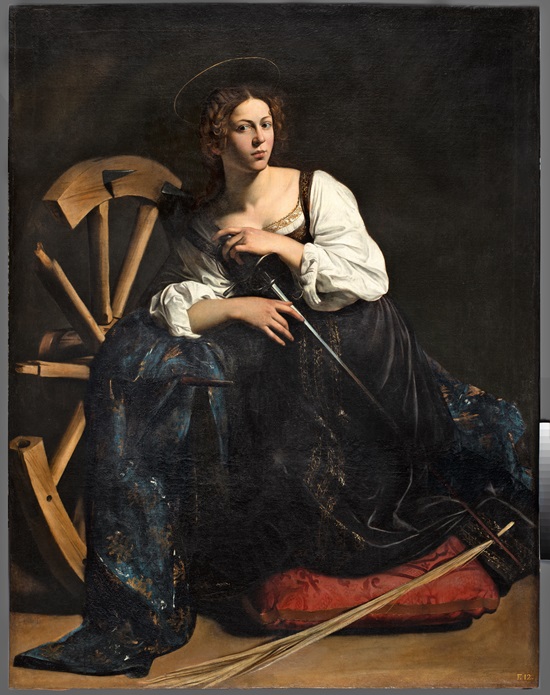
©Museo Nacional Thyssen-Bornemisza, Madrid
“St Catherine was in the Palazzo until 1924. Then it was bought by Baron Thyssen and taken to Switzerland where it stayed for decades. Since 1992-3 it’s been in Madrid. It has never been lent before. and it’s in Italy for the first time in 90 years. It was sold, of course, when Caravaggio was not ‘Caravaggio’; there was a dictator ruling here. Everything was different then. “
Salomon is proud that the show unites works that the public can’t see because they are in private collections or in hard-to-reach US museums. In addition to the 24 some of Caravaggio’s greatest canvases can be seen for free in several Roman churches.
A special bonus is that it has facilitated viewing Caravaggio’s only mural, hidden for centuries in the nearby Casino Ludovisi, commissioned by Cardinal del Monte in 1597, five years after the artist’s arrival in Rome. The Casino’s ownership and its stunning contents, including a beautiful Aurora fresco by Guercino, remain in limbo, thanks to an eight-year inheritance dispute.

Caravaggio painted the ceiling in a cramped space used by the Cardinal as a laboratory for experiments in alchemy. Its mythical themes – and the quite shocking “sotto in su” (looking up from below) view of the god’s private parts – may relate to Caravaggio’s encounters with the “Insensati” philosophical group.
These Neoplatonist thinkers, poets and patrons of the arts have been described by Clovis Whitfield as forerunners of “a new generation of enlightenment, and promoters of ‘nobilissima virtù’, such an important current around the turn of the century”. They admired Galileo and Giordano Bruno, the cosmologist priest burned at the stake for heresy in Rome in 1600, a few years after Caravaggio’s arrival there. The Insensati were open to all branches of knowledge but particularly related to the senses. This revolutionary emphasis on empirical evidence chimes in with the artist’s claim to “work only from nature”.

Salomon pays generous tribute to Roberto Longhi, the Italian art historian who first put Caravaggio on the map, rescuing him from nearly 300 years of obscurity with an historic 1951 show in Milan. This was even though in his own time he was a hero, and a great inspiration for all the painters in Europe.
“It’s a question of sensibilità,” says Salomon. “It was Longhi who discovered an important corpus of paintings by the artist that changed things. He understood that Caravaggio had transformed painting in 17th century Europe. Before it was all about beauty, sweetness, manierismo.
“With Caravaggio, it’s all about real life. Nothing is fake, there is no illusion. That brings us nearer. He was a genius with totally new ideas and a new approach. Of course it was difficult for people to understand this initially. But it’s not true that his paintings were always rejected. They also loved his paintings, such as those in the churches of San Luigi dei Francesi and Santa Maria del Popolo.”
The focused display at the Barberini encourages slow viewing and meditation. The paintings at first appear simple but they are complex, rich and always astonishing in their ability to capture “a specific and extremely interesting moment of action”, as Salomon remarks.
“That is an element of his genius. Deciding to represent Judith and Holofernes, for example, in that moment of life and death. The quality of instantaneity is another reason why people today love it and understand it. It’s nearer to reality, catching events at their peak and close to our emotions. Then there’s his biography which is within the paintings themselves, in the self-portraits and images of his friends.”
Caravaggio 2025, curated by Francesca Cappelletti, Maria Cristina Terzaghi, Thomas Clement Salomon is at Palazzo Barberini, Rome, 7 March – 3 July 2025.
Caravaggio 2025 – The Exhibition at Palazzo Barberini, Rome
Thanks to Thomas Clement Salomon, Lara Facco and Marianita Santarossa for their kind help.
A shame that the exhibition was so badly lit, and gave such prominence to works not by the artist !
I have never seen anything like that ceiling! It’s quite a revelation, in every way imaginable. I’d love to have seen it.
Wonderful to be reminded