An exhibition on the centenary of John Singer Sargent’s death.
John Singer Sargent was a society painter, painting beautiful and wealthy women. Sargent (1856-1925) was an expatriate American and a member of the New English Art Club. On display in Kenwood’s beautiful spaces are eighteen oil portraits and drawings, some of which have never been publicly exhibited. He was a hugely popular portrait painter of his time and remains a beloved figure among many fans today.
Most of the heiresses he painted were in their twenties. Sometimes mocked as America’s “Dollar Princesses.” these young women crossed the Atlantic to marry the British aristocrats in the “cash for coronets” marriage cliché. Sargent made more than thirty of these portraits. Not all the women were rich, and some married for love. This is a quote from the novelist Marie Corelli in 1905:
“…there is always a British title going a-begging – always some decayed or degenerative or semi-drunken peer, ready and willing to devour, monster-like…an American virgin, provided bags of bullion are flung, with her, into his capacious maw.”
Between 1870 and 1914, 102 American women married into the British peerage and the upper classes. Here is the first painting that struck me was of Pauline Astor, who was born into the Astor dynasty (I have cropped my photo to remove an imposing gold frame).
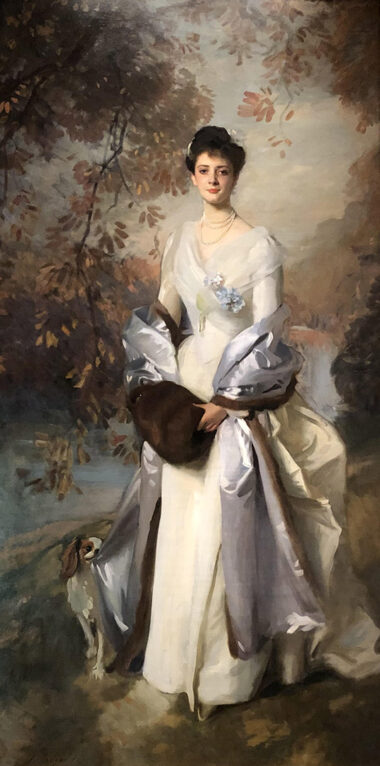
She married Captain Herbert Spender-Clay, who was untitled. Her father, William Waldorf Astor, commissioned the painting soon after her eighteenth birthday. Sargent has included her spaniel “Mussie”, tugging at the corner of her dress.
These full-length oil portraits are glamorous, powerful, candid and perceptive, with technical virtuosity rarely seen in today’s art world. Sargent could make the rich look very much richer. He held up a mirror to them, so they could understand how wealthy they were, which is not unlike today’s art market within the higher echelons.
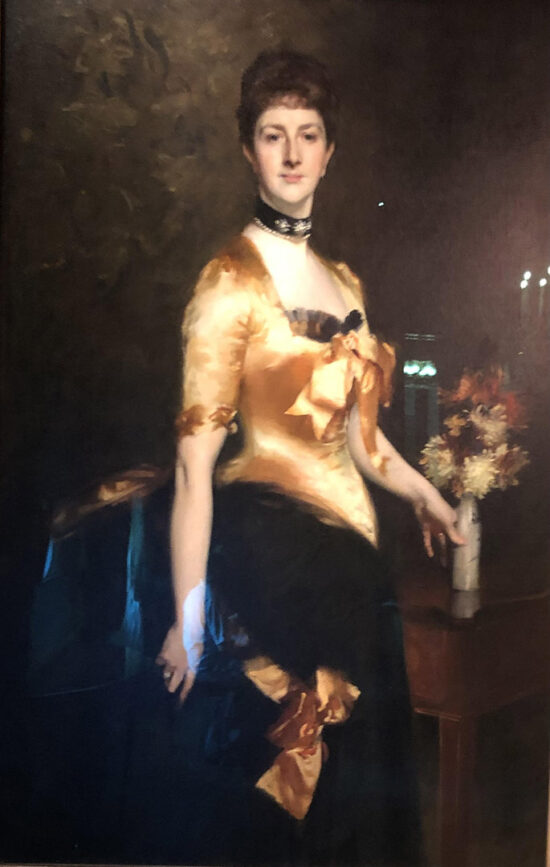
This is a portrait of Edith Playfair nee Russell (1848-1932). She married “Baron” Playfair at the age of 29 in 1878, when he was 59, marking his third marriage. Her stepson remembered Edith as “one of the last capitalists to drive round Hyde Park every afternoon in a carriage-and-pair.”
British critic Roger Fry downgraded Sargent’s art as “applied art” It seems he could not grasp the artist’s ability to capture the social mask, holding up a mirror to the rich, demonstrating the “grand style” of living.
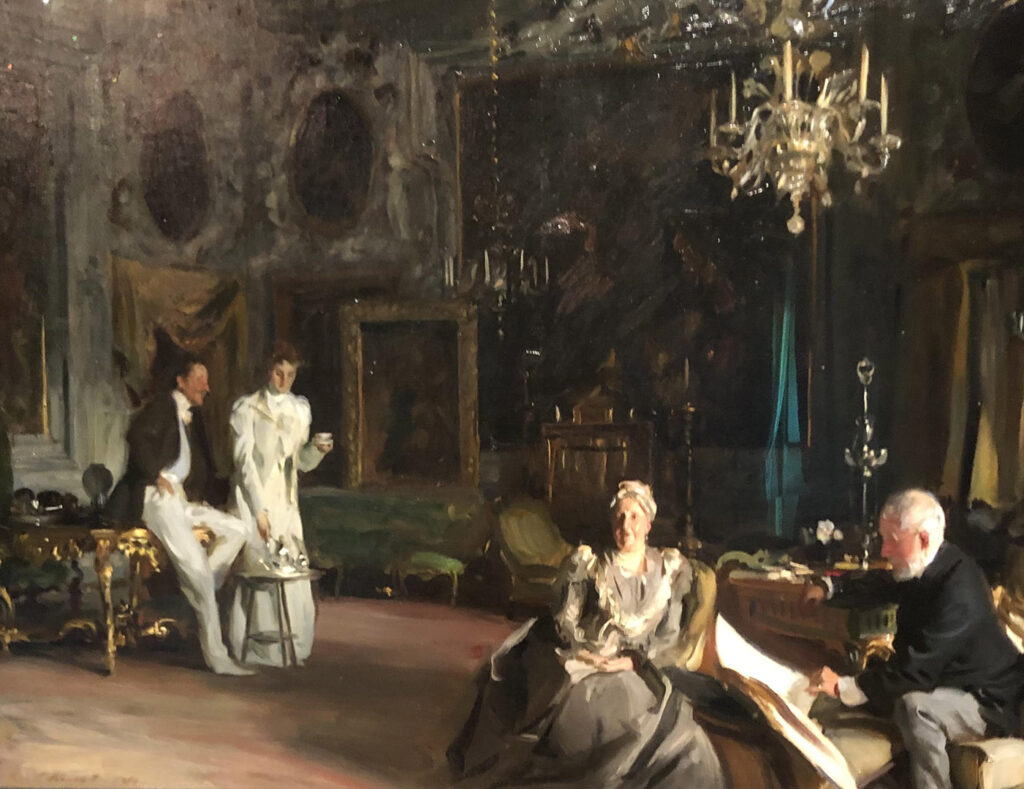
In 1899, Sargent depicts a moment in time within the Palazzo Barbaro in Venice. Bright sunlight from the canal bounces off the elegantly dressed family and touches gilded tables.
He was as fluid with charcoal drawing as he was with painting, and numerous drawings are on display.
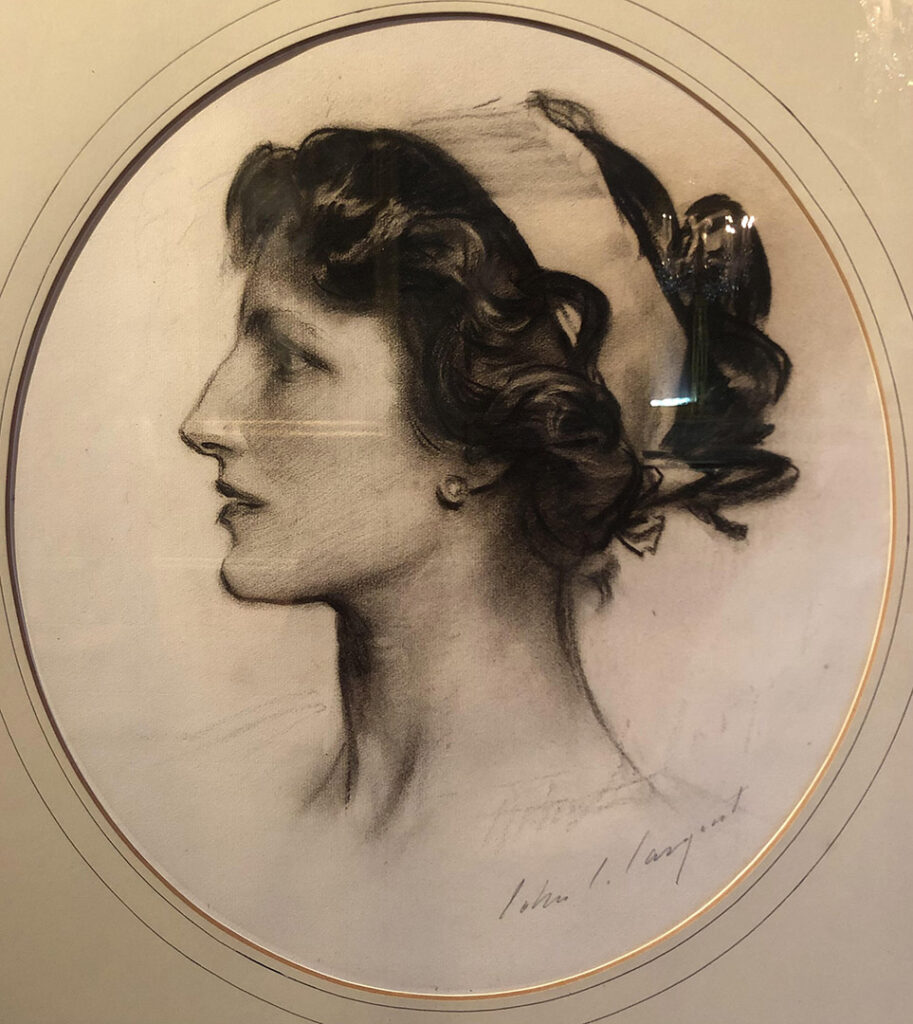
The most striking aspect of Sargent’s painting and drawing is its simplicity, which overflows with perfection, life, movement and visual drama – painted with extraordinary breadth and freedom, glowing with life, making an ineffaceable impression. It is no wonder he was in such high demand for portraits.
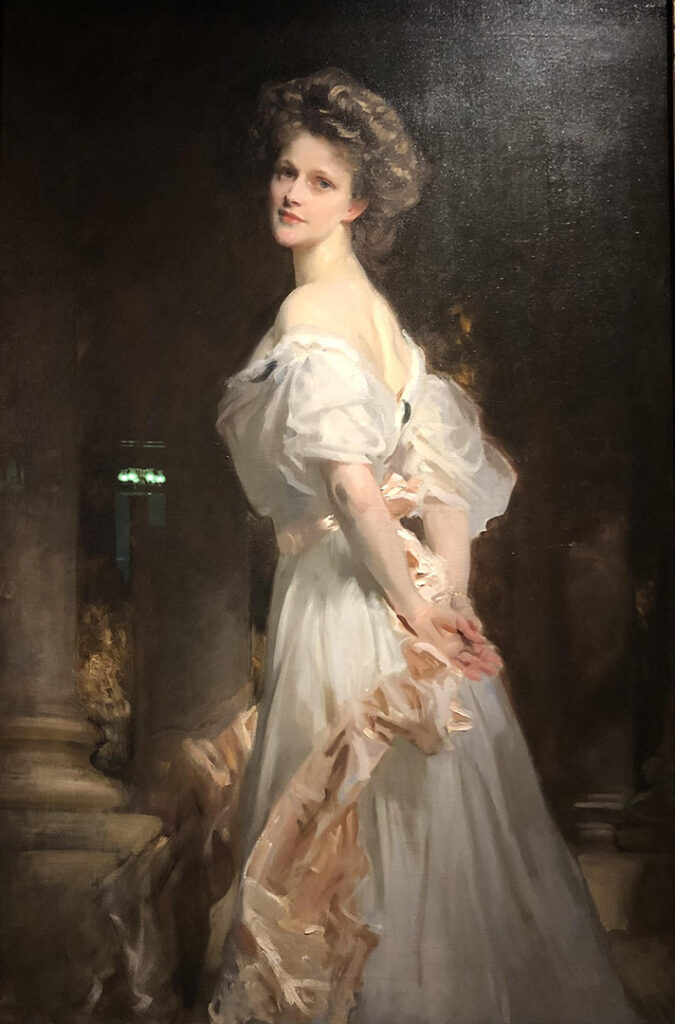
In 1906, Nancy Witcher Astor, née Langhorne (1879-1964), married Waldorf Astor.
Sargent can be somewhat overlooked due to the early modernist abandonment of naturalist correspondence as a criterion, with a premium placed on the strength and authenticity of individual responses and feelings and increased relaxation of the requirements of naturalism. He was painting alongside artists like Van Gogh, Gauguin, and Picasso. He studied under the portrait painter Carolus Duran (1838)917); he followed in the tradition of Velázquez and Manet – with the virtuoso brushstroke, painting directly with a loaded brush.
The venue for the exhibition, Kenwood House, is delightful and one I recall fondly from my childhood when it still had red squirrels roaming the surrounding woods. As a slice of history, the exhibition is well worth the experience.
Peter Clossick Past President London Group, June 2025
Heiress: Sargent’s American Portraits
16 May to 5 Oct 2025
Kenwood House, Hampstead Lane, Hampstead, NW3 7JR
Curated by English Heritage
All images were taken on my iPhone.