Clelia
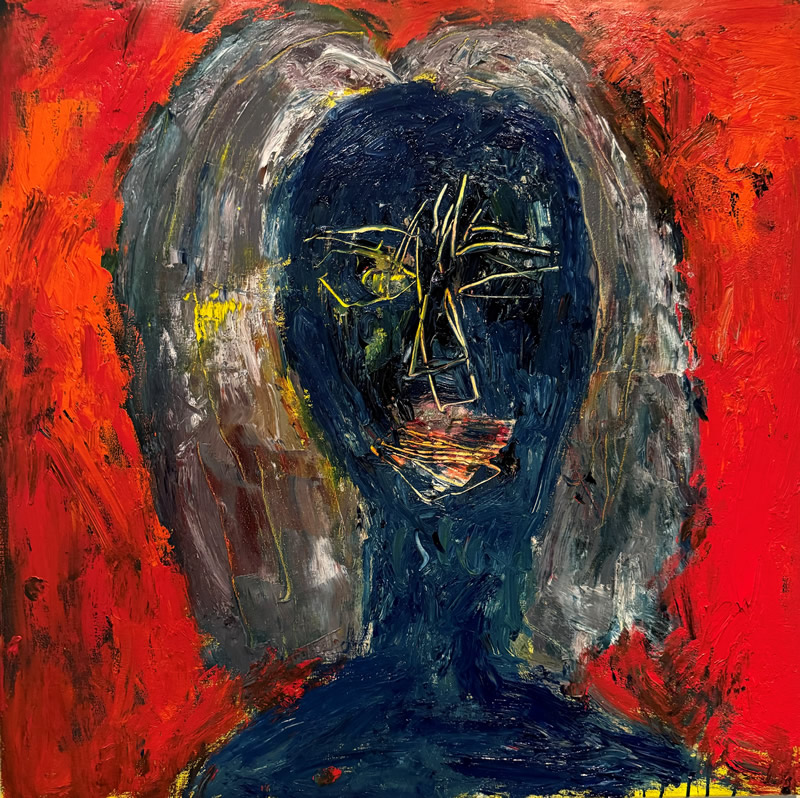
Her dark presence is suggestive of an ancient icon — stillness, the frontality of an archetype à la Carl Jung. Iridescent hair radiates in a silvery-grey halo, with streaks of white, blue and yellow, set against a fiery red.
Eyes, nose and mouth are scratched into the deepest of blues, revealing yellow ground. The lips tremble; the nose shifts as though seen from different angles as in a Cubist painting. And yet she is serene. She taps into an ancient archetype: the mother of mothers, a being with the elemental power and mystery of Black Madonnas, venerated in Marian Coptic images, African sculpture and across Japan, India, Europe and Latin America.
She has a quality of Otherness that is alien, elemental and full of power, connecting us to a universal lineage that holds its ground, resisting explanation. She is simply there, existing with a timeless authority, a force that can’t be tamed.
Clelia is the latest in Frances Aviva Blane’s long history of painted and drawn Heads. It is the Blane we have long known, maximally in oils or minimally drawn in charcoal on paper. And yet this newest head, blue-black rather than the usual pale white, is a departure.
When abstraction becomes liberation
Lithuanian American critic Meyer Schapiro once affirmed that Abstract Expressionist works offer communion rather than communication:
“Paintings and sculptures,” he proposed, “are the last hand-made, personal objects within our culture. Almost everything else is produced industrially, in mass and through a high division of labour. Few people are fortunate enough to make something that represents themselves, that issues entirely from their hands and mind and to which they can affix their names.”
A cultured Marxist with a multidisciplinary approach, Schapiro defended abstract painting against charges of “inhumanity” levelled by Stalinist proponents of Socialist Realism. He championed the liberating qualities of abstraction as an “example of inner freedom and inventiveness”, including mastery of the formless and accidental.
He saw the Ab-Ex abandonment of representation, its embrace of spontaneity, its welcoming of improvisation and accident, as enabling self-expression, as vital to human flourishing. His understanding drew on Karl Marx’s concept of freedom from capitalist alienation. In this way, the artist might provide the ground for more general emancipation — an escape from the alienated nature of human labour imposed by the capitalist system.
“Hence,” Schapiro wrote, “the great importance of the mark, the stroke, the brush, the drip, the quality of the substance of the paint itself, and the surface of the canvas as a texture and field of operation — all signs of the artist’s active presence. The work of art is an ordered world of its own kind in which we are aware, at every point, of its becoming. All these qualities of painting may be regarded as a means of affirming the individual in opposition to the contrary qualities of the ordinary experience of working and doing.” (The Nature of Abstract Art, 1937)
Along with critic Clement Greenberg, Schapiro championed the Abstract Expressionists of 1940s and 1950s New York— Rothko, Pollock, de Kooning, Hofmann, Guston — now viewed as classics. It was a man’s world, but Schapiro’s all-embracing approach, and his legacy, as art historian Patricia Mathews noted in 1994, “was keenly felt by feminists”. He was among the first, she says, “to break the hermetic vacuum of art-historical analyses, allowing myriad interests to rush in, feminism included.”
Into the new Millennium
Until after the millennium, the contribution of Black artists in the UK — and more widely British abstract artists whether male or female, remained unknown to the wider public despite the advocacy of a few passionate critics. Pioneering artist Denis Bowen and his New Vision gallery, who promoted abstract artists, remains largely unrecognised. As late as 2017 a major Royal Academy show still focused mainly on the white male protagonists of the New York School. That same year Black Ab-Ex painter Frank Bowling was finally given a solo show at Tate Britain, aged 83.
But it took another six years for the extraordinary contribution of female Ab-Ex artists globally to reach a wide audience, thanks to a collaboration between three women curators who staged Action, Gesture, Paint: Women Artists and Global Abstraction 1940–1970, in three venues one of which was Whitechapel art gallery, just down the road from Greatorex Street.
“I was fortunate to be at the Slade School of Art,” Blane reflects, “and to have teachers like Jess Jaray RA, Bruce McClean and Prunella Clough.” Leaving the Slade in 1993, she entered the public art scene with a bang at a degree show for Slade post-graduates in the Mall Gallery, where we met for the first time, before a huge self-portrait. Its ambiguity struck me: strident and bold, but with eyes blanked out by shades, looking out and inwards simultaneously. It now hangs in Moorfields Eye Hospital in City Road.
In the late 1990s and Noughties, through her association with curator-gallerist Angela Diamandidou, Blane showed in unsung venues around Clerkenwell. Industrial sites about to be demolished or refurbished provided a perfect raw backdrop. Her abstract charcoal drawings displayed at Shillam and Smith architects’ studio had a “sharp, nervy elegance”, critic Andrew Lambirth noted. Dirk and Theun Vonckx of De Queeste Kunstkamers in Abele-Watou, Belgium have held multiple exhibitions, showcasing Blane with Frank Auerbach and Louise Bourgeois amongst others.
Blane has inspired notable critics who interpreted work that is both knowing and viscerally disturbing. In contrast to celebrated contemporaries like Jenny Saville and Tracey Emin, Blane’s honesty never feels simply confessional or gratuitous. Despite titles like ME ME ME, it is not just about her. It is about being human — for better and for worse. Emotions locked into these works range from despair, in fragmented, deconstructed mindscapes to being absorbed by seas of paint, that is alive, as it swirls and spatters, seemingly by itself.
A mouth that cannot speak
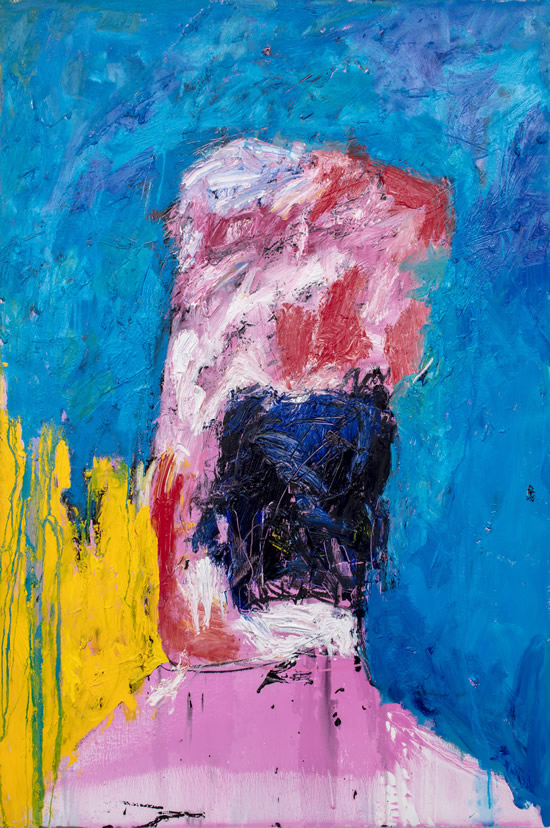
We are shocked by Smile, a six-foot-high triptych from 2020, at its centre a raw, bleeding pink face, its gaping black maw silhouetted against a strident blue, mixed from cerulean, indigo and Prussian blue. It makes Munch’s Scream look tame. As Anna McNay remarks in Penny Woolcock’s film If the answer is no, then actually yes, it is “a mouth that cannot speak”. And yet it shouts at us, demanding a reply.
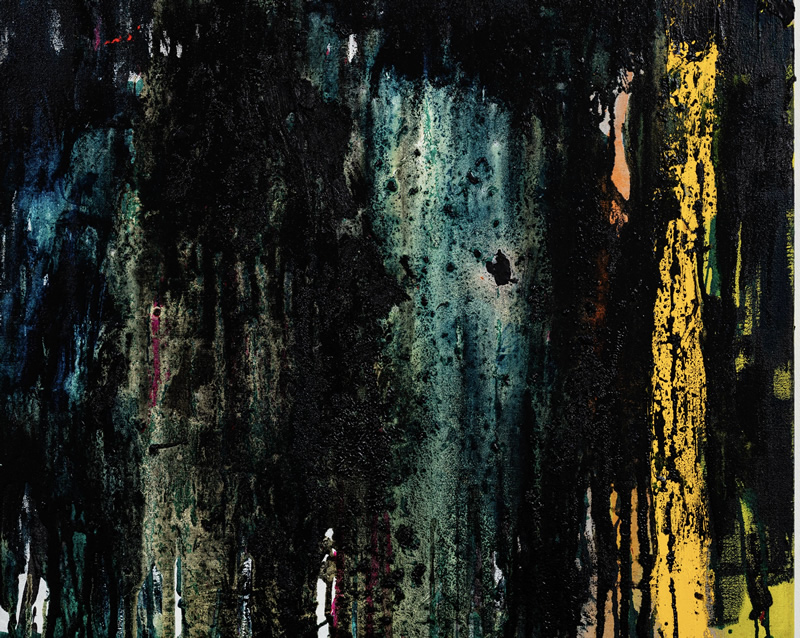
Clowns and Pierrots hide their grief beneath white greasepaint masks with smeared red mouths. A huge canvas titled Clown shares that sense of occlusion: something is hidden. A continent? A face? It is none of those things and yet a dance of reds and yellows defies the black gloom. Can there be any hope? A ghostly yellow mark stalks the edge. Violent beauty pulses through pitch-black smudges that lengthen into drips crossed by finely woven greys.
Viewed alongside the Heads, Blane’s large-scale abstractions acquire an apocalyptic quality. The simple title Michael, for example, belies the frenzied falling of dripping reds and rusts spilling over a nearly two-metre-square canvas, obscuring unidentified shapes. It suggests the ongoing killing of innocents, from Gaza to Ukraine and elsewhere.
As Schapiro wrote: “We see, as it were, the track of emotion, its obstruction, persistence or extinction… A whole emerges with a compelling, sometimes insistent quality of form, with a resonance of the main idea throughout the work… possessing an extraordinary tangibility and force.”
Abstraction as a sensuous, human experience
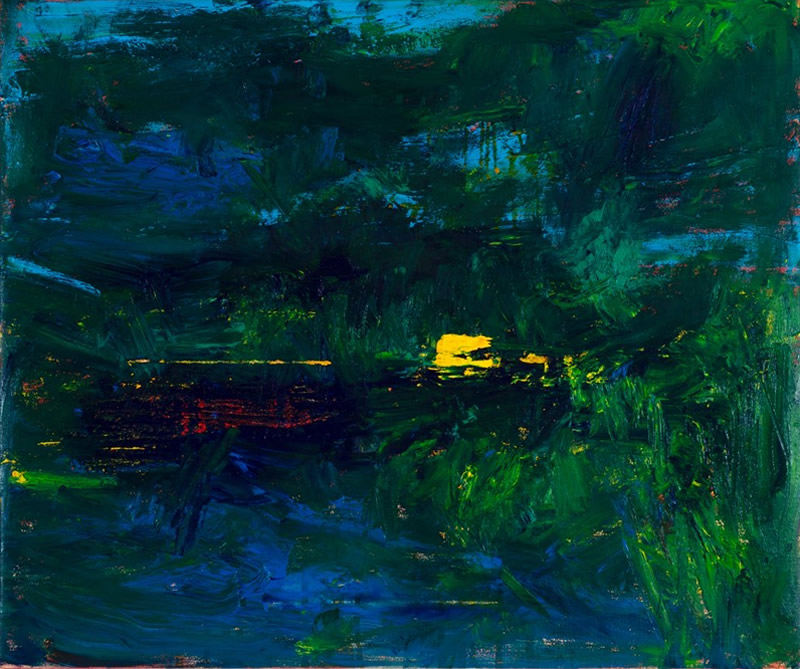
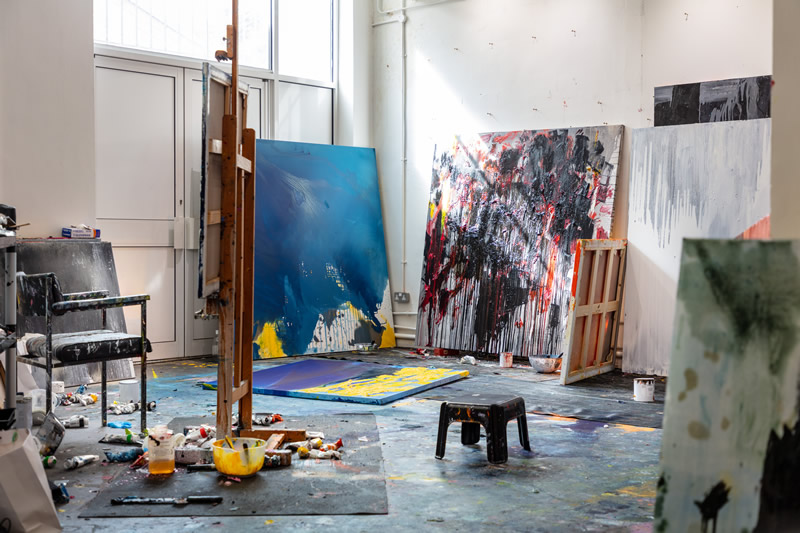
Blane constantly deepens the contrasting but complementary sides of her practice: the semi-autobiographical heads, and totally non-objective, abstract works. She pushes images to the extreme, adept at shaping visual and mental contradictions: from minimalism to complexity; representation to abstraction; black and white to the strongest of colours. From nothing to something. From the possible to the impossible.
In a world of countless digital images projected through camera phones, monitors and screens, we are hungry — even desperate — to feel the handmade: the touch of a hand, the incarnation of a thought, the sound of a voice. We need to smell and taste physicality, three-dimensionality, weight, texture, size. High-resolution tech may provide startlingly accurate reflections, but we still want more.
At Greatorex, be prepared for the wow factor — and for slow, intense, patient looking. Allow these rich complexities of colour, texture and meaning to penetrate. Order arises from disorder; accidents of paint become sources of beauty. These works are not “abstract” in the sense of being empty or formal — quite the opposite. Abstraction here is a concrete, sensuous experience. Allow yourself to be provoked. Be stirred into an intensely human activity in which the power to create something that has never existed before becomes universally yours.
Producer & Director: Penny Woolcock
IMPOSSIBLE is at Greatorex Street Gallery, 10 Greatorex Street London E1 5NF 3 June — 21 June 2026