Viewing the artist Renoir through a twenty-first-century lens is especially enjoyable for those with a romantic sensibility. Renoir and Love features leisure scenes, women and children, gardens and outdoor gatherings and intimate portraits, joyful scenes of modern life at the time.
Born in 1841 in Limoges, he was the son of a seamstress and a tailor, the sixth of seven children. An artisan family, they moved to Paris in 1845 for better economic prospects. When he was nine years old, Renoir’s older sister Lisa introduced him to painting and took him to the Louvre. He also attended choir school.
Soon he was apprenticed to a porcelain painter under Charles Gleyre. There, he gained precision, speed, and skill with luminous colour on white ground. In this studio he met Monet, Sisley and Bazille. In 1862, Renoir also enrolled for evening classes at the École des Beaux-Arts.
Renoir did not portray working-class misery, believing that art should bring joy and delight to people. He placed great emphasis on how people interacted and the social interchange.
I found many surprises, not only being face to face with works that I had only known from reproductions, but also some for the first time; many have never been seen in the UK.

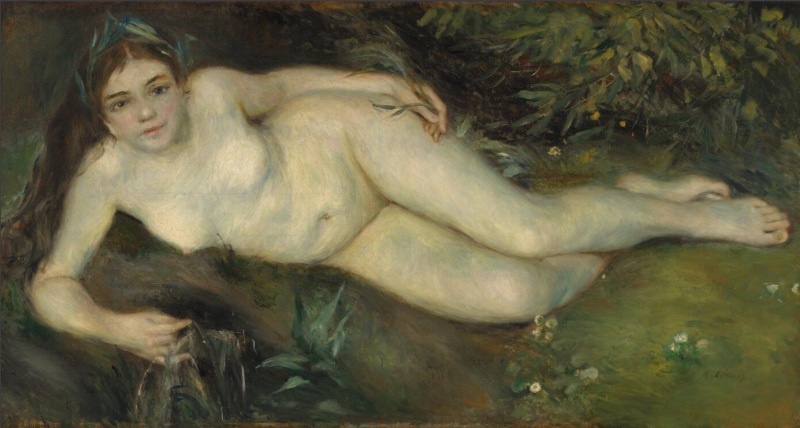
In Secrets neither figure wears a wedding ring, a detail contemporary viewers would have noticed. I was surprised to learn he had two children with his romantic partner and favourite model, Lise Tréhot. The first child died in infancy, but Renoir recognised neither child legally, and Tréhot did not raise the other. But he secretly supported the second child in the last decades of his life. Lise was the model for A Nymph by a Stream (1869-70), where she may be pregnant with one of Renoir’s two illegitimate children.
He married Aline Victorine Charigot, a seamstress in 1890 and they had a son, Jean, born in 1867. Renoir was delighted to become a father again, with Pierre, in 1885.

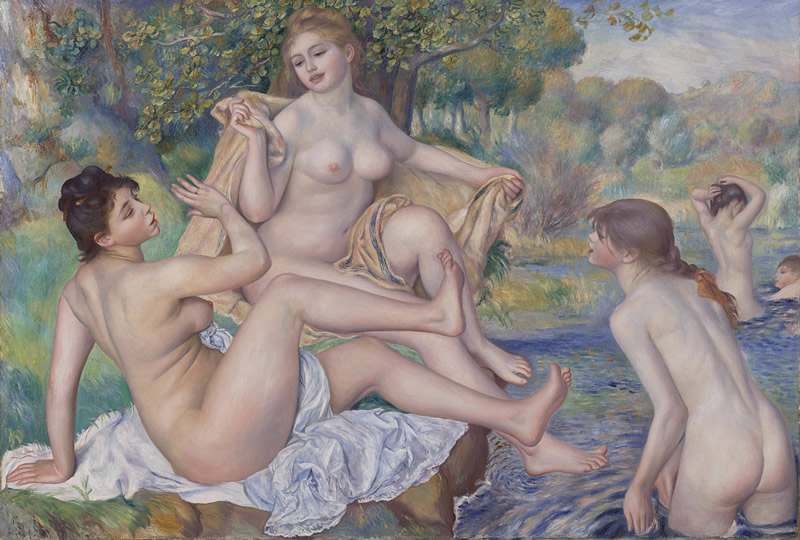
Influenced by the Italian Renaissance, Renoir later moved away from the early Impressionist Style, where he worked closely with Monet and Sisley, etc., toward a more classical line with smoother modelling of surface and form. The Great Bathers: A New Arcadia, the latest of his works here, is a good example of Renoir abandoning his earlier painting techniques.
Without a doubt, this exhibition is well worth a visit for pure pleasure plus insight into the social relationships of the day.
By Peter Clossick, NEAC Past President of the London Group
- Read Corinna Lotz’s review: Renoir’s celebration of human relationships