
If there’s one artist who brought religious art down to earth to express spiritual torment and revelation in a way that 400 years later still shakes you, it’s Caravaggio.
When Michelangelo Merisi da Caravaggio arrived in Rome in 1592, an impoverished young man from Milan, no one would have guessed that he would become one of the most notorious and revolutionary artists ever.
Caravaggio found ways to direct light and shade to give expression to the complexities of the human mind and heart. He captured powerful emotions – faith, devotion, inspiration, contemplation, enlightenment as well as doubt, betrayal, mental and physical torture, and death.
The years around 1600 were marked by political and spiritual crisis. Europe (including the artist’s own family) was wracked by the plague and great-power tensions. In 1588, Spain, the greatest Catholic power of the age which controlled Naples, Sicily, Sardinia and Milan, had been defeated at sea by Protestant England. There, Queen Elizabeth’s death in 1603 ushered in a period of uncertainty, including Guy Fawkes’ doomed attempt to resurrect Catholicism by blowing up Parliament.
The Roman Catholic church was fighting off the Reformation with a renewed commitment to the poor, which also found an artistic expression. Caravaggio with his deep immersion in Rome’s low-life, his photographic naturalism, his democratic approach, became a force to be reckoned with.
Using his friends, lovers and street people as models, he stripped Biblical stories down to their essential human content and gave them immediacy in the period of history known as the Counter-Reformation. He presented the great religious stories as experiences open to everyone, even the poorest, most simple people. Gone are the pompous nobles and church patriarchs. These saints and sinners are ordinary men and women.
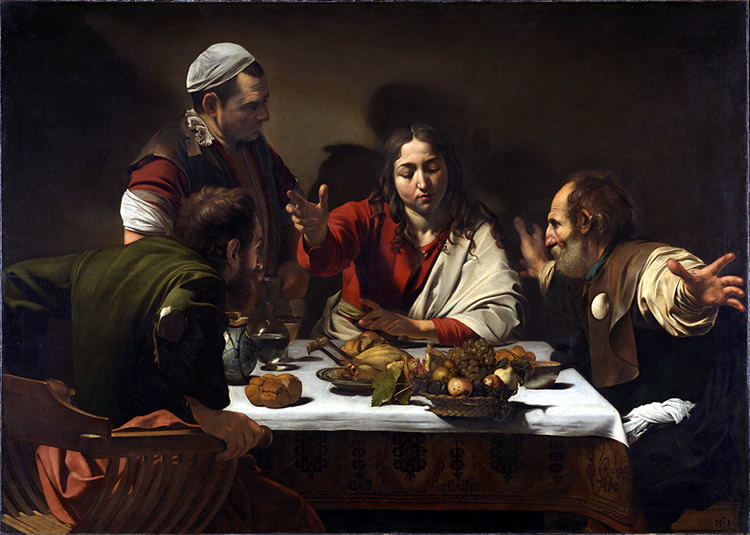
The National Gallery’s show, Beyond Caravaggio, is evidence of how he immediately inspired artists in Rome and further afield. Its Supper at Emmaus and The Taking of Christ from Dublin’s National Gallery take pride of place.
The National Gallery, London
The Supper, made in 1601, shows his prodigious skills. A table with its astounding depiction of fruit, chicken, bread and wine is a still-life in its own right. An illusionistic basket is poised as though it might fall into our space, heightening the feeling that everything is on a knife-edge.
The scene is illuminated by the light falling on the central figure of Christ. Again with downcast eyes, he looks inward with almost feminine serenity, while the bodies of his disciples express astonishment. The seated disciple on the left, his threadbare elbow jutting out of the picture frame, grips the edge of his chair in disbelief. The pilgrim on the right flings out his arms. Each movement contributes to the mystical moment when the disciples suddenly realise that they are in the company of the resurrected Jesus.
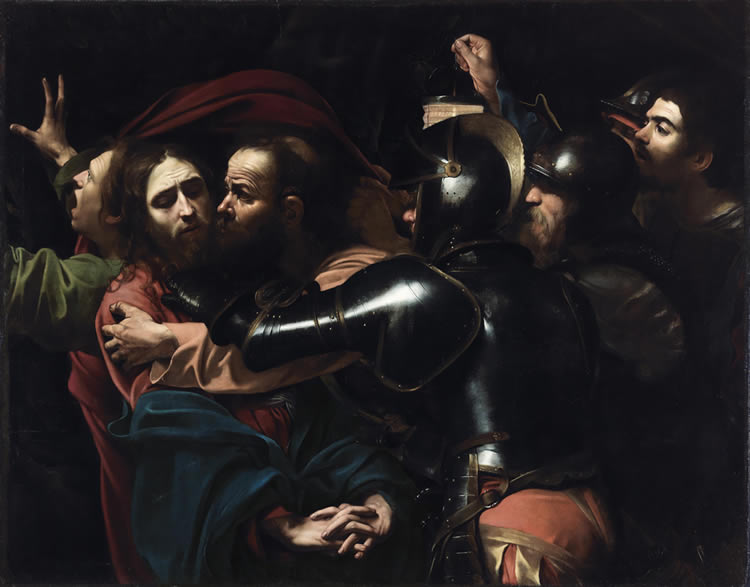
The Taking of Christ, made just a year later, disappeared for some 200 years. It was mistakenly attributed to the Flemish painter Gerritt von Honthorst and only rediscovered in 1990, thanks to a curator from the National Gallery of Ireland. For this composition, Caravaggio adapted a woodcut by the great German artist, Albrecht Dürer. Instead of presenting the entire tumultuous scene, Caravaggio zooms on the faces of Judas and Christ – the brush of lips – the moment of betrayal that identifies Christ to the Roman soldiers – soon to be followed by the crucifixion.
As Judas closes in, Christ, eyes downcast, seems to draw back just slightly. Is it just before or just after the kiss? The metallic gleam on the armoured shoulder is at the very centre – the power of the state about step in as soon as the treacherous deed is done. The full anguish of the event is expressed by the flailing hands and open mouth of St John who flees off to the left.
Beyond Caravaggio sheds light on Caravaggio himself, but still more on those around him. His immediate impact is clear in The Ecstasy of Saint Frances by his arch rival Giovanni Baglione also from 1601. It’s fascinating to compare and contrast the master with his peers, who explore the various sides of his innovations.

Birmingham Museums and Art Gallery
Amongst the images of violence, crucifixion and death one stands out especially, in gentle light relief. It’s Orazio Gentileschi’s The Rest on the Flight to Egypt. The Holy Family seems guarded by a sleepy donkey, whose huge head and furry ears form the centre of the painting. It shares the sense of tranquillity and blonde palette of Caravaggio’s variant, made some 20 years earlier.
© The Burghley House Collection
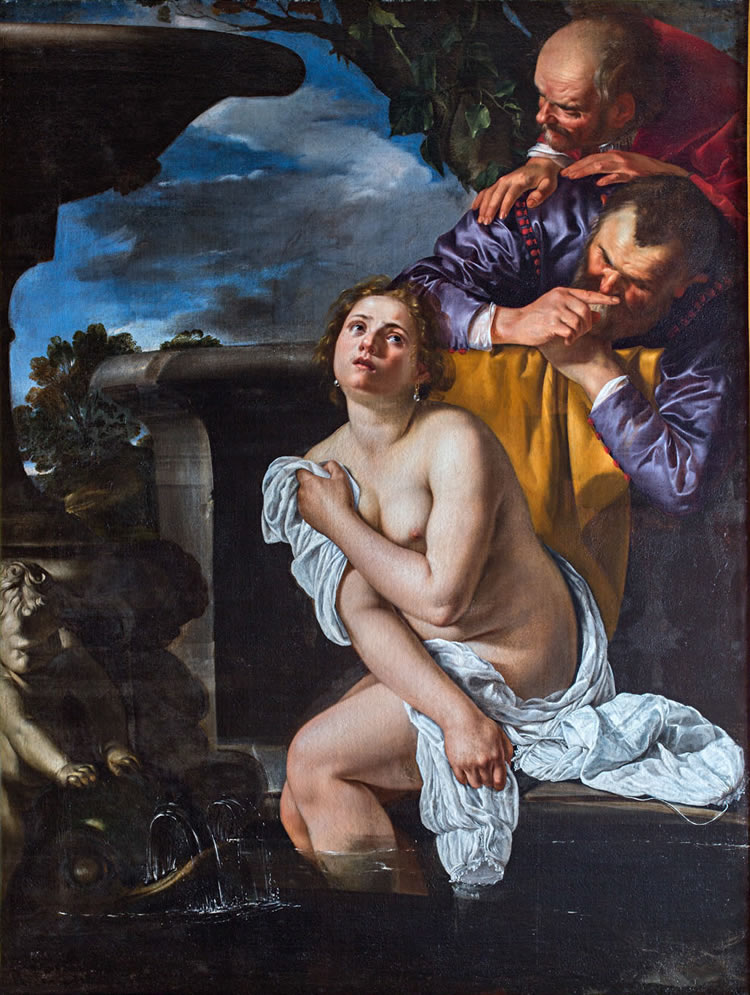
Gentileschi’s daughter Artemisia is the only female painter featuring in this show. Her Susannah and the Elders was attributed to Caravaggio for almost 200 years. It’s a great depiction of a vulnerable woman preyed upon by lecherous elders. We are reminded that of Artemisia’s other Biblical heroine, Judith, who beheaded the giant Holofernes. Her version of this scene of female power was undoubtedly inspired by Caravaggio’s earlier depiction made in 1598-99.
Caravaggio led a tempestuous life, fleeing Rome for Naples and then Malta after being accused of murder following a swordfight. He died of malaria short of his 40th birthday as he tried to make his way back to Rome.
This is a show haunted by absences. Each image stands out on its own but is enriched by its association with others and those we may have in our memories. Caravaggio’s ghost hovers everywhere. See it and be awed by this democratic moment in the history of art.
Beyond Caravaggio is at the National Gallery until 15 January. It travels to the National Gallery of Ireland (11 February – 14 May) and Royal Scottish Gallery (17 June – 24 September).