Working artists greet a celebration of Leon Kossoff in a long-overdue show at London’s wonderful Annely Juda gallery.
© The Artist’s Estate
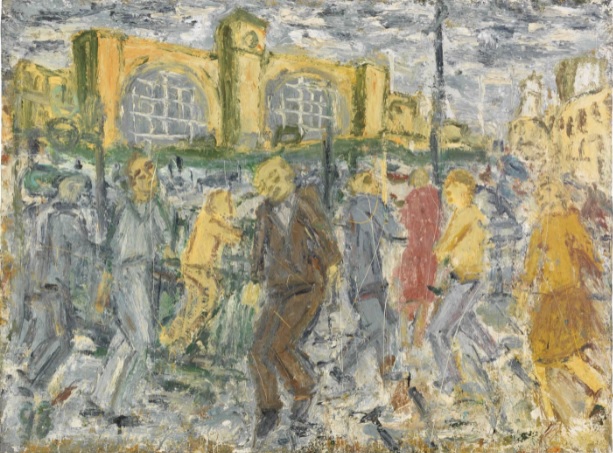
As we free-float through the technological ether of Twitter, Zoom, Skype, Instagram and all the rest, painter Peter Clossick welcomes the material substance of an under-appreciated London artist. Leon Kossoff (1926-2019) captured often bleak London scenes and made them into objects of fascination and beauty, which he infused with a deep sense of humanity.
An overdue posthumous show brings together never-before seen paintings in which Kossoff searched, say the curators, “for a way to bring myriad experiences together in a single image, every brushstroke telling the story of doubt and opportunity that went into their making, all of them threatening to dissolve into fleeting abstraction at any given moment”.

Peter Clossick
I write as someone who has been highly influenced by the man and have a deep admiration for his art. Much has been written about Kossoff’s history and background, a London boy from Brick Lane. He was a very private individual and not one to seek celebrity status. A slight man in stature who I met a couple of times at private views and with whom I once had an interesting conversation about Stokes paint. All artists of a certain mindset have used Stokes industrial oil paint, purchased in large quantities and used with abandon due to its low cost.
Stokes paint, now no longer manufactured, was a staple of Kossoff and painters like Frank Auerbach (both influenced by David Bomberg), especially in their early works. Leaving trails, wrinkles and globules of oil upon the surface due to its greasy, syrupy nature. Long paint as used by the old masters which they mixed themselves, before the short buttery paint in tubes available today. Cut with a medium that does not show the brush marks and used directly from the Stokes tins, it is thick and viscous.
Kossoff’s heavy impasto painting brings the eye onto the surface, before we see the image, a perceptual movement where the surface texture overrides the perceptual experience. Which becomes one we must seek out, constantly being carried along by the rhythms and movements of the brush marks. Reversing the old masters’ technique, where you see the image before the surface facture. Kossoff precisely describes Edgar Allan Poe’s thesis, “Unity of Effect”, with an all-over technique of working. It has an instantaneous unity that draws you into the experience of looking. In a flurry of movement which is almost a quest for the absolute – fail, pick-up and go on, over and over again. “Unity simulates the condition of life”, as the old artist Frenhofer says to the young Poussin in Balzac’s The Unknown Masterpiece.
Kossoff’s painting is like a tapestry of interweaving threads which create the whole, rather than with a singular linear direction. They are complex works with the reality of texture, living life through the body where the drawing becomes embedded in the paint. He claimed that he could not draw and his project was to achieve that aim. Self-creation requires self-abnegation and constant revision. He was a master of this process, whether it’s this or that, finding that both sides of the coin can be true simultaneously.
The absence of self brings the realisation of the image into full fruition. a mingling of presence and absence. It’s a lived moment in time, physical presence, not pictorial illustration, with a gestalt of emotion fused into a single mass.
I find it a relief to stand in front of a Kossoff painting, from the technological world that we live in, floating in the ether. Where you can feel grounded by the solidity of his vision. Stretching tradition but not breaking the thread. He creates a double vision, an optical phenomenon, which won’t stay still and is not meant to, A truly original statement on the nature of looking, reaching into metaphor and meaning. I cannot wait for the forthcoming exhibition, as I know it will be well worth the visit.
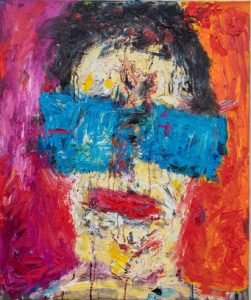
Frances Aviva Blane
Good news: Leon Kossoff is remembered with three international shows. Chiefly I respond to the love in his work. Not only does he celebrate London where he worked and lived but also his parents and family. His gloomy but beautiful palette is reminiscent of Walter Sickert and the transience of life.
A Life in Painting (1926-2019) opens at Annely Juda Fine Art, 30 September and runs until 4 December. It travels to New York and Los Angeles early in 2022. The exhibition is accompanied by a fully illustrated 120-page exhibition catalogue, titled Leon Kossoff: A Life in Painting, to be co-published by Annely Juda Fine Art, Mitchell-Innes & Nash and L.A. Louver, and will be available through the three galleries upon request.