By Barry Dalgleish
In the Eastern Mediterranean, the discovery of substantial reserves of natural gas in an area known as the Levantine Basin (map below), could propel Israel to the top of the league of major Middle Eastern energy producers.

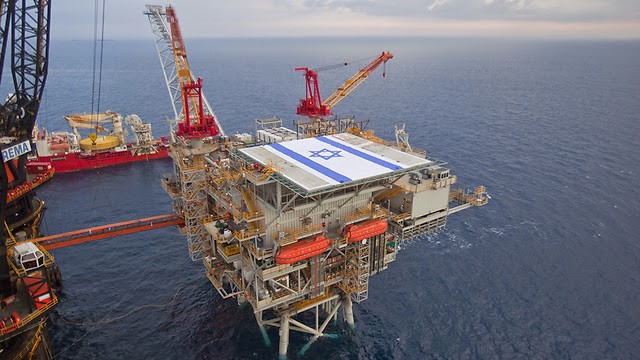
On March 30, 2013 Israel began production in the Tamar field. The Tamar and Dalit fields could supply Israel with gas for two decades. The larger Leviathan field is estimated to hold 18 trillion cubic feet of gas.
We pick up the story in 1999, when Israel approached the British Gas Group (BG) to conduct exploration in the region. However BG pulled out in 2005, selling its stake for only $1! US based Noble Energy moved in as the primary player. Why did BG pull out of the deal? The simple answer is Palestine. An article from TomDispatch covers the background to the story.
Following the creation of the Palestinian Authority (PA) as part of the Oslo Peace Accords, the PA would take responsibility for territorial waters off the coast of Gaza. This would have an important bearing on any Palestinian claim to offshore natural gas.

Indeed in 1999, it was actually the PA that established the deal with BG. What followed was some familiar wheeling and dealing from Israel. TomDispatch summarises what happened:
BG promised to finance and manage their development, bear all the costs, and operate the resulting facilities in exchange for 90% of the revenues, an exploitative but typical “profit-sharing” agreement. With an already functioning natural gas industry, Egypt agreed to be the on-shore hub and transit point for the gas. The Palestinians were to receive 10% of the revenues (estimated at about a billion dollars in total) and were guaranteed access to enough gas to meet their needs.
In 2000 however, with a rapidly expanding economy and poor relations with its oil-rich neighbours, Israel found itself facing a chronic energy shortage. Instead of dealing with the problem by developing renewable sources of energy, Prime Minister Ehud Barak took control of Gazan coastal waters and cancelled the deal with BG before it was sealed. Instead, he demanded that Israel, not Egypt, receive the Gaza gas and that it also control all the revenues destined for the Palestinians — to prevent the money from being used to “fund terror.”
It’s clear that the Israelis were framing the whole issue as a security threat, reinforced by the Hamas election victory in 2006.
The death of Yasser Arafat, the election of the Hamas government and the subjugation of the Palestinian Authority have enabled Israel to establish control over Gaza’s offshore gas reserves.
After Prime Minister Ariel Sharon came to power in 2001, Palestine’s sovereignty over the offshore gas fields was challenged in the Israeli Supreme Court. Sharon stated unequivocally that “Israel would never buy gas from Palestine” intimating that Gaza’s offshore gas reserves belonged to Israel. In 2003, Sharon vetoed an initial deal, which would allow British Gas to supply Israel with natural gas from Gaza’s offshore wells.
In short, Operation Cast lead, which commenced in December 2008, was an attempt to nullify the ‘terrorist’ threat from Hamas. This would pave the way for Israel to consolidate offshore gas reserves:
In the wake of the invasion, Palestinian gas fields were de facto confiscated by Israel in derogation of international law. …What is now unfolding is the integration of… adjoining gas fields including those belonging to Palestine into the orbit of Israel.
But lets not forget claims from other countries in the region — Lebanon, Syria and Cyprus.
Lebanon became the first flash point after Israel began exploratory drilling in disputed waters. This led to a threat of attack from Lebanon if Israel began production in the area.
Israel expanded its naval presence in the area and deployed drones to monitor the area. But Lebanon wasn’t deterred. In 2013, Lebanon began negotiating with Russia, to develop Lebanese offshore claims, under the protection of the Russian navy.
Early 2015, stalemate pervaded. Israels’ exploration was limited “in light of the security situation.” Noble Energy was unwilling to invest given the standoff with Lebanon and the Russians.
Meanwhile in Syria, currently in a state of war, another kind of stalemate was effected. Bashar al-Assad’s regime, also got the Russians onboard, negotiating military support in exchange for a 25-year contract to develop Syria’s claims to the Levantine gas field. Part of the deal was an expansion of the Russian naval base at Tartus, ensuring a significant presence there.
The Palestinians though were still prepared to push for their share in the offshore gas. They negotiated with Gazprom, with the prospect of bringing Russia into the exploration arena. However nothing concrete had emerged. Israel though wasn’t going to hang around. With an energy crisis at home, it was time for the next assault on Gaza.
In a controversial Guardian article, author Nafeez Ahmed reported:
According to Anais Antreasyan in the University of California’s Journal of Palestine Studies, the most respected English language journal devoted to the Arab-Israeli conflict, Israel’s stranglehold over Gaza has been designed to make “Palestinian access to the Marine-1 and Marine-2 gas wells impossible.” Israel’s long-term goal “besides preventing the Palestinians from exploiting their own resources, is to integrate the gas fields off Gaza into the adjacent Israeli offshore installations.” This is part of a wider strategy of:
“…. separating the Palestinians from their land and natural resources in order to exploit them, and, as a consequence, blocking Palestinian economic development. Despite all formal agreements to the contrary, Israel continues to manage all the natural resources nominally under the jurisdiction of the PA, from land and water to maritime and hydrocarbon resources.”
In a follow up article in The Ecologist, Ahmed cited further revelations about the Great Gaza Gas swindle. It would appear that things were not as they seemed regarding the roles of Noble Energy and BG.
In May 2013, Israeli officials were in “secret talks” for months with the British Gas Group, which owned the license over Gaza’s offshore resources.
According to the US Energy Information Administration (EIA), the Gaza Marine holds about 1.6 trillion cubic feet in recoverable gas, and “offshore Gaza territory may hold additional energy resources.”
Determining the size of these additional resources requires further exploration which, however, is limited by “uncertainty around maritime delineation between Israel, Gaza, and Egypt.”
Israeli sources said that the Gaza gas issue was expected to come up in US President Barack Obama’s talks with Israeli leaders during his visit to Israel at the time. The talks also included Netanyahu’s personal envoy Yitzak Molcho and former British Prime Minister Tony Blair in his capacity as Quartet (US, UK, EU, Russia) special envoy to the Middle East. Palestinian leaders though, were excluded from the talks due to “political sensitivities and the complex relationship between the Palestinian Authority and Hamas.”
According to the report of the Israeli chief scientists, the government’s gas policy is based on underestimating future Israeli demand and overestimating the country’s gas production potential. In reality, the scientists said, Israel will need “50% more natural gas than has been forecast until now and its offshore reserves will be empty in less than 40 years.”
Its clear that there was no way proceeds from any gas exploration could end up with Hamas:
Israeli defence minister Moshe Ya’alon — then former IDF chief of staff — explicitly advocated that the only way in which Gaza’s gas could be developed was through an Israeli military incursion to eliminate Hamas.
Ya’alon’s concern was that “Palestinian gas profits would likely end up funding terrorism against Israel”, a threat which “is not limited to Hamas” and includes the Fatah-run PA. As preventing gas proceeds from “reaching Palestinian terror groups” is “impossible”, Ya’alon concluded:
“It is clear that without an overall military operation to uproot Hamas control of Gaza, no drilling work can take place without the consent of the radical Islamic movement.”
Ya’alon’s concerns voiced in 2007 — and the prospect of using military force to begin gas production in Gaza — remain relevant today. As the man in charge of Israel’s current war on Gaza, Ya’alon is now in a position to execute the vision he had outlined a year before Operation Cast Lead.
Thus, the exclusion of Palestinian representatives — whether Fatah or Hamas — from the latest negotiations between Israel and BG is no accident.
While PA president Mahmoud Abbas was independently seeking to reach a deal with Russia’s Gazprom, Netanyahu had already “made explicitly clear that he could never, ever, countenance a fully sovereign Palestinian state” — which is why he deliberately torpedoed the peace process, according to US officials.
The article concludes:
Israel’s own commitment to blocking a two-state solution and bypassing Hamas meant that its only option to bring Gaza’s gas into production was to do so directly — with, it seems, the competing collusion of American and British energy companies.
With Gaza in ruins following Operation Protective Edge, any hope of an economic windfall from offshore gas has also been blown apart. But Israel’s exploitation of the offshore resources has been limited. There’s the ongoing dispute with Lebanon. Internal wrangling within Lebanon makes it difficult for anything of substance to emerge from within the country. Then there is the fact that Lebanon has been technically at war with Israel since 1948.
Given the border disputes between the two countries, an article from Ya Libnan notes that:
In the absence of a mutual agreement on the border and division of resources, Israel could follow the “right of capture” rule, which allows a nation to extract oil or gas from its side of the border, even if the reserves stretch into another country’s territory. Some Lebanese politicians have accused Israel of attempting to steal Lebanon’s oil and gas resources, and militant Shiite Hezbollah has sworn to use its weapons to defend them. Israeli officials have warned of retaliation for attacks on its oil and gas facilities.
The United Nations Convention on the Law of the Sea offers specific guidelines for maritime borders, but Israel is not a signatory to the convention. “It requires mutual recognition of those borders,” says Gal Luft, executive director of the Institute for the Analysis of Global Security in Washington. “So this will require the two sides to sit down and agree on this, which I don’t see happening.”
Israel has placed buoys where it believes the sea border lies and routinely defends it with armed force. The UN does not recognize the line as legally binding, but the naval component of the UN peacekeeping force in south Lebanon observes a 1.25-mile buffer north of the line to avoid potential confrontations with the Israeli navy.
In May 2021, the Gaza conflict flared up again. Seven years after his initial reporting, Nafeez Ahmed revisited the current state of play over gas resources. Writing in the Byline Times, he stated that:
the latest hostilities broke out following an escalating dispute between Israel and Hamas over control of Gaza’s offshore gas reserves, which hit a wall just a month before the latest hostilities.
A UN report along with a US Army study published under the Obama administration further suggest that the Biden administration’s decision to go ahead with a $735 million arms sale to Israel is linked to US strategic interests in supporting Israel’s domination of East Mediterranean energy resources including gas potentially owned by Palestinians.
With oil and gas major Chevron taking over Noble Energy, this is much more than a decades old conflict. This is a resource war with wider Geo-political implications, with US imperialism at the very heart of it. The Eastern Mediterranean will become a focal point in the new cold war between the US and Russia.