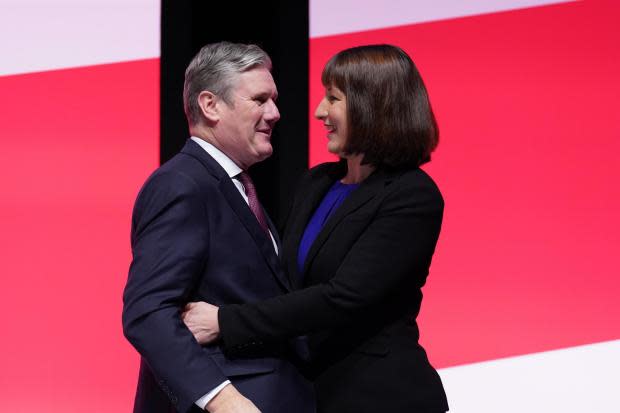

A year ago, Keir Starmer won what became known as a ‘loveless landslide’. Labour achieved a massive overall majority on an historically low turn-out of under 60% and with just a third of the vote.
A year later and the ‘loveless landslide’ has turned into a loveless nightmare, culminating in the debacle in the House of Commons when Starmer had to abandon not only his chancellor, Rachel Reeves, but the main plank of a welfare ‘reform’ bill in the face of a backbench revolt.

Flushed with victory in 2024, the government was able to push through the termination of the winter fuel allowance for older people; a year later it proved incapable of forcing MPs to vote for severe cuts in disability benefits.
While Starmer’s and the government’s rapid loss of authority may appear astonishing, it says as much about the febrile, political and economic times we live in more than the calibre of the cabinet (which, in truth, is pretty low grade). Capitalism is crisis, never more so than today.
Labour took office with a programme of tight controls on public spending, a promise of economic growth not seen in the UK for decades based on freeing up capitalism from over-regulation, the elimination of post-war planning controls and a crack-down on immigration. Their manifesto was conservative with a small C.
Supporters of former leader Jeremy Corbyn (by now expelled) were quickly purged in a crackdown on dissent. When a small group led by former chancellor John McDonnell voted to scrap the Tories’ two-child benefit allowance cap as a quick way to tackle poverty, they were suspended from the parliamentary party.
All the emphasis was on speed and action, with Donald Trump’s presidency cited as both an example and an inspiration of how to achieve change by ‘going faster’, defying traditional opposition. There’s change and then there’s change, however.
Trump is now more than halfway to establishing an authoritarian regime which has contempt for the law, disappears people off the street and from their workplace and locks them up before deporting them and thinks Russian dictator Vladimir Putin is a great guy. Having strutted around as a peacemaker, Trump has sent jets to bomb Iran.
Starmer, of course, fawns over Trump, picking up his papers when the US president drops them, even though tariffs against UK imports imposed by the White House remain in place, while the US administration abandons Ukraine to Moscow’s interests.
On Israel’s genocidal war in Gaza, Starmer stands shoulder to shoulder with Trump. The UK continues to supply arms and is silent while every day civilians are wantonly slaughtered and the area’s infrastructure laid to waste. Even when conscripts say they’ve been ordered to shoot at Gazans queuing for food, Labour is silent. The deliberate destruction of Gaza’s health service and the systematic killing of doctors shown on the film broadcast by Channel 4 (after the BBC dropped it) draws no reaction.
The Israeli Defense Force can, apparently, do no wrong. Drop a 500lb bomb on a seaside cafe and wipe out the customers? That’s alright because they were ‘terrorists’ drinking coffee and relaxing. All criticism is deplored by Starmer, who tells Glastonbury that having the Irish band Kneecap at the festival is wrong.
When it comes to authoritarian measures, Labour is close behind Trump. Palestine Action is now being designated a terrorist group along with Al Qaeda and Isis for spray painting RAF planes (only nine Labour MPs voted against proscribing the direct action group), with home secretary Yvette Cooper taking her cue from the Metropolitan Police and the Israeli embassy. Pre-offence police raids and conspiracy charges are commonplace to stifle protest. Mere opposition to Netanyahu’s is regime is automatically dismissed as anti-Semitism. Again, Starmer follows Trump on this suppression of dissent by way of slander.
So, after 12 months, what is the point of Labour and where do we go from here? As to the first proposition, there is no merit in a government like Starmer’s. Environmental protections are abandoned. More spending cuts are on their way. It’s hard to disagree with John McDonnell when he says this is a return to austerity.
Britain is labouring under a neoliberal, right-wing government in a period of capitalist system crisis globally. Chancellor Reeves lives in fear of the international bond market, which lends money to governments to cover deficits – at a price which increases when lenders sense instability. The cost of borrowing has gone up under Reeves and taxpayers have to foot over £110 billion a year just to cover debt interest payments.
Global public debt reached a record high of $102 trillion in 2024. Although public debt in developing countries accounted for less than one third of the total – $31 trillion – it has grown twice as fast as in developed economies since 2010.. These figures don’t account for corporate and household debt, which have also soared.
Labour’s failure is a story of rapid decline foretold. The global economy has not recovered from the 2008 financial crash and we are entering a period of trade war led by the United States. The state’s capacity for meaningful government-led reforms is essentially non-existent. Instead, the reverse is happening. Labour is ditching any effective climate change policies, for example, in a desperate bid to help big business.
The present system of power, until now dependent on representative democracy for its legitimacy, is seen to be failing. Into the vacuum step right-wing populist parties like Reform in the UK and Trump in America, the AfD in Germany, the National Front in France and others around Europe. Their trajectory is the extinguishing of every semblance of democracy. It is the measure of Starmer’s failure that he is opening the door to Nigel Farage and Reform.
Creating new democratic forms of direct power like Popular Assemblies would enable society to break the political logjam and open a new chapter of human history. These are democratic alternatives to the dictatorship of the bond markets, part of a financial and economic system whereby a tiny minority owns most of the world’s wealth. Reconstructing the present political and state system is vital if we are to get off the slide towards authoritarian rule. In Assemblies, all the major problems for humanity can be analysed, discussed and solutions proposed that end undemocratic control by super-rich capitalists, money markets and their political representatives.
That’s the way forward after a year of hard Labour.
The challenges faced by the capitalist paradigm, along with those of previous 20th-century communist and fascist systems, underscore the need for a potential paradigm shift. As we navigate this transitional period, we find ourselves in an era characterized by “Mannerism.”
To move forward, popular assemblies and the empowerment of the people are essential. There should be incentives for the entire voting population to participate in elections. Currently, power is often held by a minority that is elected to control the majority.
Yes, what is the point of the Starmer government? The argument that it is better than the Tories doesn`t hold. Both parties work within the rules set by the system–by the banks, the corporations, the billionaires, the hedge funds and the other instruments of the capitalist system. Nothing changes, nothing can change. Farage and co, who of course also work to the same rules while pretending otherwise, stand by, ready to gobble up both parties as the ship sinks, as disillusion sets in.
Well said Peter.