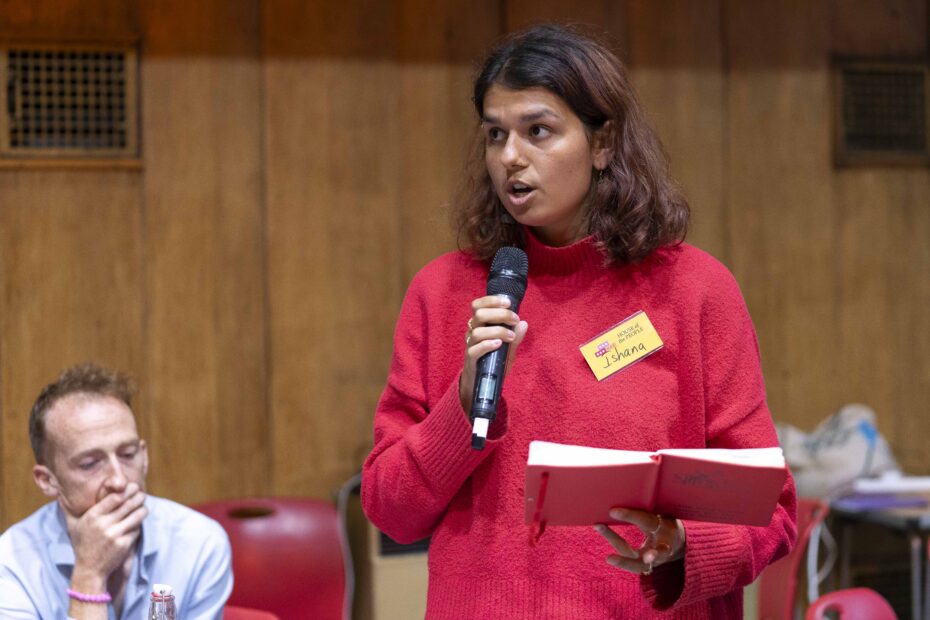

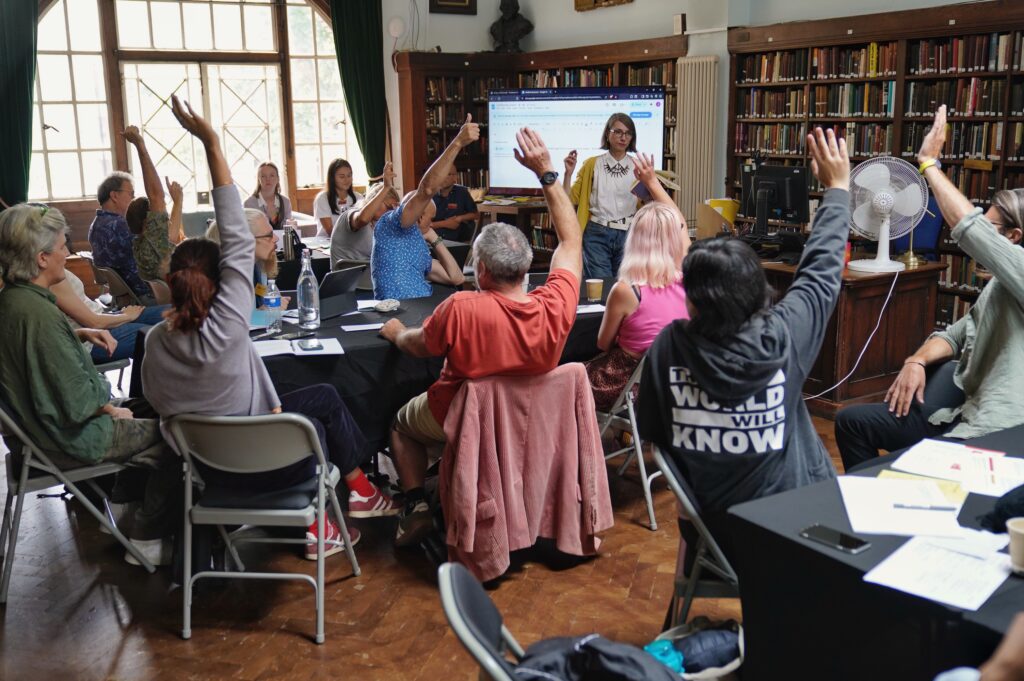
A significant milestone in charting a new, democratic social and political pathway for UK communities marked the historic inaugural House of the People sitting, held over three days in London.
Brought together by the Assemble project team, 100 people from across the UK drafted priorities for a people’s charter, as a citizens-sourced democratic mandate. The aim is to replace the House of Lords with a permanent citizens’ assembly as part of an ‘upgrade’ of democracy.
Half the participants were drawn from over 1,000 entries in a national lottery and selection by a sortition process; the other half were from 75 local assemblies. The organising team spent months preparing — and worked day and night during the event — to create something powerful, inclusive, and effective, which the Real Democracy Movement salutes.
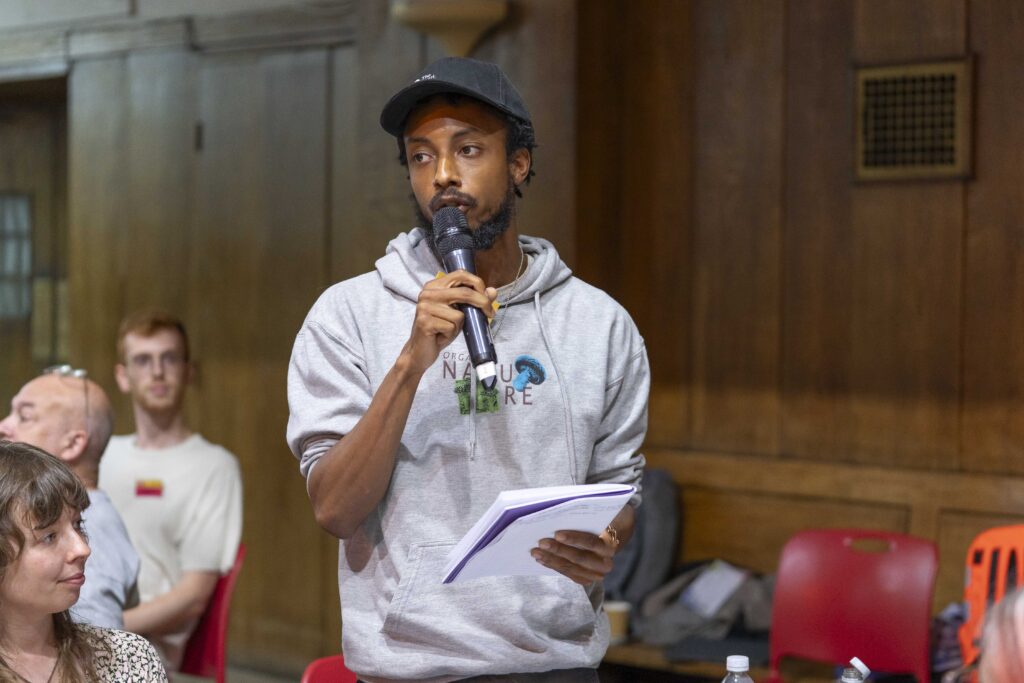
On democratic renewal, there was a proposal from the table for legally-binding citizens’ assemblies at national and local level, though this didn’t make it to the priorities list.
Advanced technology was deployed to bring out the key points in the discussions on a range of topics and set out priorities which will form the basis of a campaign charter. Here they are in summary form:
- Tax wealth by removing tax loopholes and closing tax havens
- Slash political corruption by banning lobbying, gifting, and second jobs in politics
- Establish a Future Generations Act which prioritises people and nature over GDP
- Implement an immediate embargo on all arms, trade and support for Israel and other countries which violate international law
- Grant councils power to repurchase disused homes and protect renters’ rights.
The gathering reflected a profound desire to confront the many problems and crises affecting people across the country. A recall of the House of the People is planned for Liverpool in February 2026.
Results of the local assemblies, which involved over 2,000 people, were brought into the discussions allowing citizens “to deliberate on genocide, economic inequality, climate and democratic renewal”.
In the opening session, Yaz Ashmawi from Assemble said that the House of the People is “creating our own table” and “upgrading democracy.” Given that powerholders remain unaccountable and the public’s questions are often ignored, the creation of our “own table” was both vital and urgent.
Why does this matter? Because the current system isn’t working. Powerholders remain unaccountable, and our questions go unheard and unanswered, Yaz said.
Observations from the RDM
RDM, which had observer status at the event, agrees that sounding out and deliberating priorities to lay the ground for a charter is a great step in the right direction. The next House of the People should consider how its priorities are to be achieved.
It is more than clear to many that the existing political system is incapable of delivering on the most modest of demands. That is why right-wing populist parties like Reform are rapidly gaining ground, and also why hundreds of thousands of people have expressed interest in the new left party proposed by Jeremy Corbyn.
So, the question of questions, which is entirely appropriate for the House of the People to consider, is who will deliver if the present system can’t/won’t?
Learning from the Chartists
It is crucial to have this discussion, learning from the great Chartist movement of the first part of the19th century. The Chartists wanted the vote for adult males. Many saw the capture of Parliament as the way to overthrow a ruthless, market-driven capitalist system.
When Parliament rejected their petition, the Chartists debated how to proceed. Some turned to military action in a bid to overthrow Parliament. Others believed that moral persuasion was the way forward.
Chartists called for annual elections, to address the power imbalance. This should be noted, as we move towards 2026, when local councils will be elected for a four-year term.
The Chartists launched newspapers to reflect the debate and turned the movement into the first mass party of the working class with membership subscription. Ultimately, the British state granted some workers the vote in 1867, by which time it had consolidated its power over society.
Why the state?
Today, that state is in crisis globally and the system of representative democracy has broken down. The election of the Starmer government by only around 20% of those entitled to vote, and its actions since, make this clear. A year ago, people voted for change and ended up with a right-wing government.
In turning to authoritarian government, Starmer and his pro-corporate Cabinet openly oppose measures to deal with the rapidly-unfolding ecological apocalypse.
However, the state still holds the power over people. It works closely with the corporations and financial system to deliver for capitalism – which is the source of climate breakdown – because that is its main purpose.
Understanding the nature and role of the state as the lynchpin that holds the current system in place is decisive. How to move beyond this state and its political system is therefore the crucial, open debate to be had, in which all points of view are respected.
So, key questions for the next sitting of the House of the People should include:
- How will the transition from developing to implementing the identified priorities be achieved?
- What is the role not, only of the two Houses of Parliament, but of the UK state as a whole?
- Who are the real powerholders? Does the current system primarily serve the interests of global corporate power and the politicians who uphold them?
- If so, what viable alternatives or solutions should be proposed?
Proposals for the road ahead:
- Form alliances
The House of the People needs alliances with other democratic and social movements to work together for system transformation. - Open up the reform vs. revolution debate
This tension runs deep in British history — from the Chartists to today. Let’s talk about it honestly and make practical decisions. - Launch a constitutional convention group
At the Liverpool event, form a group to begin serious planning for a people-led constitutional convention. - Educate for transformation
We need accessible political education — on Chartism, the British state, dual power, and how revolutionary change happens.
The House of the People is a significant, historic initiative. Let’s make sure it succeeds. As John Smith, a delegate from West Yorkshire, commented after the event: “Democracy in its current form is not so much broken as not fully implemented and so was always going to be corrupted by other power structures. I believe that democracy must continue to be developed so that every institution and organisation is a house of the people.”
To redress the democratic deficit within the UK.
A People’s Assembly for Justice and Democratic Renewal
We call for a statutory time limit for public inquiries, with mandatory inclusion of Citizens’ Assemblies—ensuring all affected persons and communities have a direct seat at the table. This is not only a matter of efficiency but a demand for democratic innovation and social justice.
Too many historic injustices—WASPI, Hillsborough, Windrush, Orgreave, the Post Office scandal—remain unresolved, denied closure, and justice delayed. These cases are not isolated; they form the backbone of a mass democratic movement seeking redress, recognition, and reform.
We demand:
Timely, inclusive public inquiries with enforceable deadlines and genuine participation from those affected.
Redistribution of power through local, grassroots assemblies, where community voices lead the agenda.
An end to economic inequality and ecocide, recognizing that social justice and climate justice are inseparable.
A new model of value: exchange for labour that respects social mobility and builds social capital, not just profit.
A national strategy to restore public trust, repair harms, and rebuild democracy from the ground up.
This is a call for transformative change, not piecemeal reform. Through grassroots assemblies, democratic ownership, and collective accountability, we can create a fairer, greener, and more just society.
Decision-making in England (I’m afraid I couldn’t comment on the other parts of the UK although I suspect it’s exactly the same) is not in the least bit representative. We need ‘real’ people involved. Real people, living real lives – those who have to live with the real world consequences of the decisions made on their behalf. The current system is broken. It’s time for change.
Democracy here in the UK, in the current political and economic framework has ceased to function and as none of these systems are working for the people they ought be serving, if not broken they are malfunctioning. This is an opportunity to, together, really listen and deliberate to bridge our differences and move forward to make some really people led changes in and for our society, a fairer and more just society with communities at it’s heart.
I agree with John Smith that our democracy needs to go back to it’s roots until every institution and organisation is a house of the People and in order for our democracy to be healed and flourish.
Thank you, all who designed, organised, supported and most of all who took part in this first National People’s Assembly, it was a truly incredible experience and felt like a shape of things to come.