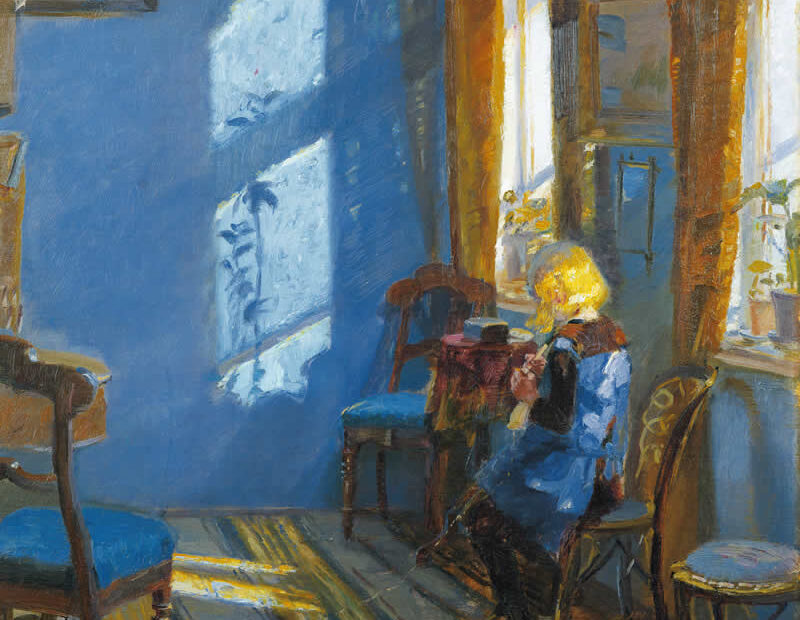
Ane Brøndum gave birth to her fifth child Anna in 1859 in the fishing village of Skagen on the northern-most tip of Denmark’s Jutland peninsula. Skagen was quite unknown in those days, but things were soon to change.
Hans Christian Andersen called for artists, poets and critics to go there after a stay in the Brøndum family hotel, just as Anna was born. Despite Skagen’s isolated (but still reachable) location, artists and writers formed an international community, flocking from other parts of Europe, Britain and even the US.
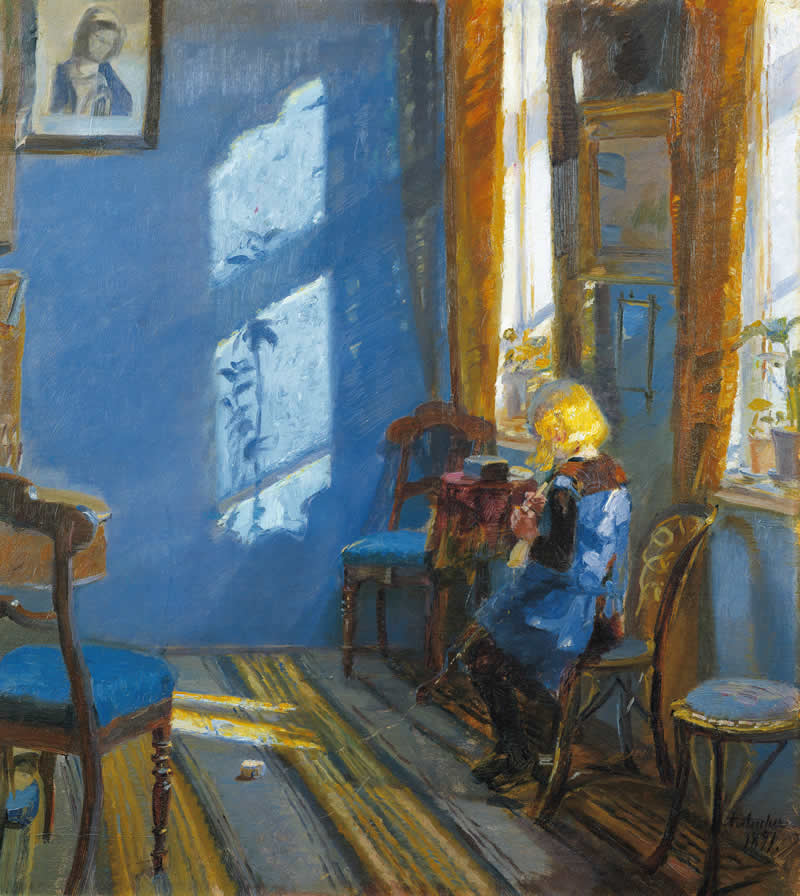
They were inspired by the Barbizon group in France, who included Camille Corot, Francois Millet of The Angelus fame, future Impressionists and Vincent Van Gogh. Skagen was amongst the many such colonies that sprang up in the 1880s, often in the northern coastal villages of France (Pont Aven), Great Britain and Germany. The combination of sea, sun and simple lifestyle proved irresistible, to escape growing industrialisation, hectic city life and live cheaply.
For Anna, Skagen was no temporary destination but her lifelong home and place of work. She lived and painted there, supported by her mother, sisters and her husband, the artist Michael Ancher. As the curators of Painting Light, the first solo show for the artist in the UK, explained at the opening, she became the beating heart of the artist colony that began to form in the years following her birth.

Courtesy Skagens Museum
It was the artistic activities in her mother’s hotel that inspired and nurtured the young Anna. Aged just 16, she travelled to Copenhagen to study painting, encouraged by her mother, who wrote to her: “nothing is dearer to me than to pay for your learning, you know that”. The private drawing school training paid off and she soon began exhibiting, making her formal debut in 1880 with Old Man Whittling Sticks in Copenhagen. She continued to show her work in the capital for the next 55 years.
Like her earlier scene of an old woman counting coins earned from selling bread, the man is depicted in deep tones of browns, umbers and rust reds. Both old people have bulbous noses, gnarled hands, eyes downcast as they concentrate on the task in hand. The dark colours, peasant faces, the focus on human labour is reminiscent of Vincent Van Gogh’s gloomy Potato Eaters from 1885. As with Van Gogh, there is little indication that Anna would become best known for her luminosity and freedom with colour and brush.
Danish critic Georg Brandes dubbed the transformation of Danish art during this period “the Modern Breakthrough”, which he championed with writer Henrik Pontoppidom. It was Pontoppidom who encouraged Michael Ancher to show his portrait of Anna pregnant with their child, considered offensive by “a female audience”.
And, instead of settling into the role of mother and wife, Anna went on to paint for the rest of her life, becoming Denmark’s most famous woman artist. She was an equal partner with her husband, as revealed in their collaborative Judgement of a Day’s Work (1883). The couple are relaxing in a cosily lit room and reflect on an image, with Anna in an authoritative pose.

Her growing confidence shines out in the iconic The Maid in the Kitchen, made in 1883-6 and shown in London’s Guildhall in 1907. A woman silhouetted against a light window peels vegetables in a simple kitchen. It shares the still calm of Dutch 17th century interiors with their tantalising open-door glimpses. Women at work was a theme to which the artist returned again and again. Here the maid (but she could be a housewife) is seen in a contemplative mood looking forward to the work of Vilhelm Hammershøi, her near Danish contemporary.
The Anchers soon visited Vienna, where they met Peder Severin Krøyer, a Norwegian brought up in Denmark, one of the country’s most beloved artists. In his Summer Evening on the Beach, Skagen. magical pink light bathes the beach in a soft glow, lapped by a blue-violet sea. In the distance are two figures in white, Krøyer’s wife and Anna, promenading arm in arm. Capturing such beach and sea light effects led Ancher to daringly abstract canvases such as Boats at Sonderstrand, Moonlight. Many of these bold studies remained hidden in the artist’s home and were never shown in her lifetime.

The couple also made friends with the Southport landscape painter Adrian Stokes and his wife Marianne Preindlesberger / Stokes, who visited Skagen in 1885, where he depicted a young woman leading sheep among the sandhills. The same year the Anchers travelled to Paris for the first time, experiencing the excitement of French Impressionism.
Many of her contemporaries in the late 19th century shared the theme of people at work, particularly girls and women out of door, a style sometimes described as Naturalist Realism. Outstanding amongst them was Julien Bastien-LePage, Hubert Herkomer, George Clausen and the Glasgow Boys in the UK.

What made Anna special is her focus on the daily life of Skagen’s women, largely indoors, looking after children, at work or relaxing with a book or reading the Bible. Usually alone, no doubt because their husbands were out sea, her subjects are sometimes in groups including old men. Immersed in feathers, they pluck geese, chickens and seagulls. They shear sheep. They knit or sew by hand or with sewing machines. They teach children, carry out hard domestic tasks, or read. They take delight in rabbits fed indoors.
A completely different mood prevails in Grief (1902) (see Peter Clossick’s review) with its powerful symbolism: a young woman crouches on one side and and old woman on the other, both bowed before a huge dark cross. The sorrowing nude, her long hair draping down, is sensuously painted, her tragic pose reminiscent of countless Mary Magdalens, as well as Van Gogh’s lithograph, Sorrow which he drew 20 years earlier.
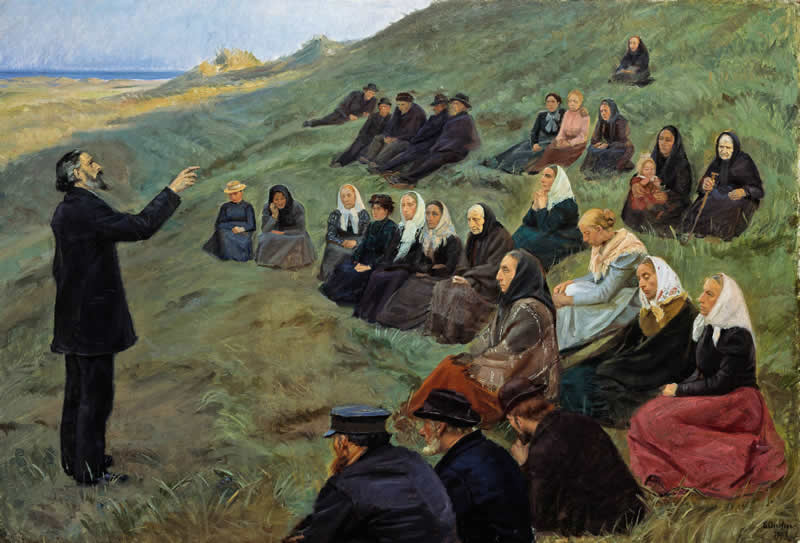
A Field Sermon, made a year later, is a large-scale figure composition. Sunlight is confined to a flat wedge in the distance. The faces are sketched portraits revealing the deeply religious nature of Skagen’s women, who, as in other poor rural communities, were followers of the Home Mission, a religious revival movement. It’s a strange image with dark shapes cut out against a grassy slope, which seems to encroach on them. The women,mostly in black with headscarves, look resigned, subdued and sorrowful. The menfolk are clustered separately, somewhat glumly, on each side.
Anna was a product of two worlds, the collision of old and new, rural simplicity together with a sophisticated knowledge of modern trends in art and life. “Her unique position enabled her to depict this special place through the lens of a modern artist” as Dulwich curator Helen Hillyard writes. It was a challenging place to occupy: in this show we feel a sharp clash between Modernity and the values of a religious community.
Not since the Hayward Gallery’s Dreams of a Summer Night 40 years ago, which included Ancher’s painting of a Skagen village funeral, have we had a chance to appreciate in depth a Scandinavian woman artist from this period. Thank you, Dulwich Picture Gallery, for bringing Anna to London! We remain hungry to see more, not only Ancher herself but also her colleagues and friends.
Anna Ancher: Painting Light is at Dulwich Art Gallery until 8 March 2026