
Courtesy Skagens Museum
It is always exciting to discover a quality artist who has not previously appeared on your radar. Such was my amazement when I entered the exhibition at the Dulwich Picture Gallery of Anna Ancher (born Anna Brøndum, 1859 – 1935).
She made her only remaining self-portrait in her late teens: what a powerful piece for one so young!
Anna Ancher came from a well-respected middle-class family that owned and operated the only guest house in Skagen. At the age of 15, her mother enrolled Anna in Vilhelm Kyka’s drawing and painting school for women, continuing to support her financially.
How many nineteenth and early twentieth-century female artists have we heard of, apart from the select few? Anna is well known in Denmark associated with painters, who were based in Skagen, a fishing community with an artist colony on the Northern point of Jutland in Denmark. Though I must confess that I had not heard of her.
She was renowned for depicting everyday life with realism, with her primary interest in depicting light effects. Anna travelled to Paris and was influenced by Impressionism. She is not forgotten and received recognition in her lifetime. Her painting At the Grave beautifully expresses the quality of light.

In Sunlight in the Blue Room, light illuminating the entire space, made in 1891, is regarded as one of her most important works. It depicts her daughter Helga in the guest house run by her grandmother and aunts. At the time, this painting was criticised as being “too modern”.
Her subjects were interiors and character painting, focusing on domestic, everyday scenes that emphasised colour and light through skilled paint application, scumbling, and glazing, from dark to light. The Maid in the Kitchen is depicted in a style reminiscent of 17th-century Dutch interiors, influenced by Vermeer.
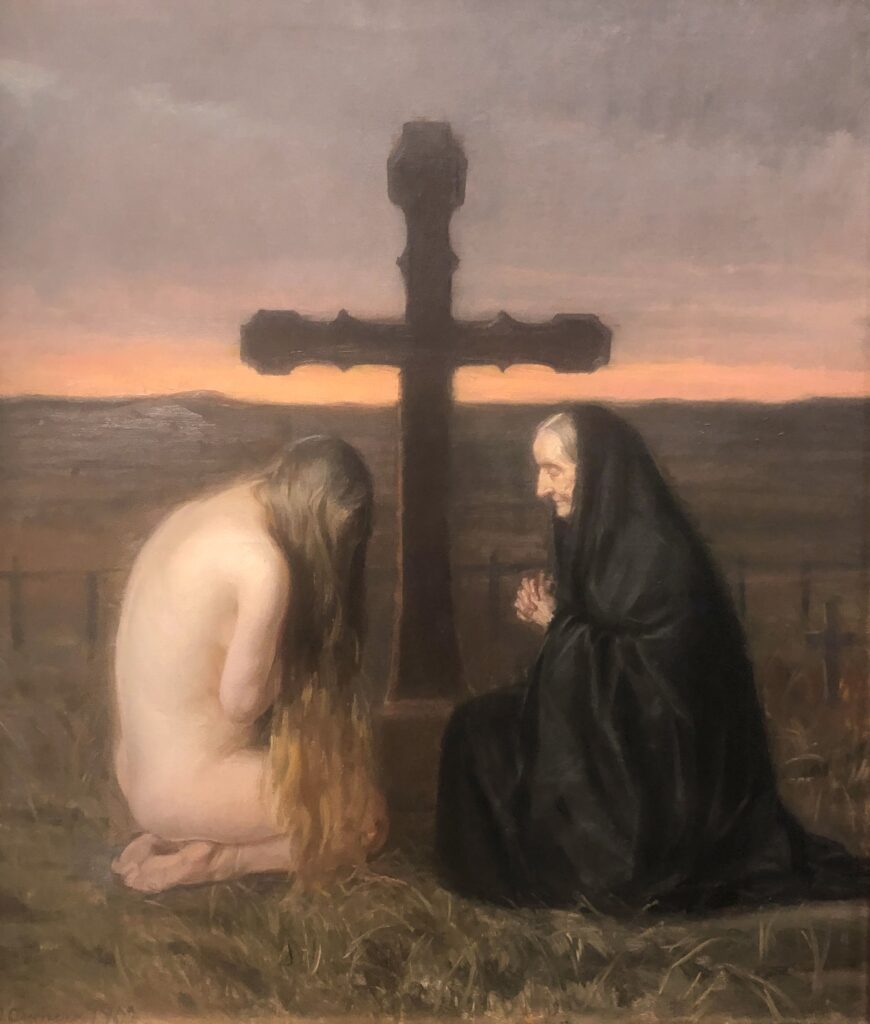
Death is a recurring theme in her work, and to me, one of the most remarkable paintings in the exhibition was Grief from 1902, an image that Anna encountered in a dream, of a mother and daughter bent over a grave.
Anna stood at the junction of the late nineteenth century to the early modern. I would highly recommend seeing this, as her work is remarkable, full of emotive feeling in depicting local character and the way light enters and illuminates space.
Peter Clossick is a member of the New English Art Club and past president of The London Group
Anna Ancher: Painting Light is a the Dulwich Picture Gallery, 4 November 2025 – 8 March 2026