Early on a freezing December morning in 1825, a group of officers in the Tsar’s army assembled 3,000 men in Senate Square, in Russia’s capital, St Petersburg. They had agreed not to swear an oath of allegiance to the new Tsar, Nicholas I, in the hope that this would spark the downfall of the autocracy, lead to a constitution and the emancipation of the serfs.
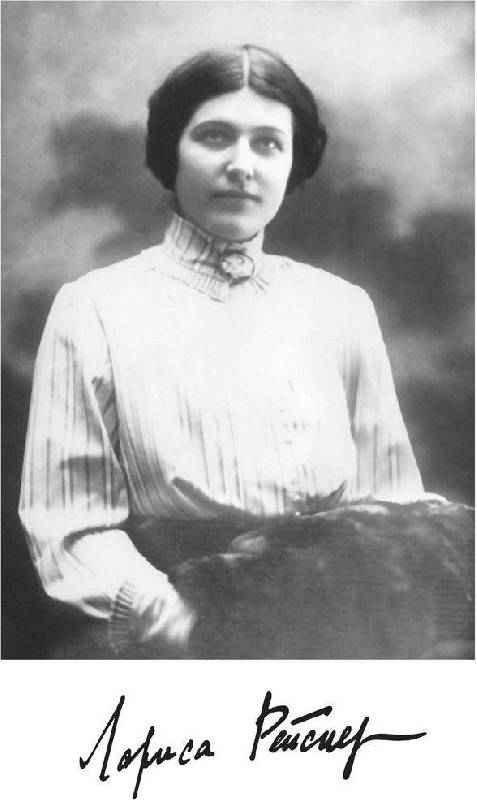
Bolshevik revolutionary fighter and journalist Larisa Reisner commemorated the centenary of the first major uprising against the Tsar with a group of essays. Her account has been translated into English for the first time in a lovingly crafted edition, illustrated with drawings of the leading Decembrists and their opponents.
The revolt was a disaster. But understanding what happened remains vital. As these vignettes make clear, underestimating the rapidity of political transformation is a grave mistake. Exactly when there seems to be a standstill, things nonetheless undergo profound changes. Regimes that appear impregnable can crumble within days and even hours. And when that happens there will be unexpected turns and transformations, amongst the mass of ordinary people and those in leadership.
Reisner took a leading role in the 1917 Russian revolution and subsequent Civil War. She sailed as a commander on the warships of Trotsky’s Red Navy. She became a diplomat in Kabul, going on to work in Weimar Germany for the Communist International, and reporting on miners’ lives in Ukraine’s Donbass in early 1925. She died in February 1926, a few months before her 31st birthday. The Decembrists was amongst her last published works. In a moving tribute, critic Viktor Shklovsky wrote that she “was greedy for life. And in life she filled her sail ever wider. She tacked her course close to the wind”.
Cathy Porter’s introduction notes: “Reisner was known for her supreme confidence with her material, and her insistence on thorough research…”. She utilised her delving into the newly-released Russian state archives, not to write a dry history but to enter the minds and hearts of a disparate group, united by hatred of autocracy, but divided by sharply differing class loyalties. The passion, anger, hopes, and despair of the revolt is told in a spare, blow-by-blow, sometimes poetic style.
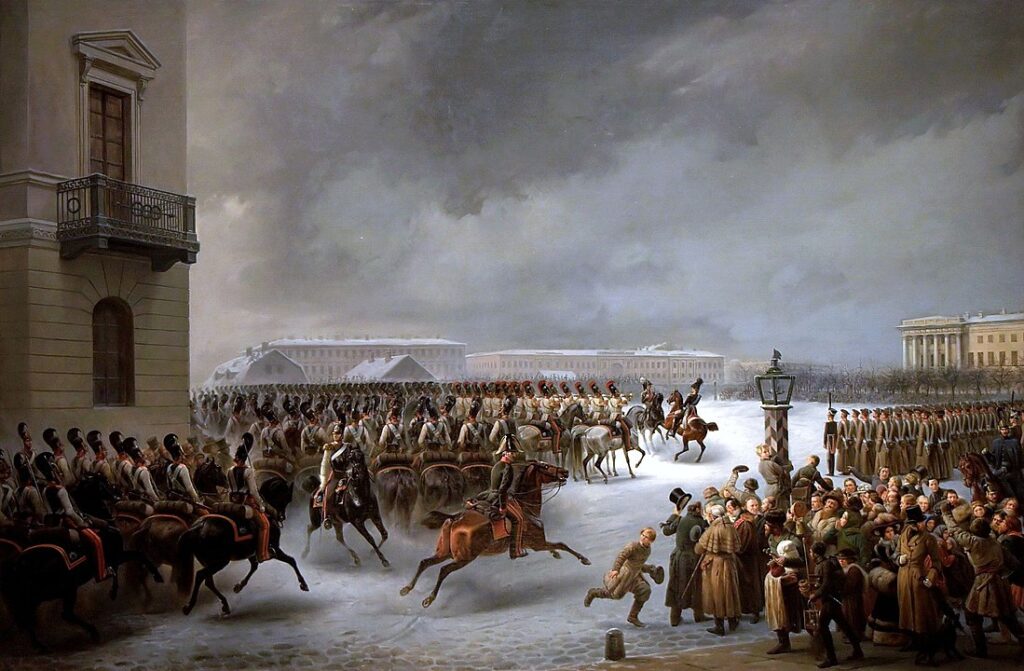
It was defeated over just one long, sub-zero day in St Petersburg, though not through lack of support from the thousands of ordinary citizens who crowded around the vast square. It was betrayed from within by the man appointed to be leader or “Dictator” by the conspirators, Prince Trubetskoy. But despite this betrayal, “the Decembrist uprising in purely military terms, had many chances of succeeding”, is Reisner’s opening line.
The Decembrists inspired many accounts, including an early one by Alexander Herzen, the aristocratic anti-Tsarist writer, who during his London exile established the first free Russian press in Europe. But this analysis of a military rebellion is by a woman who was herself a revolutionary.
Reisner lets us feel how the leading protagonists were shaped by changing events around them and how they also defined those same events. As Shklovsky said: “She had just taught herself not to describe or name her theme but to unfold it.” It’s as though we are reading a deeply psychological Russian novel condensed into a mere handful of pages. And we feel the bitter cold of that December day, when the soldiers turned out to stand in Senate Square, in response to their rebel officers, not knowing what the future would hold.
Her account closes with these tragic lines: “A foreigner rode up, stared at the frozen rebels, and rode off with a contemptuous laugh. ‘Que diable! Si on a voulu fair une révolution, ce n’est pas comme cela qu’il fallait le s’y prendre!’ [What the devil, if you wanted to make a revolution, you wouldn’t make it like that!”]. And still they stood there, as they had been ordered to, clutching their frozen weapons in their frozen hands.”
There is a sharp reality in the evocation of three members of the Decembrists’ Northern Society: Baron Steingel, Piotr Kakhovsky and Prince Trubetskoy. Trubetskoy epitomises the aristocratic attempts to curb the excesses of absolute monarchy (known in France as the Fronde civil wars). His original enthusiasm is revealed through flashbacks to the Prince’s early days in the “liberal spring air of Europe. Who wasn’t a rebel on the streets of Paris in their twenties?”, Reisner writes.
But by late 1824 the main leaders were united above all by their fear of a popular mass revolution. Trubetskoy hated Pavel Pestel, leader of the more radical Southern branch of the Society, who had a real plan for a republic. Trubetskoy “quickly mobilised a network of spies and provocateurs to sabotage Pestel’s work”.
Most devastating is the passionate relationship between would-be regicide Piotr Kakhovsky, “the most naïve and trusting of the Decembrists” and the idealistic poet and publisher Kondraty Ryleev. Reisner makes us feel the ebbs and flows of enthusiasm and despair. We cringe when the impoverished Kakhovsky is treated contemptuously by the wealthier aristocratic officers.
When it dawns on Kakhovsky that the Society “no longer corresponded with the interests of revolutionary Russia”, he is shaken, especially when his closest comrade Ryleev caves in to the conservatives, big on talk but who, at the crucial moment, turns tail.
Reisner’s brutally honest account resonates at a time when many question how long, after more than a quarter of a century, Vladimir Putin can continue to rule. Under him, the Russian state has ramped up repression, with over 100,000 political prisoners currently languishing in Russia’s jails with Stalinist gulag camps being re-used to hold anti-war opponents. Much of Ukraine lies in ruins as Putin attempts to rebuild the Russian empire of the Tsars.
The Decembrists, by Larisa Reisner, is translated and introduced by Cathy Porter and published by Rab Rab press Helsinki.
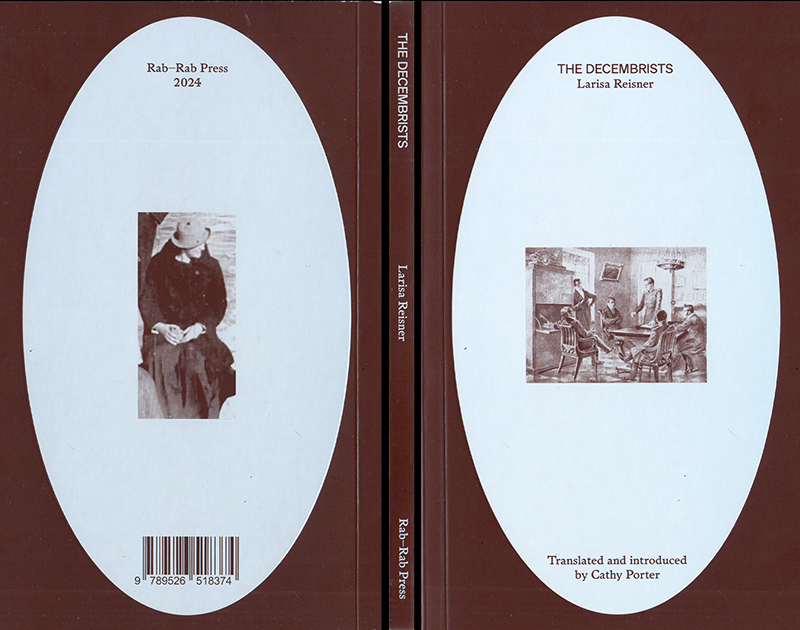
The Book Launch – Larisa Reisner. A Biography & Writings – YouTube with Cathy Porter, Sezgin Boynik and US writer Alex Billet:
Revolt Against the Tsar: The Decembrists A historical video.