How the TUC betrayed the 1926 General Strike
The historic General Strike in Britain began at one minute to midnight on May 3, 1926. It was called off by leaders of the Trades Union Congress (TUC) acting unilaterally nine days later, just as the action was gathering momentum. As we mark the centenary, crucial issues the strike raised about power, the state and capitalism remain unresolved.

Essentially, 1926 was a sympathy strike, in support of the 1.2 million miners and their families, who were resisting pay cuts and a longer working day, and many of whom were locked out of their pits. Most workers throughout the country were under the same threats, as the Tory government of Stanley Baldwin, under pressure from the employers, sought to cut costs and rein in the unions.
The end of the First World War had left British capitalism almost bankrupt, seeking costly loans from US banks. The coal industry was in a trade war with other producers in Europe and intent on cutting wages while lengthening the working day. Tens of thousands of miners were out of work, with many living in poverty and half-starving, as over-production throughout Europe led to lay-offs. Lloyd George’s Liberal Party was in decline and split, the Labour Party was on the rise but dominated by right-wingers such as Ramsay MacDonald. The Tories were united in their determination to defeat the increasing power of the trade unions.
It was a period of turmoil, of revolution, of red scares, and a fear of anarchy that was harnessed by the ruling classes and the press to help de-rail the workers’ struggles for a decent life. This was the period of the Zinoviev letter, a fake document drawn up by the British state, outlining details of a Bolshevik plot to take over Britain. It helped the Tories to a massive victory in the election of 1924 at the expense of the first Labour government.
By 1926, the ongoing betrayal of the ideals of the Russian revolution under Stalin led to Moscow directing the infant British Communist Party to adopt the position of ‘All power to the TUC’, with fateful consequences. Arrests of leading members of the party and police raids, were, nevertheless, commonplace.
A confrontation between the employers and trade unions appeared inevitable from 1919, when the Triple Alliance of miners, railwaymen and transport workers threatened to strike against the coal owners’ plans to cut wages and increase the hours worked. The government swerved and set up a Royal Commission which came out in support of the miners. It recommended a wage rise of 2 shillings per shift, a shorter working day and the nationalisation of the mines.
The coalition government of the time, led by Lloyd George, flatly rejected the idea of nationalisation, and returned the mines, which had been taken over during the war, to the old owners in 1921. The owners then announced large wage reductions and posted lock-out notices at all the collieries. The Triple Alliance called for a strike of miners and railway workers. The government declared a state of emergency, machine guns were posted at pitheads and troops were sent to working class districts. The leaders of the Triple Alliance took fright and called off the threatened strike ‒ an event that became known as Black Friday. The government agreed to subsidise the industry, so confrontation was postponed.

A further crisis in the mines erupted in the summer of 1925, shortly after Britain’s return to the pre-war gold standard which made the export of coal more expensive. The mine owners announced a new wage structure with pay cuts of between 10% and 25%, plus a longer working day.
In the following deadlock, another Court of Enquiry was set up. The miners appealed to the General Council of the TUC ‒ which had just been set up to replace the Triple Alliance as the supreme body of all the trade unions ‒ and won their support. The TUC general council, eager to prove its power, placed a complete embargo on the movement of coal in the summer of 1925.
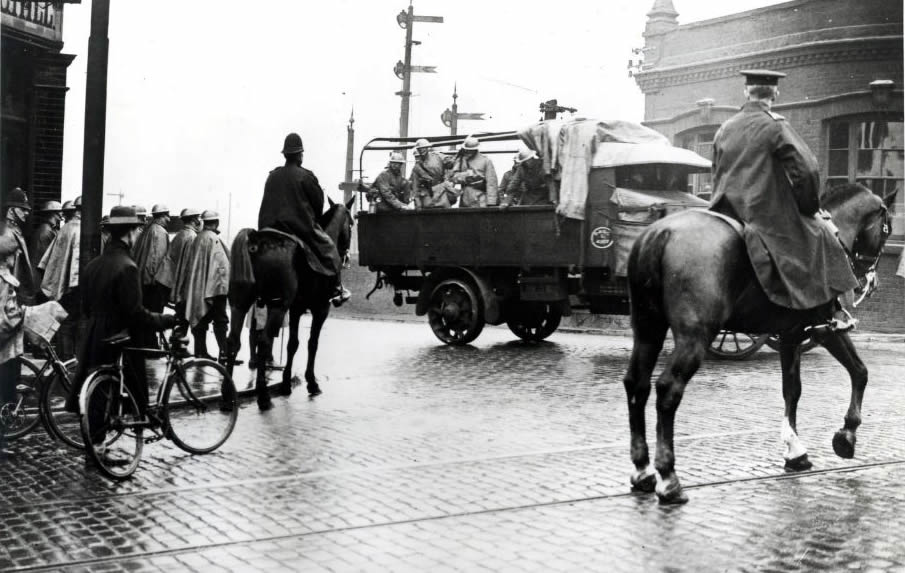
The Court of Enquiry meanwhile had issued its report criticising the owners and strongly favouring the idea of a fixed minimum wage. The owners flatly rejected the report’s recommendations. The government refused to give a further subsidy, declaring that “all the workers in the country have got to face a reduction of wages”.
Under pressure and playing for time, Stanley Baldwin`s government eventually decided it would, after all, give a subsidy to the industry, but only until 1 May1926. It also set up yet another inquiry into the workings of the industry. All sides fell into line. The owners withdrew their threats; the miners carried on working and the TUC withdrew their embargo. The subsidy had postponed the confrontation for nine months. Known as Red Friday in the trade union movement, this deal in fact played heavily into the hands of the Establishment.
The right wing of the trades unions and the Labour Party saw this temporary settlement as a glorious victory for the unions, as did many Tories and their press. The leaders of the Miners Federation (later to become the National Union of Miners), Herbert Smith and A.J. Cook, warned against this hubris, calling the agreement nothing more than an armistice.
Baldwin explained later in life that he had agreed to the subsidy (which cost £23m) because “we were not ready” for a showdown with the unions.
The government needed to prepare and that is exactly what they did. An extensive strike-breaking apparatus was put in place during the ‘armistice’. The Organisation for the Maintenance of Supplies (OMS) was launched, supposedly non-political and non-party, but stuffed with lords and knights at the top. An appeal for volunteers of all kinds including special constables and drivers was made, and money contributions were also sought. Detailed preparations for the transport of food, coal and fuel by road were formulated with haulage companies. Stocks of everything were built up. Plans for the navy to move into the power stations and run them were drawn up, and a special air service was set up. Many of these elaborate plans were made without much noise and in semi-secret.
The leaders of the unions warned about these preparations or dismissed them with C.T. Cramp of the NUR saying: “Personally I have not the slightest fear of these jokers. They are people who have never worked in their lives.”. But the Labour Party of Ramsay MacDonald said little or nothing about them, either because they didn`t know about them or, more likely, because they approved of them.
By the spring of 1926 the government was ready. The trade unions, on the other hand, had done little to prepare, except for the holding of meetings up and down the country. The TUC General Council of the TUC was hampered by the individual unions still pursuing their own separate interests, and little was agreed. The TUC was dominated by a fear of the implications of a general strike, and they constantly searched for a compromise.
Arthur Pugh, a right-winger had recently been elected as chairman of the General Council, and J. H. Thomas, leader of the railwaymen’s union, an MP, and a man described by Julian Symons in his book, The General Strike, as “the greatest buffoon the Labour movement has known, a man who dropped his aitches as eagerly as he put on a dinner jacket”, also had a big influence on the council.
Little attempt at planning for the transportation and provision of food to working class areas was made, and the vital issue of communication with the different parts of the country ‒ which would prove to be a huge weakness in the strike ‒ was not worked out. Attempts to set up workers defence corps to defend communities against the OMS and the fascists were proposed but defeated. All-in-all the General Council of the TUC failed to foresee events or prepare for them. As a body it assumed a compromise would be found and a strike averted.
Meanwhile the Samuel Commission, the latest inquiry, into the mining industry, produced its report in March 1926, recommending several small improvements for the future like joint management-worker committees, but a cut in wages for the present. The Miners’ Federation rejected it out-of-hand. At the last minute, the owners made an insulting offer of a 13% cut in pay and an extra hour of work per day. On April 30 the union leaders voted to hand over their autonomy to the General Council for the duration of the strike and voted to approve a national strike by 3,653,527 for and 49,911 against.
The die was cast and despite desperate efforts in the final hours by the General Council to resume negotiations, the strike went ahead. J.H.Thomas, in a lone initiative, used the fact that the miners had assigned their powers over the course of the strike to the TUC General Council as sufficient reason to re-open talks with the government, even with Baldwin himself, on the basis that the miners would have to agree a pay cut. This came to nothing, but the desperation of the trade union leaders to get a last-minute settlement indicated their reluctance.
The General Strike was not against the coal owners as such, but against the government that had taken on the role as defender of the owners everywhere. It had become a strike by the workers against the state, a political strike for power, to bring down the government ‒ that is what it was, even if it was the last thing the General Council of the TUC thought it was or wanted. The ruling classes certainly knew it.
The Emergency Powers Act was signed, the OMS lists of volunteers were passed to government, two battleships were anchored in the Mersey, with other warships assigned round the coasts, naval contingents were sent to various sites for guard duty, other troop movements were made, telegrams were sent out to the government Civil Commissioners, and the BBC announced news of the strike. The Daily Mail tried to publish the notorious “For King and Country” editorial accusing the trade unions of wanting to make a revolution “by destroying the government and subverting the rights and liberties of the people”. The print union NATSOPA refused to print it.
The strategy of the TUC strike committee, led by Ernest Bevin, of the Transport Union, was to call out only transport workers, print workers (including those who worked for the newspapers), iron and steel, metal and heavy chemicals workers, building workers and electricity and gas workers, but not engineers or postal workers or woodworkers or several other unions that were held in reserve.
The workers’ reaction to the strike call was “immediate and overwhelming”, writes Julian Symons. “There can be no doubt that its completeness surprised the government, as well as the TUC”. Symons surmised that some members of the TUC were less than enthusiastic about this, and as for the Labour Party, he writes that they “must have viewed the strike response with positive dismay”, so eager were they to find an “honourable way out”.
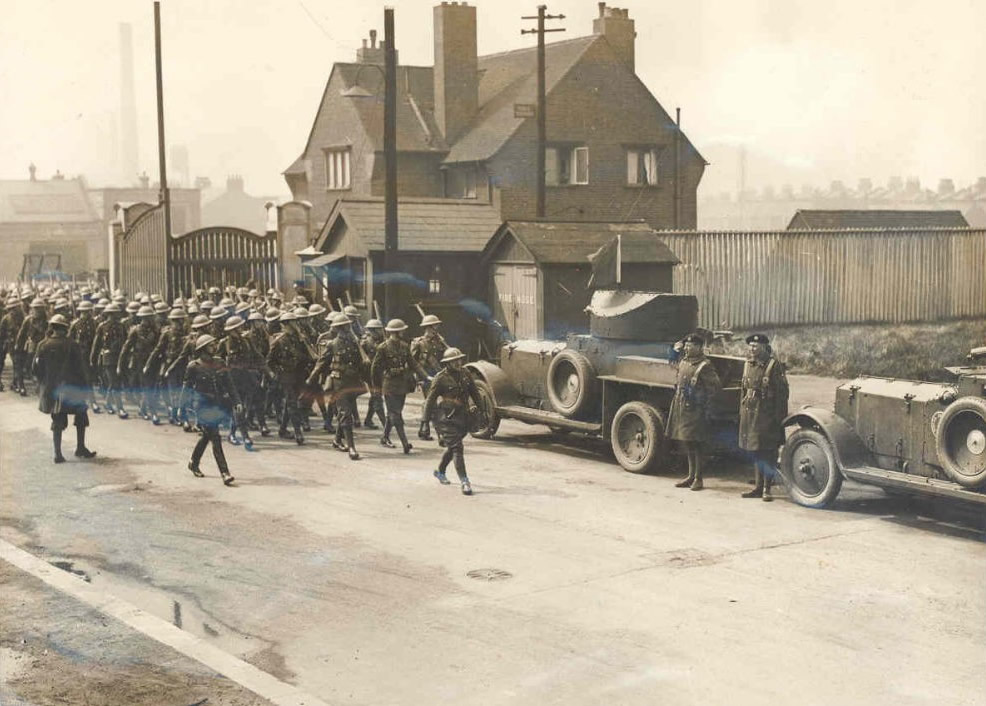
All trains, including on the Underground, and buses were halted. The London General Omnibus Company could not run a single one of its 4,000 buses. Strike-breaking volunteers, many from Oxford and Cambridge Universities, would only later be called upon to drive the buses, more as a lark than anything else. The docks were heaving with pickets throughout the country. The TUC was besieged by requests from smaller unions and even groups of unorganised workers to join the strike, but they were restrained for the present.
The General Council had created several committees, the most important of which was the Strike Organisation Committee. The TUC wanted to exert a tight grip on the strike, especially in the provinces, because they feared losing control. They issued many warnings before and during the strike to the local committees not to go beyond the guidelines. But with poor communications, resulting from the lack of preparation, this quickly caused big problems, as requests for advice on matters big and small went unanswered.
Many of the strike committees learned, as the strike progressed, to take matters more into their own hands, without consulting the centre. The TUC’s strategy of trying to control the strike from the centre contrasted with the government approach, where civil commissioners were given a large degree of autonomy and responsibility.
Most of the national newspapers managed to produce a two or four-page sheet, with the help of management but had trouble distributing the copies. The government produced its own propaganda sheet, the British Gazette, distributed by car and lorry to all corners, with Winston Churchill as the editor. Churchill, as might be expected of the man who, as home secretary in 1910-11, had sent troops to Tonypandy in South Wales in 1910-11, to break a strike of miners for a minimum wage, was a government hard-liner.
He lacked the subtlety or strategic vision of Baldwin, who understood the value of a softly-softly approach, and who needed the continuing support of the middle classes, while relying on the TUC general council to collapse. By all accounts the British Gazette had little influence on the course of the strike. Being known as a government tool lacking in objectivity, it was treated with distrust, even derision. It ran at least two articles in praise of Mussolini and the Italian fascists.
The TUC at the last minute decided to publish its own paper, The British Worker, but that too had its problems, mainly to do with the distribution. It carried warnings to strike committees to adhere strictly to the guidelines. Many of the strikers hardly saw it, a consequence of the lack of preparation of the TUC before the strike. The TUC discouraged separate local publications, advice that was largely ignored. Most of the strike centres found it necessary and useful to have their own newssheet.
Most people picked up the news from the BBC via wireless sets. Lord Reith, the BBC director-general, had understood the message from government that communications should be controlled by the state as far as possible.
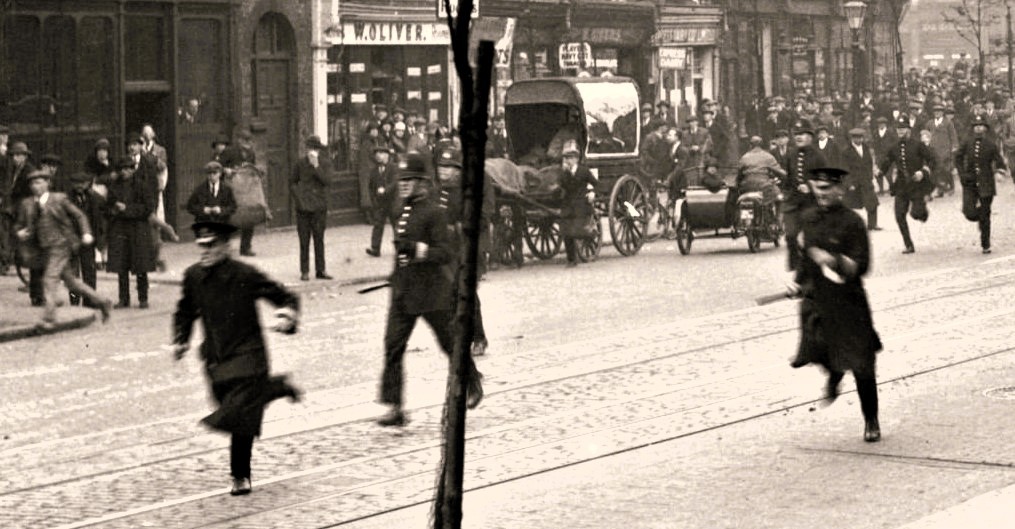
In the big towns and the working-class areas, especially in the North and the docks, the anger and bitterness was most evident, and confrontations flared, but even here there were few full-scale battles, just plenty of police charges and arrests. Railway workers demonstrated their strength with the derailment of the Flying Scotsman, driven by strike breakers near Newcastle, and another train in a tunnel near Edinburgh.

There were large daily pickets at the London docks, where the government had planned to unload food and provisions. Hundreds of volunteers with lorries tried to break the picket lines, unsuccessfully. But in the night, the “volunteers” were secretly ferried by the navy to the other side of the ships, avoiding the pickets. Troops with machine guns were on hand. It was after one of these escapades that the lorries, loaded with food, and at the insistence of Churchill, were given a provocative military escort to Hyde Park, more as a photo opportunity than anything else.
The TUC had charged existing trades councils in every area with the “responsibility of organising the trade unionists in dispute in the most effective manner for the preservation of peace and order”. The strike gave them a new life, and they became, in many areas, the real expression of the local movement. Many became Councils of Action, a name borrowed from the time when bodies were formed to resist the proposed intervention against the Russian Revolution by the British government.
In some areas Councils of Action existed alongside the central strike committee. In many cases, they became the central co-ordinating body, incorporating the area strike committee and the individual union strike committees. Such a body could co-ordinate the actions, and could claim to represent everyone in the community, not just trade unionists. Some of these centres were overwhelmed with offers of support, often volunteers with offers of bicycles, motorbikes and cars. Sub-committees were formed by them, for co-ordinating transport, food, relief for those in distress, for finance, permits to drive, propaganda and publicity, for sport and entertainment and so on.

The extent and influence of these Councils of Action is still debated. They are seen by many as a way of broadening the strike and attracting community organisations to join. At the end of the strike, the Labour Research Department sent out a questionnaire to all the Councils of Action and central strike committees throughout the country, requesting information about their experiences. They received 131 replies, of which 55 were made in the name of the Council of Action. The rest were made in the name the central strike committee or just the strike committee. They give a valuable insight into their influence, the problems they faced and the measures they took.
Several called out the lack of representation for women, who were not well organised in unions. Most of them found ways of coping with the difficulties as the strike went on, often by improvising in ways that went against the narrow instructions from the General Council of the TUC. Late on, the West Ham Council of Action reported: “The general question of lines of communication began to be settled towards the close of the strike”.
Most of the strike centres/Councils of Action found ways, sometimes with community help, of publishing newssheets of local strike news and happenings. Again, these publications often went against the centralising hand of the TUC which had stipulated that local strike bulletins should be largely confined to re-printing material from the British Worker ‒ but the British Worker only reached places like Newcastle 5 or 6 days late. These local news bulletins became very important locally for morale and for informing the local communities, with some of the strike centres producing runs of 10,000 copies on several rotary duplicators running flat out at the same time.
Many had cartoons and jokes in them, often directed against the special constables and the volunteers from the universities and the Stock Exchange: “We understand”, the Marylebone newssheet reported, “that luncheon cars are to be put in trains running between Westminster and Blackfriars”. The St Pancras bulletin printed a variation on that theme: “A train that left Manchester on Tuesday at 9.30am is reported to have arrived at Marylebone at 10.15 am Friday”. The Strikers Alphabet featured in several of them:
A if for ALL, ALL OUT and ALL WIN,
And down with the blacklegs and scabs who stay in,
B is for Baldwin, the Bosses` strong man,
But he`s welcome to dig all the coal that he can
… and so on up to Z, which was for Zeal, shown by the Vigilance corps,
Zealous that workers aren’t trapped by the law.
Several of the responses to the questionnaire raised the issue of workers’ defence corps. At Methil (Scotland) a corps of 700 men was raised as a definite riposte to police charges against pickets, after which “there was no further interference by the police”, their report said. In Croydon and Willesden large forces were built up but not used. The Lincoln Council reported that “the police asked us to supply the whole of the Special Constables — which we did”, effectively meaning the unions took over the running of the streets.
This extract from Brighton Council of Action is representative of many: “Council of Action well attended…about 300. Mounted and foot police came down to tram depot, charged the crowd, hitting them with sticks two feet long with knobs on the end. Object ‒ to get the trams out (none were running). 22 arrests were made. Tried next day, sentences from 1 to 6 months. Moved in C of A after raid and arrests that a workers’ defence corps of at least 500 men be raised to protect workers meetings etc; This was lost. Reformists said it would make more trouble… ILP and Co-op delegates said they would leave C of A if carried. Position on May 12: Solid and every sign of wishing to continue struggle by the workers. Apparent surprise at strike being called off.”
Many of the reports from the Councils of Action highlighted the “magnificent response” to the strike with no signs of weakening towards the end. Oxford reported: “Position on May 12 ‒ No weakening. Increased enthusiasm and determination. Bitter disappointment at cave in”. Several also reported arrests in their areas, and police charges. It became evident that the police could not trust local forces to mount charges on pickets in their own area, so forces from outside the area were brought in, when necessary.
At the very moment as local strike committees and Councils of Action had overcome problems and become more confident, and established their power locally, the strike was suddenly cancelled. The process of building the strike was interrupted ‒ at a stroke. The government itself was becoming increasingly alarmed, and the General Council of the TUC took fright, as they saw that the strike was gathering momentum. About 8,000 engineers in Sheffield, for instance, had walked out on the day before the betrayal, to join the 80,000 already out there.
The reaction of many of the workers to the strike’s sudden and unexpected cancellation was disbelief at first, then anger. Many thought the news, as it reached them, was government propaganda. But with no alternative leadership and with the workers assuming the TUC would not bring about an end to the action without a victory, the slow drift back to work was unstoppable.
The government and the British Worker constantly alleged that the strike was crumbling. Some of the union leaders at the TUC also claimed that there was a drift back to work. John Bromley of ASLEF apparently said to A.J. Cook: “unless the strike is called off now, there will be thousands of trains running. … It is no good, we cannot go on any longer…we are busted”. He was supported by Thomas of the NUR and others. But it seems these reports were a fabrication, and certainly there was no sign of any weakening from the regions. Rather the opposite ‒ 24 hours after the surrender, the number of strikers had increased by 100,000. In Sheffield 80,000 workers were on strike. On the last day engineers joined the strike, only to have to call off their walk-out the next day.
An examination of the Ministry of Transport files of the locomotive engineers reporting for work each day of the strike (published in Symons’ book) shows only a very slight increase in a return to work. The number of LNER company train drivers and firemen ready to work on May 5, near the beginning of the strike, was 79, and a week later, near the end of it, the number was 104, out of a total of 11,500. For the London Midland the respective numbers were 93 and 273 out of a total of 14,671. For signalmen the percentage increases were even smaller. Some, if not all, of these increases would have been down to the volunteers, the plus-four brigade, reporting for duty.
The General Council’s own Intelligence Committee reported that the numbers going back to work were “so slight as to be of no real value at all…”. And this committee also said that “many reports show that the strike is extending and that factories and workshops not directly involved are slowing down or shutting down”, while also warning of the government`s increasing aggression.
Symons concludes that “it was not fear of a breakdown, but fear that the strike might get out of their own hands that primarily moved the most influential members of the General Council”. Faced with a threat to their own power, they preferred surrender.
And surrender it certainly was. Bevin appealed to the miners’ leaders to accept the Samuel Commission recommendations (including a pay cut) and the decision of the TUC to end the strike. The miners refused, and Herbert Smith asked: “Are you going back without any consideration for the men who are going to be victimised in the movement?” And he accused the General Council of having been “on the Prime Minister`s doormat” without the miners’ knowledge.
Victimisations were wholesale and widespread. The TUC had not obtained any guarantees against victimisation or cuts in wages or transfer of workers to lower-scale jobs. They left it to the individual unions to sort out the return to work, which was a negation of the original plan for unified leadership. The government said it had no power to compel employers to take back every striker. Many workers were not taken back to work at all. Some had to tear up their union cards before being taken back. Some employers held that the strike was illegal and unconstitutional. Dockworkers, railway workers and other powerful groups refused to go back until they had agreed the terms themselves.
The betrayal of the strike and the subsequent return to work by the miners six months later, because of poverty and starvation, was a disaster for the trade unions in Britain. Membership dropped sharply. And the government felt strong enough to enact The Disputes and Trade Union Act in 1927, banning sympathetic strikes, opening the trade unions up for civil damages, limiting the right to picket, attacking the use of union funds for political purposes, banning civil servants from joining any union that had political affiliations, and banning the closed shop.
A suitable epitaph for the strike might be the report from the Hull strike committee: Alarm ‒ fear ‒ despair ‒ a victorious army disarmed and handed over to its enemies.
Given that the TUC General Council preferred surrender to the pursuit of a strategy to win, how could the strike have been won? The weakness of the trade union leaders was, of course, known to many of the shop stewards, the unofficial leaders of the workers’ movement in the factories and workplaces. They were the backbone of the strike, but as individuals they couldn’t do much. What was needed was an alternative leadership, and there was none. The young British Communist Party in 1924 had launched the Minority Movement with the aim of winning workers over to the ideas of revolution and to the necessity of building a revolutionary party to achieve this.
At the outset, this went well. The miners` leader A.J.Cook was part of it. But by 1926, Stalin and the bureaucracy, had taken control of the Soviet Communist Party, and were in the business of destroying the ideas and policies, as well as discrediting the original leaders, of the 1917 Revolution such as Leon Trotsky. The line of class compromise with capitalism, and of building separate centres of socialism in each country, had a disastrous impact on the new communist parties of the world. In Britain the party was told to get behind the General Council of the TUC during the strike, with the slogan ‘All Power to the TUC’. With this policy, it lost any influence it might otherwise have had.
Clearly, the world is vastly changed from how it operated in 1926. Corporate-led globalisation and the support of neoliberal governments for ‘market solutions’ has considerably weakened the power of the trade union movement in the UK and elsewhere. At the same time, mainstream political parties like Labour and the Tories are rejected by large sections of voters. The current political system as a whole offers no solutions to a myriad of burning issues. This opens up the possibility of creating a new, democratic alternative. The Councils of Action created in 1926 showed that challenging for power was on the agenda of the strikers, even if it was the last thing on the mind of the trade union leaders. Building on that historic achievement a century ago is our task today.
Sources:
The General Strike, by Julian Symons
The General Strike of 1926, by R A Florey
Warwick University Digital Collections. Reporting the General Strike.