
By Corinna Lotz
London is blessed. Displays at Tate Modern, Whitechapel Gallery and Dulwich Art Gallery all feature outstanding women artists this spring. And for the first time in the UK, Berthe Morisot can be appreciated as a trailblazer for 20th and 21st century art.
In recent years, there have been frequent solo shows of her work in France and the United States but none in the UK, so this is unique chance to appreciate this hitherto elusive-in-Britain Impressionist artist. The last time a body of Morisot’s paintings appeared in a London gallery was 1905, in a group show alongside her fellow Impressionists, whom she called her “confreres”.
The Dulwich show comes in the wake of a small but perfectly formed display of the relationship between Morisot’s close contemporary and fellow painter, Eva Gonzales with her teacher Edouard Manet at the National Gallery. Both women shared huge talent and inspirational exchanges with him.
Morisot was no fellow traveller or hanger-on of the Impressionists. She was highly respected and treasured not only by Manet, Monet, Pissarro, Degas and Renoir but also many critics of her day and the Symbolist poet Stéphane Mallarmé.
In the first space at Dulwich, Morisot’s chevalier-like self-portrait confronts us. It dates from 1885, when Impressionism as a style was already experiencing a crisis, as form disappeared into light and air. Now moving in a new direction, Morisot is already developing a different sense of form and drawing, as evidenced by the rust-brown sketched outlines of shoulder and arm. She depicts herself as a mature professional, grey hair tied back, emerging defiant and alert from a welter of beige, black and flesh-coloured hatchings and squiggles. A black scarf around her neck is dashed off with bravura, her palette barely defined.
Morisot travelled to England as we can see in the sparkling depiction of her husband Eugene standing by a window in West Cowes on the Isle of Wight, her only painting of a man.
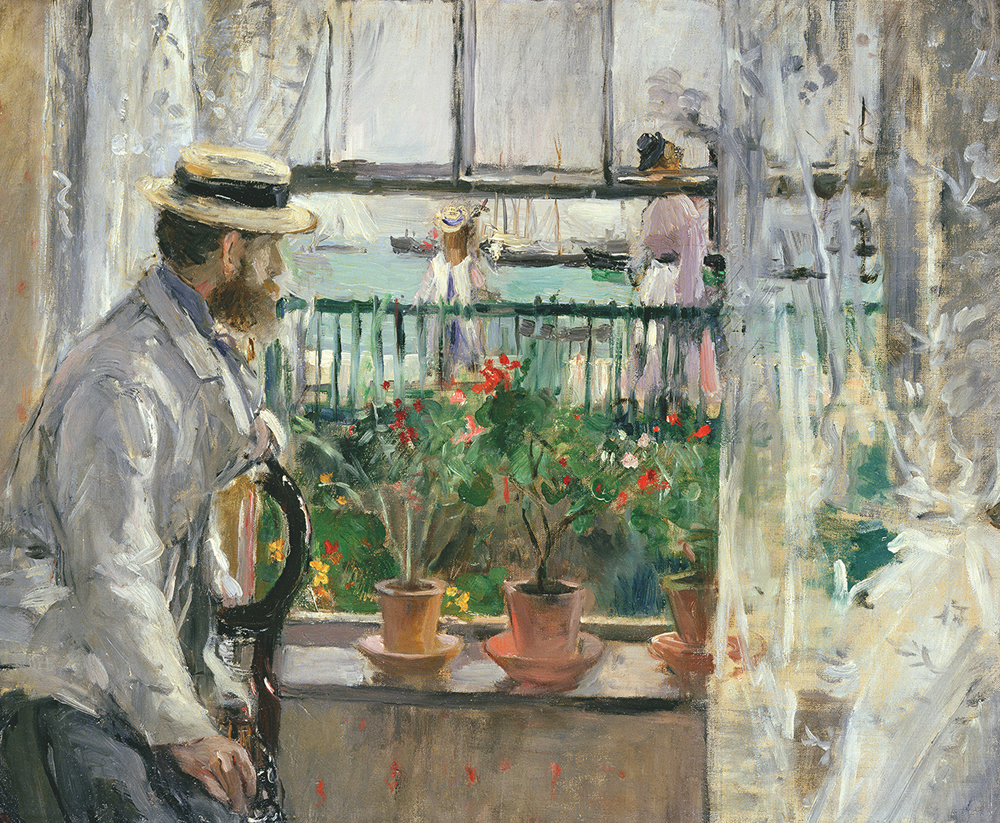
By the mid-eighties Morisot already had two decades of painting to her credit. She began with copies from old masters, and landscapes inspired by her teacher Jean Baptiste Corot, who encouraged her, along with her equally talented sister Edma, to work out of doors. By the 1870s, a blonde palette a la Manet became her signature style. Her brushstrokes grow bolder and her loose drawing more and more daring.
Her deceptively tame subjects – young girls, women and children in domestic or garden settings – are just that: deceptive. The exceptional way in which light is captured and suffuses her entire canvas is deeper than mere description. The lightness of touch, the rhythmic and agitated movement of paint went beyond that of any contemporaries. This was not gesture for its own sake: Her sitters are contemplative, their internal life expressed as much by what we don’t see in them as in their surroundings. Description is abandoned in favour of direct sensation.
The Psyché Mirror, a full-length view of a young woman studying her reflection, we feel almost like a voyeur, not only of her casually draped body but what might be passing through her mind. Psyché is French for a dressing mirror, a poetic association with the human soul, entirely in keeping with the downward introspective gaze on the girl’s face.
Women before mirrors – never has this theme been made so entirely seductive, full of barely stated possibilities. The shimmering silvers of Girl at her Toilette, a few flowers, a glass, a dress falling off a shoulder, a black neckband, an arm disappearing into a deliquescent feathering on the right side of the canvas fuse into a continuous flow, held together like a sequence shot in a film.
The curators set out to reveal how Morisot tapped into the critical renaissance of 18th century art that swept France post-Commune, after the restoration of Napoleon III. Thus the midsection at Dulwich places her alongside Rococo artists such as Boucher, Watteau and Fragonard. The comparisons are there and it’s great to see her connections with English artists such as Reynolds, Romney and Gainsborough. But rather than looking backwards, she helped herself freely from that time making the 18th century masters into a springboard that gave her extra liberties.
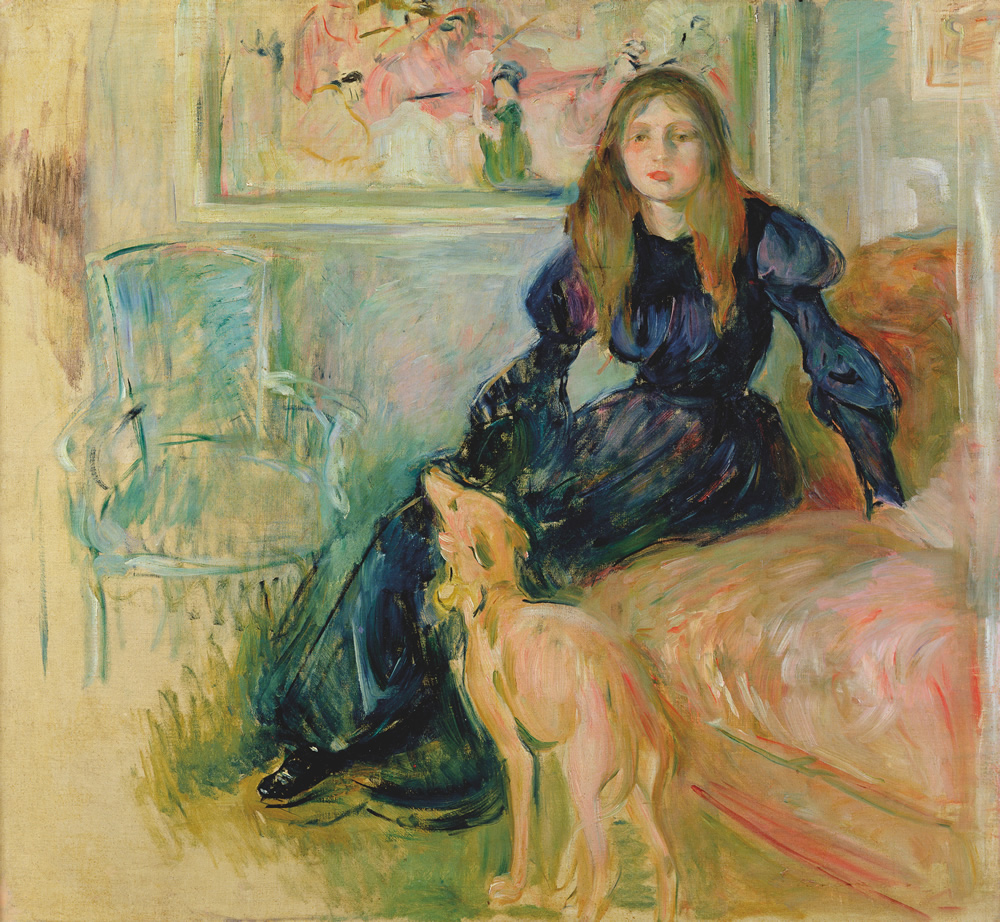
The final space is a splendid one, with infants playing with a basin of water and a touching image of Morisot’s beloved daughter Julie in mourning for her father. There is real pathos here, but no chocolate box sweetness. Instead, she crystallises a moment of intensity, a “contretemps”, an in-between moment. She was a genius who distilled a crisis “in a sudden eruption of modern enchantment”, as Mallarmé wrote.
Berthe Morisot: Shaping Impressionism is at Dulwich Art Gallery until 10 September 2023
- See also: Peter Clossick, Berthe Morisot – ahead of her time
Pingback: Berthe Morisot – ahead of her time – Real Democracy Movement