
Just a few days after the publication of the big picture Global Justice Report from Thomas Piketty’s World Inequality Lab (WIL), Donald Trump’s erstwhile but failed government cost-cutter-in-chief Elon Musk became the word’s first trillionaire.
However you view it, the report looks set to achieve its goal, aided and accelerated by Musk’s new status: the launch of a deepening, urgent debate about the profound global actions needed to achieve a world of equality by 2100 whilst keeping the planet’s rising temperature to 1.8oC.
Critiques of the report are proliferating. Some accuse the authors of dangerous Utopianism, of a failure to understand basic economics, of offering politically impossible proposals. There are others who are in broad support. Some say it’s a huge document but at only 136 pages it’s the content, the complementary set of interconnecting, interdependent measures put together by up by 200 plus academic researchers that make it big and challenging.
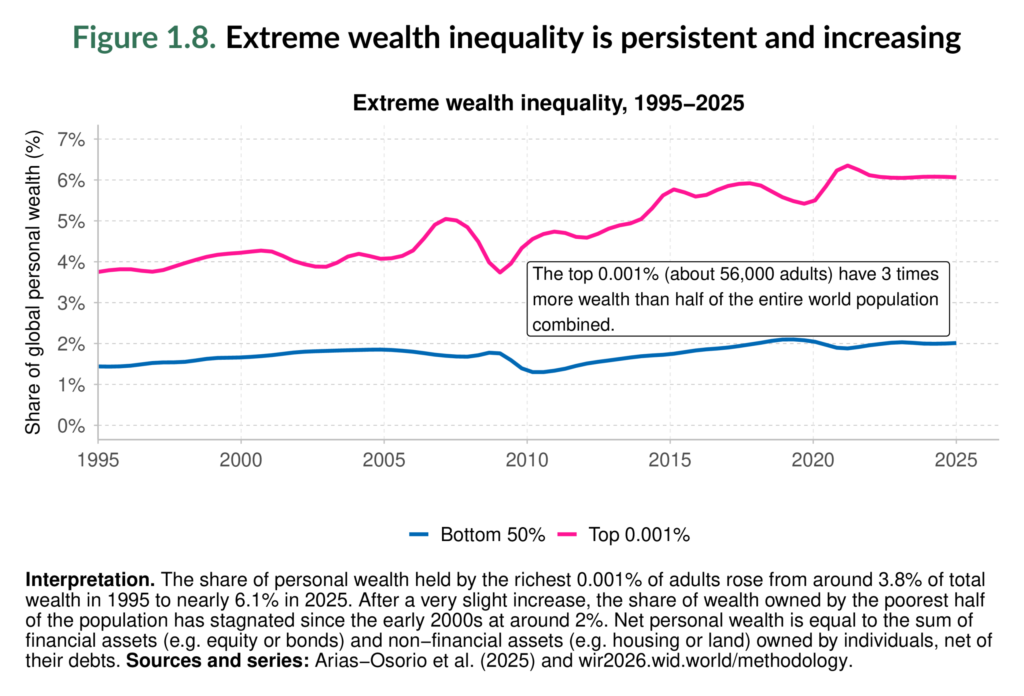
Could it really be possible to converge on a monthly income of 5000 euros for every person on the planet over the next seven decades? This, and the WIL’s many other radical ideas depend on taxing the rich. Heavily. So, the tendency to rapid enrichment of an increasingly tiny minority over the last seven decades would have to be put into reverse. In the report’s words:
it is possible to reconcile planetary habitability and high well-being for all, but only if the transformation rests on three pillars simultaneously. Fast decarbonization of energy systems is necessary. But we also need a major shift toward sufficiency – understood as a sharp reduction in labour hours and material footprint and large changes in consumption patterns, food habits, land use, and forest cover. In addition, neither decarbonization nor sufficiency can be financed and politically sustained without a drastic reduction in inequality of income, wealth and power, both between countries and within them.
The compression of global inequality is not only compatible with deep decarbonization; it is a necessary condition for shared prosperity on a finite planet. The Global Justice Report is the first attempt to propose a fully quantified plan going in this direction, combining four dimensions that today’s debates often treat separately: redistribution at the world scale, a deep reform of the international financial and economic order, a radical transformation of energy systems, and substantial shifts in consumption patterns.
It’s a big ask for sure, but a necessary one. And its bold proposals are founded upon historical precedent – like the rate at which reduced working hours has been achieved through increased productivity. It’ll need global wealth and income taxes – rising to 90% of earnings, and a new democratically-formed global institution – the Global Justice Platform – to somehow organise and distribute a huge global wealth fund. Changes on this scale may seem insurmountable but are no more so than the post-war world-scale organisations set up at Bretton Woods in 1944. And if the US and/or China choose not to take part? Their exports can be made subject to very high tariffs to ensure they pay their share.
The authors acknowledge that their proposals are ‘arguably too moderate and gradualist’ but set within the limits of what seems politically possible. But, as the conditions for habitability continue to deteriorate, the need for big changes like these are becoming more evident.
There is a clear recognition in the report of the need for a change in actual power structures, but it is a confused and unhelpful picture. The report states that: “In the past, the march toward equality did not always happen in peace. It did not emerge as the steady outcome of a quiet process based upon well-organized collective participation and democratic deliberation. Social struggles and popular mobilizations have been at the forefront of the long run movement towards greater political and socioeconomic equality over the past 250 years, from the revolutionary events of the late 18th century to the social movements of the early 21st century. In effect, social struggles should be regarded as among the most effective forms of political participation, alongside electoral processes.”
Perceptively, it recognises that it is not only a social struggle in itself, but the political and economic circumstances surrounding the struggle: “In some cases, crises, wars, and catastrophes of all sorts also played a crucial role in accelerating political change and institutional transformations.” Recognising this it continues: “It is likely that other crises and catastrophes – including climate and environmental disasters, and new nationalist rivalries and conflicts over resources – will also play a critical role in the future, perhaps on a truly global scale this time.”
But what is lacking is a concept of a road towards this kind of movement to bring about this kind of change. If there is a lesson from that last insight surely it is that we cannot wait for these environmental disasters and global conflicts to inflict pain on the peoples of the world. NOT waiting for this to happen is the real lesson of history.
The problem lies in the last sentence of the paragraph we first quoted, which sees social struggles as effective forms of participation alongside electoral processes. But as we are now clearly in a period where electoral processes in themselves have lost their significance, delivering more of the same every time, then what kind of political change can replace these electoral processes? Surely the answer is that we should not see our social struggles as an adjunct to the electoral theatre of the absurd, but rather chart our way towards a different politics. And this would have to be done in stark opposition to the current system of rule.
Forming independent assemblies of the people would be a crucial step towards the development of the new democracy the report aspires to. It is not that the institutions, NGOs really, that the report promotes, are useless – they are not. But they can be and are often co-opted. They are ineffective. They are isolated from the masses and too often live in academic and quasi-governmental silos.
As they say, the path is made by walking. If the path is just the old well-worn electoral fraud, then ultimately, we will fail to rise to the challenges the report so clearly explains. Through new territory we need to carve out a path to real democracy, and we can only do it by coming together in assemblies aimed at developing the power structures that will not only challenge but replace the existing ones.
Gerry Gold thanks Penny Cole for her contributions to this article.
- Global Justice Report presentation
- Thomas Piketty introducing the Global Justice Report
Superb analysis which takes forward the essential analysis from this report
What a great article with a positive view!