Reflecting on recent work by Frances Aviva Blane

Submerging yourself in Blue on White, Frances Aviva Blane’s nearly two metres square abstract painting, carries some potential dangers. Surrounded by deep sea blues, your eyes might get lost and you could almost drown, pictorially speaking. Where do you start looking? What is it that you are seeing? Is it a landscape, is it a sea, is it a mindscape?
It can be – and it is – all those things. Above all, it’s not a depiction or a copy of something. It’s an exercise in pure aesthetic joy, a play with colours and textures. It’s good just to start with the oil paint – in all its splendid permutations: daubed on thick, brushed on thinly, dribbled, smoothed, flung from a distance or in thin washes.
The canvas is divided into two halves, with a watershed down the middle, separated by a downward streak of white. On the right the deepest of blues, then veering into black.
On the brighter, left side ultramarines and turquoises are suspended over whites, with spatters and lightly drawn horizontal bars. Bottom left is a “classic” dark grey splat reminiscent of Joan Miró. The colours are restricted to shades of blue, verging on black, with a few flecks of yellow in the centre, intensifying the turquoise.
We can derive excitement from tracking the varying pressure of the artist’s hand as she guides her brush or tilts the canvas. We feel the physicality of the paint which forms rhythms with a distinct vitality to which we can return again and again, always discovering something new.
What does it all mean, you may ask. For Blane, working with oil on linen is always a testing out process. How much can she get the paint to do? How can accidents be deliberately created so that they are simultaneously intentional and, contradictorily, take their own unguided course? It’s precisely this openness to both creation and interpretation which rewards the viewer with intriguing paths to follow.

A second big canvas, Orange, pares things down to one colour: a massive swathe of orange swooshes down from the left, while a few spatters are allowed to fleck over the right. It’s a conversation between the powerful march of almost solid orange with the hovering, taunting, vanishing yellow: an exercise in minimalism, close in spirit to Miró’s joyful cosmic suns.
As this selection reveals, Blane’s work is divided into pure abstraction on the one side and her “heads” and “portraits” on the other. Her Untitled Head charcoal head drawings test out the limits of our ability to identify a human face made with just a few lines. They are comparable to, but totally different from, incredibly pure and minimal drawings of faces by masters of the pen and pencil like Matisse. Blanes’ Untitled Head Drawing 2 is a few scribbled lines, rough, apparently slapdash and incomplete. One eye is damaged, the other a mere squiggle. No ears, no neck, only one side of the face. It is immeasurably sad.

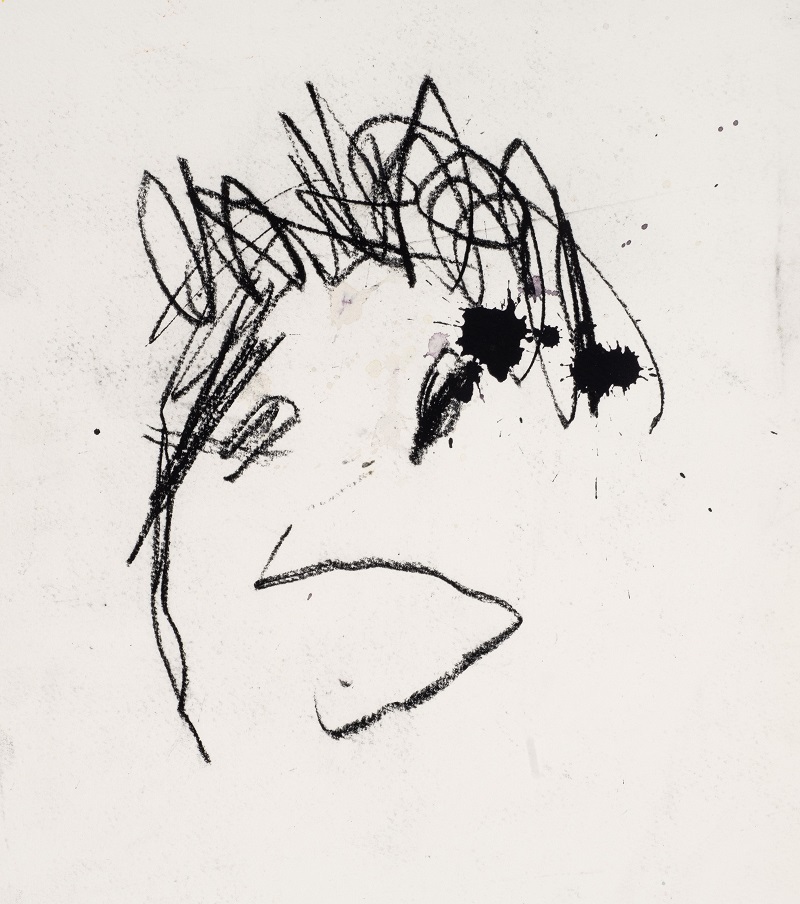
Blane has long admired Miró. Like him she takes her art to the limits, whilst also creating her own language, gesture and calligraphy. For us as for these artists, blue symbolises the infinite, freedom and escape. Miró explicitly supported the anti-Franco opposition. In the late 1960s and early 1970s he burnt and lacerated his own canvases in a deliberate effort to destroy painting as illusion, but there was also a directly political edge. These were tumultuous years, not least in Spain. Miró was in sympathy with the political unrest against the Franco dictatorship, living in internal exile on his native island of Mallorca.
Blane always refutes any suggestion of a “message” in her work or reference to present events, direct or indirect. Rather, her heads convey an existential human grief. Her monsters, like those of Miró, are sad and gentle giants. Her lightly sketched faces are both herself and archetypal clown-like beings which reflect our feelings back to us. She shares Miró’s aspiration to freedom, his essentially anthropomorphic humanism. Through her deconstruction of paint, through deliberate absences, through her focus on her own image, she makes us think and re-think what it is to have emotions and how we connect with our fellow human beings in our own, even more tumultuous, impossible times.
me me me!, by Frances Aviva Blane, is at Zuleika Gallery, 6 Park Street Woodstock, Oxfordshire OX20 ISP
Extended run until 2 November 2024.
