Interview with Jutta Fleckenstein of Munich’s Jewish Museum
The experience of thousands of displaced people in immediate post-war Germany is brought to light in a unique collaboration between two Munich museums. Curators at the Stadtmuseum and the city’s Jewish Museum explore the stories of the estimated 200,000 people who passed through the Bavarian capital between 1945 and 1950.
Many were Jewish survivors of concentration camps and death marches. Others were forced labourers, prisoners of war, political prisoners and refugees from Ukraine, Armenia, Kalmykia, and Russia as the Allied armies defeated the Nazi war machine.The DPs, as they were called, were supposed to return to their country of origin or re-settle somewhere else. However some, particularly non-Jews, chose to remain in Munich.

Jutta Fleckenstein, who has worked at the Jewish Museum since its beginnings in 2007, explained that Munich was at the centre of many DP camps within the city and surrounding area.
Their primary carer was the United Nations Relief and Rehabilitation Administration (UNRRA) which had to look after the eight million people who ended up on Allied territory in 1945 with immediate care – clothing, medicines, food and later repatriation.
“As the Allied troops moved westwards,” Jutta says, “they brought survivors from concentration camps and death marches along with them. They arrived in the American zone under the protection of the Allies to regain their health and search for their relatives, and find a new homeland, not to return to Germany.”
When they returned to their homelands many Jews encountered renewed anti-Semitism. For example, in the Kielce pogrom in 1946, some 42 Jews were murdered by the local Polish population led by the Stalinist Polish Workers Party. Thus, displaced people arrived in Munich fleeing different kinds of persecution. For the Jewish survivors it was the fear of renewed anti-Semitism; for others it was the threat of what might happen if they ended up in the Soviet zone.
“Leaving Munich then turned out to be very difficult for Jews because Palestine under the British mandate barred them from entry and the US also had very restrictive entry laws. Thus, a kind of waiting room arose where no one knew what would happen, what was the destination,” Jutta explained. She found this “waiting room” period from 1945 to 1950 intriguing: how could such a traumatic time engender a self-conscious Jewish community in this brief period?
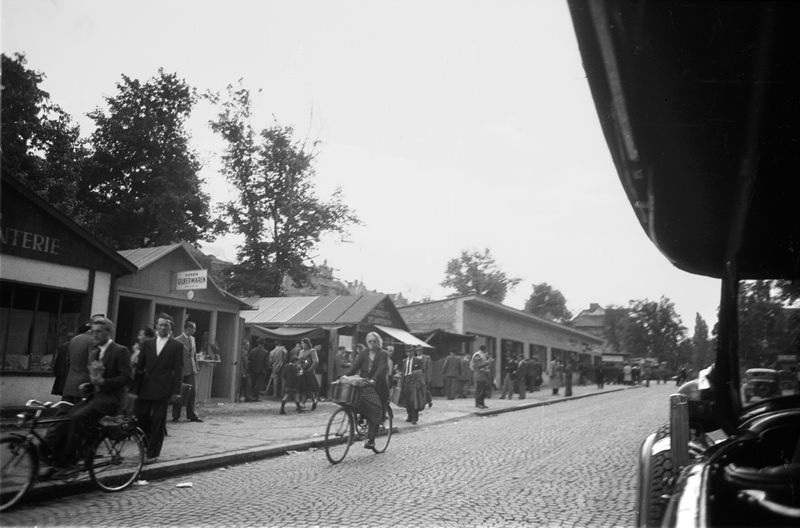
Munich Displaced focuses on certain neighbourhoods in and around Möhlstrasse, which was at the heart of many Jewish institutions, such as the American Jewish Joint Distribution Committee (JOINT), Kosher restaurants, shops, and places where the exhibition curators followed up addresses and photographs belonging to Displaced Persons.
“Thanks to digitalisation,” says Jutta, “we’ve been able to research many archives, such as the YIVO Institute for Jewish Research, the Ghetto Fighters’ House Museum, the Yad Vashem memorial museum in Jerusalem, JOINT and the World ORT Archive in London. They provided images which have helped recreate the multi-facetted and rich cultural life that Jewish DPs created in Munich during this time.”
In early July 1945, people quickly came together from the different occupied zones to form the Central Committee of Liberated Jews, whose headquarters was based in Munich, bringing together representatives from the various occupied zones, so that they could speak with one voice. In January 1946, it held its first congress in Munich’s town hall. Dr. Zalman Grinberg, former director of the Kovno ghetto hospital in Vilnius, Lithuania, took the lead.
Directly after the war ended, all DPs, regardless of origin, were sent into the same camps. This only changed after August 1945 when the Americans sent top government official Earl Harrison to Munich to check on how refugees were being treated. In a dramatic report, he said: “We are treating Jewish men and women in exactly the same way as the Germans, only we don’t liquidate them”, by which he meant they were being held in camps in fenced-off zones and in poor conditions. After his report, camps were set up solely for people of Jewish heritage and with improved provisions, so that a kind of “extra-territorial” space was created, supplied and protected by the US.
“But”, says Jutta, “Jewish residents were self-organised: they created their own police, court and legal department. Members of the group carried out these responsibilities for the others. It was an important step because it acknowledged the unique experience of these DPs. They had been through an “absolute genocide” as Prof. Dan Diner von der Hebrew University has described it. This distinguished their experiences from those of others who had also suffered terribly.
“The separation meant that people did not have to live in the same camp as those who had been their oppressors, such as collaborators who they would have recognised from concentration camps, some of whom may also have been forced into these jobs.
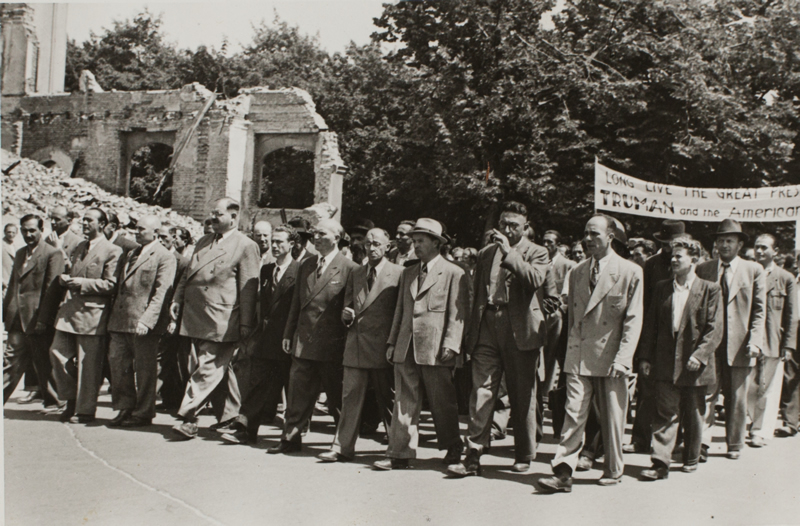
“Finding documents, such as the photo of a protest march against the turning back of the Exodus ship, revealed that the situation in Palestine became known in the German camps and that a large group of people reacted to it.
“They were shocked that 4,515 people, who had endured the Holocaust plus a long sea journey were turned back from Palestine by the British navy, under instructions from Labour’s foreign secretary, Ernest Bevin. Survivors were then forced to land in Marseille, simply to be re-interned in another camp, and then sent to Germany to wait yet again. That’s why people went on the street to demand: ‘Where should we go? Do we even have a nation?’ This still has an explosive power even today.
“A group met in Möhlstrasse and agreed to ask the Americans for support. They wrote on their banner in English to describe their situation: ‘we are in a camp, we don’t know where we will end up; we can’t remain like this’.”
“This raised other questions for me: how did the local German population react to seeing up to 2,000 people marching with a big banner through central Munich’s Prinzregenten Strasse under the protection of the American military, in such a struggle for their future? Plus, there was a further demonstration in 1949 against the publication of an anti-Semitic letter in the Süddeutsche Zeitung (South German Newspaper). The Munich police sought to clear them off the streets as a ‘disturbance’.
“There had been no possibility of action for so many years,” Jutta continues. “They wanted to decide and have a voice for themselves instead of being shoved from one camp to another as refugees. Many of them were sick with tuberculosis and this became an additional reason they couldn’t leave because they were not allowed to enter the United States, for example. Some decided to go to Palestine when that was finally allowed, though it was largely because to enter America you needed a relative or someone to vouch for you but that was very difficult.”
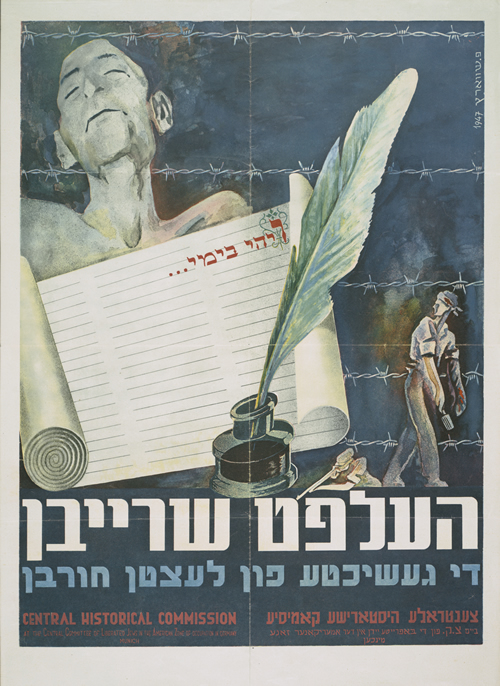
Jutta remains impressed by the way that people organised in this brief period. Posters advertising theatre productions, literary readings and searches for witnesses revealed the many activities taking place during this brief period. Produced under the auspices of the Historical Commission of the Central Committee of Liberated Jews, there was an urgency about collecting survivors’ memories so that traditions would not be lost and to preserve objects that documented the Shoah in different countries.
“In 2010, in an earlier project I thought I had acquired a real understanding of the overall situation of DPs, but all the new material that I have discovered has made it possible to trace individuals, for example those on the Exodus demonstration: there’s so much more that has been preserved and made available. The history of DPs is revealing how not only Germans but the diverse ethnicities and nationalities of displaced persons are an integral part of Munich’s culture and history.
“It’s important to understand how people struggled with being displaced and how they sought to create their own identity by taking up their professions, for example setting up small shops as watch makers, so they could be independent and have their own livelihood, transforming displacement into something good.
“My hope is that this period may become part of the collective consciousness of people who live in Munich, even after the exhibition is over.”
Munich synagogue chair Dr Rachel Salamander and Oresia Poletko, daughter of Ukrainian former forced labourers, greeted visitors at the exhibitions’ opening, along with both museum directors and curators.
Munich Displaced: After 1945 and without a Homeland is at the Jewish Museum until 17 March 2024 and at Münchner Stadtmuseum, until 7 January 2024. Both museums are at St Jakobs Platz, Munich.
Featured image: Demonstration against the turning back of Exodus passengers from Palestine under British mandate, July 1947 © From the Archives of the YIVO Institute for Jewish Research, New York