That we’ve broken their statues
That we’ve driven them out of their temples
doesn’t mean at all that the gods are dead.
Ionia, CP Cavafy
Oceania at London’s Royal Academy has opened at a time when efforts by indigenous, native and first peoples to decolonise their cultures have reached a high pitch.
With this astounding display of Pacific island art and culture it is possible, perhaps for the first time, to begin to appreciate their achievements.
Far from appearing as incidental victims of the colonial past, they are asserting their presence, projecting new possibilities for social and ecological survival in the 21st century.
The word Oceania was coined in 1812, not by explorers but by a revolutionary Danish journalist and geographer, Conrad Malte-Brun, himself forced into exile for his beliefs.
Since their first contact with Europeans, island peoples have faced countless challenges – from the muskets of early expeditions, to preserving their cultures against missionary zealots and even their continued existence after devastation by imported diseases.
The 20th century saw them cast off colonial rule, even as the British, French and US states carried out nuclear bomb testing. But conflicts have not ended. Protests in 2010-2011 still continued between indigenous rights campaigners in Rapa Nui (Easter Island) and Chilean police, to take just one example.
Today’s cultural wars are no longer defined by an East-West divide or old forms of Western imperialism. Now the struggles of indigenous peoples are merging with those of the majority of the world’s peoples. We all confront the results of global warming and the power of agricultural and mining corporations and state systems which promote their rule.
In place of narrow nationalisms, Tongan scholar Epeli Hau’ofa along with Samoan poet Alfred Wendt has advanced the concept of a “new Oceania” or Pulotu, the Polynesian home of the gods. He calls on islanders to remember their past in a very personal way as ‘the ocean in us’.
In the first space at the Academy, a colossal woven blue cloth is the backdrop to the plaintive voice of Marshall Islander Kathy Jetñil-Kijiner reciting, “Tell them …we don’t want to leave” as her people are forced to flee the rising sea.
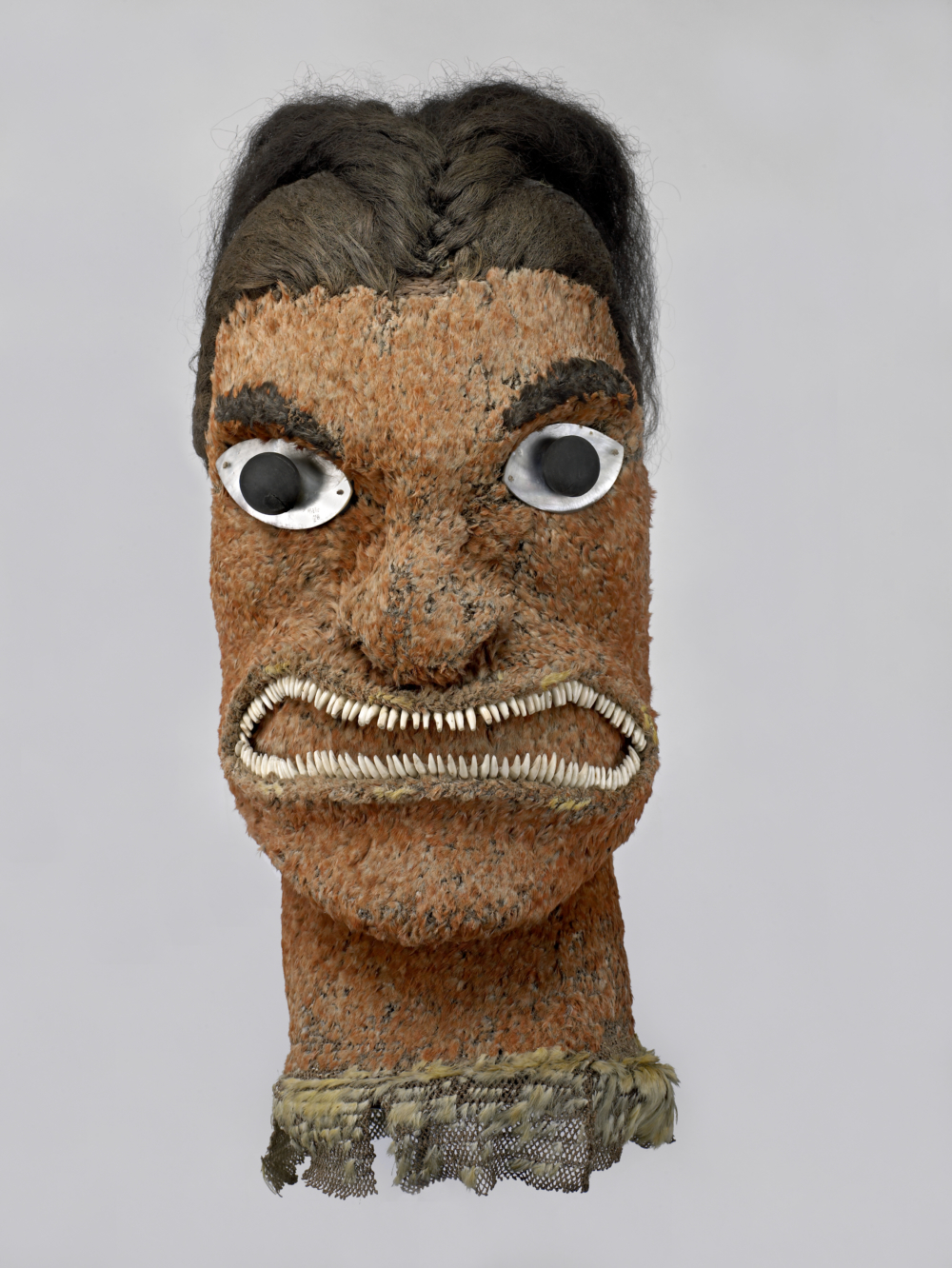
Oceania goes a long way to addressing de-colonisation in a deeper way. It is much more than a display of artefacts. It is an astonishing and poignant experience. Some objects, both sacred and profane, have never been seen before, having languished in museum basements and ethnographic collections.

Through these creative imaginings the vast and complex nature of Pacific ocean cultures leaps out at you.
This “sea of islands” was not “mare nullius” (nobody’s sea) or “terra nullius” (nobody’s land), as Captain James Cook claimed when he landed in Botany Bay in 1770, but inhabited by peoples with ancient and sophisticated cultures.
They fanned out through the Pacific to settle in the Torres Straits, the Solomon, Cook, Society, Papua New Guinea, the Windward and Marshall Islands, Vanuatu, Samoa, Rapa Nui and Hawai’i, amongst many other places.
Through the often ferocious images of other-worldly beings we begin to grasp the variety as well as the continuity between the places reached by intrepid navigators thousands of miles apart, from New Guinea in the west to Rapa Nui (Easter Island) in the east.

The curatorial group who have selected these 200 objects from public collections around the world are sensitive to the thorny problems raised by the “encounters” which led to objects being taken (or “gifted”) from Oceania to western collections.
They ask in the exhibition book: “… how is it possible to display ‘cultural treasures’ from British, European and New Zealand museums [which] are indeed displaced fragments of a tumultuous, revolutionary and often violent encounter between the civilisations of the modern West and those of the Pacific Islands?”
“Is it even possible to celebrate the beauty and artistry of the indigenous peoples of Oceania without considering the tremendous ramifications and consequences and diseases and deaths that Cook’s travels spawned?” wonders native Hawai’ian curator Noelle Kahanu.

Every word describing the history of Oceania is freighted with a complex history and meaning. “Discovery” is now replaced by “encounter”; “taking and looting” is substituted by “gift-giving or “traded”. But the unequal and often lethal nature of these exchanges, whether due to guns, religious conversion, disease or economic power, cannot be brushed over.
Representatives of Oceanic native peoples were invited to bless the RA’s spaces before the show opened to the public. Dancers in bright red costumes processed down Piccadilly to the Academy’s 18th century palace. They sought to endow it with spiritual life or mana. Their delicate fluttering hands, their stamping and chanting invoked the past within the present, not in mourning but in celebration.
There is free admission for all New Zealand and Pacific Island passport holders. This is much needed with an admission price of £20.
Oceania is at the Royal Academy until 10 December 2018. It opens at the Musée du quai Branly – Jacques Chirac in Paris 12 March 2019.
Thank you, V, for your thoughts and help in conceptualising this. Likewise Mahalo Nui.
“They sought to endow it with spiritual life or mana. Their delicate fluttering hands, their stamping and chanting invoked the past within the present, not in mourning but in celebration.”
Very eloquently expressed. Peoples of Oceania do want to move forward, each in his own way, but hopefully towards a more positive future, taking in lessons from the past.
Mahalo nui