“I want to make it interesting for all my young cousins, my young children. To make my work in a modern, contemporary Zeitgeist so that they are interested in culture, so that it’s modern. So that it’s cool.” The words of proud Gadigal artist Konstantina.
She sees her painting as a way of understanding her ancestry as an Aboriginal woman “in a modern and often very confounding world”.
RE: Imagined, an exhibition at the JGM gallery, celebrates the culture of the Gadigal people, the original inhabitants of today’s Sydney area of New South Wales who are part of the Eora Nation.
There is a freshness, a feeling of contemporaneity in Konstantina’s expansive canvases and stretched possum skins, stitched with sparkling beads.

Native plants, earths and animals, their uses and complex significance, are integral in her art. The gadi plant, for example, vital in sustaining the life of Gadigal people was recklessly harvested and destroyed by the colonial occupiers. Its flowering is often stimulated by bushfires. Intriguingly, it belongs to the same family as the asphodel, which the ancient Greeks venerated as a symbol of the souls in the afterlife.
In Konstantina’s Ngara series, the delicate fronds of a fern-like plant wave gently, made of tiny points of green and earth colours in whirling, concentric circles. They seem to move against backgrounds of whorls and overlapping circles. From the micro to the macro, there’s a feeling of infinite space, encouraging contemplation.

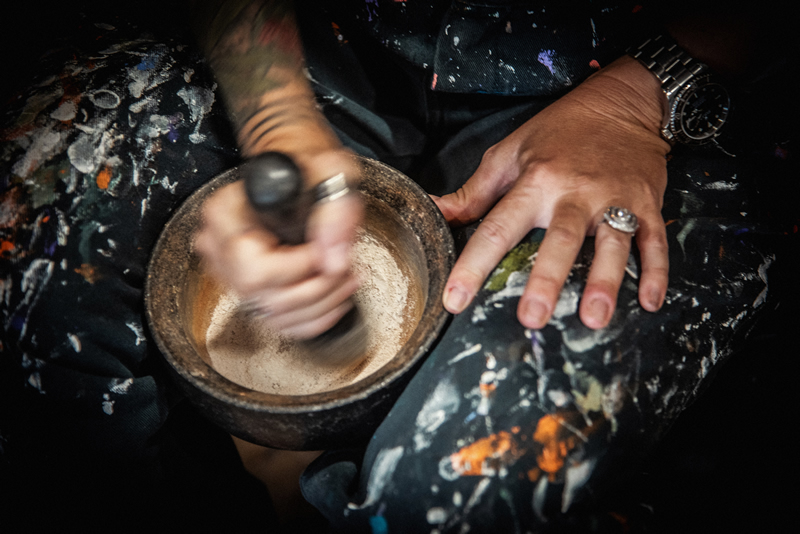
The word Barraba refers to a reed plant used to make jewellery and items of clothing. Understanding how to harvest these was a journey of discovery, including some pitfalls. Recovering such complex processes, the artist explained, requires enormous patience and determination.
An ancient geological feeling emanates from the Bamal theme. Layer upon layer of ochres, browns, rust reds, separated by chains of white dots, are arranged in horizontal waves. They are full of life. Bubbles of energy surge through, like an irrepressible leavening. Radiating stems tumble along like spiky urchins through fossilised life forms. The flowing forms arouse a feeling of stellar nebulas uncurling through outer space.

Studying her Nation’s artefacts with Oceania curators at the British Museum Konstantina is re-tracing the material process which were needed to craft objects of use and decoration by First Nations communities.
Through this joint work by the artist and curators, she helps us understand that they are “not inert, but objects with living histories which have contemporary social, spiritual and practical uses in the communities where they are from”.
Konstantina and the JGM gallery’s curators are offering a chance to plunge into and respect a culture so different from that which we experience in our usual lives. This was enhanced by the traditional “Acknowledgement of Country”, at the opening of the show.
Thanks to their efforts we can experience the resurrection of an almost buried history of a people and their culture, repressed by unspeakable brutality and rapaciousness. But here is not nostalgia or a simple attempt at mourning. Here is an assertion that this culture lives and speaks to us through its own people in the here and now. As Professor Lisa Jackson Pulver writes in the exhibition book: “And yet we are still here. Aboriginal people – we continue.”
These artworks are steps in a loving, inspired and painstaking journey of recovery and re-creation. Konstantina, the British Museum curators and the team at JGM encourage an appreciation of that which has almost been lost. To reconnect with and give new life to that which has been preserved. It’s a project not only for the Gadigal people, but more widely, hopefully endowing the word “culture” with a positive significance.

How does Konstantina’s practice relate the ongoing First Nations movement to “re-matriate” the re-learning and reviving of language, ancestral knowledge, and traditional skills sets which, through processes of colonisation, were either erased or appropriated?
Speaking to Real Democracy Movement, Antonia Crichton-Brown, writer and researcher at JGM Gallery, explained that this includes “working with organic materials, which she either sources locally on Bundjalung Country (Byron Bay) or through ethical routes, to make contemporary iterations of historical objects that have social, spiritual, political and practical purpose within Gadigal culture. Konstantina does not remake these historical objects as exact replicas but re-imagines them using non-traditional materials and techniques.
Konstantina’s re-imagining of ancient customs and techniques includes the complex embroidery of possum skins titled Budbili Nangamay (Possum skin cloak Dreaming). In these she merges designs marked out using traditional burning techniques with Czech glass beads, coloured cotton thread and sequins.
“She visualises how culturally significant objects, like possum skin cloaks, might exist in the contemporary world, should the practices of their making have been maintained throughout 237 years of colonisation,” Antonia continued. Her practice, as well as those of other Indigenous artists who grew up in urban environments, is different from the so-called ‘desert painters’, or Indigenous artists who work from art centres in the more remote regions of the Northern Territory, Western and South Australia.
“She does, however, directly engage with these artists’ practices, periodically going out to community to paint and collaborate, most recently with Kitty Napanangka Simon in Yuendumu before her passing in 2024. Konstantina holds a unique position and perspective among many other artists who also hold unique positions and perspectives that – while sitting within a movement that is enormously heterogeneous – are nevertheless connected both culturally, geographically, perhaps formally and experientially.”
—————————————————————————————————–
RE: Imagined, an exhibition of work by Konstantina, inspired by her three-year research project with the British Museum, is presented by the JGM Gallery, 24 Howie Street, London SW11 4AY until 6 December.
JGM Gallery is located next to the Royal College of Art’s Herzog and de Meuron-designed Battersea campus.
Antonia Crichton-Brown edited and designed the beautiful exhibition catalogue.