
Roger Mayne may not be a household name, but he certainly deserves to be. Escaping from his privileged middle-class background, Mayne (1929-2014) was a self-taught photographer who found visual poetry in the bombed-out, impoverished terraced streets of Bermondsey, North Kensington, Westbourne Park, and Paddington.
These names evoke stark images of a London that has largely vanished. The crumbling run-down housing has been mostly replaced by gentrified flats and houses, coffee bars, and restaurants. A two-bedroom flat in St Stephen’s Gardens (once owned by the notorious landlord Peter Rachman) can set you back by a cool £1 million.
But when I lived and campaigned as a socialist revolutionary in North Paddington and North Kensington in the late 1960s, it was still a different universe. Living in Chippenham Road and later in a one-room bedsit off Portobello Road, I experienced these neighbourhoods up close.
Moving south from Kensal Town down to Ladbroke Grove, the scene transformed. Large white stuccoed villas with leafy gardens eventually led to Holland Park. Notting Hill Gate was where these two worlds met, and sometimes collided.
In those days, the cityscape was much unchanged from the early post-war years: decaying, treeless Victorian terraces, where black and white teenagers hung around, outside youth clubs and on street corners. The Westway flyover roared overhead, and beneath one section of it was a Romany caravan encampment.
They were working-class multiple occupancy houses with a large Afro-Caribbean population dating back to the Windrush years. Many worked in West London’s light engineering factories, and there was also a substantial population of building workers from Ireland.
This part of West London became the focus of Mayne’s camera between 1956 and 1961. His Southam Street Album chronicled lives lived in crumbling Victorian slums. Following in the footsteps of famous photographers such as Henri Cartier-Bresson, Mayne captured the gritty reality of street life in post-war Britain. In particular, he took between 10,000 and 15,000 images of young people by 1959.
He absorbed the work of US practitioners such as W Eugene Smith, Margaret Bourke-White and Berenice Abbot, and in the UK Bert Hardy and Bill Brandt’s contributions to the Picture Post. Cartier-Bresson’ ‘s The Decisive Moment (Images à la Sauvette) helped inspire Mayne’s ability to pin down what Langston Hughes described as “the sweet flypaper of life”.
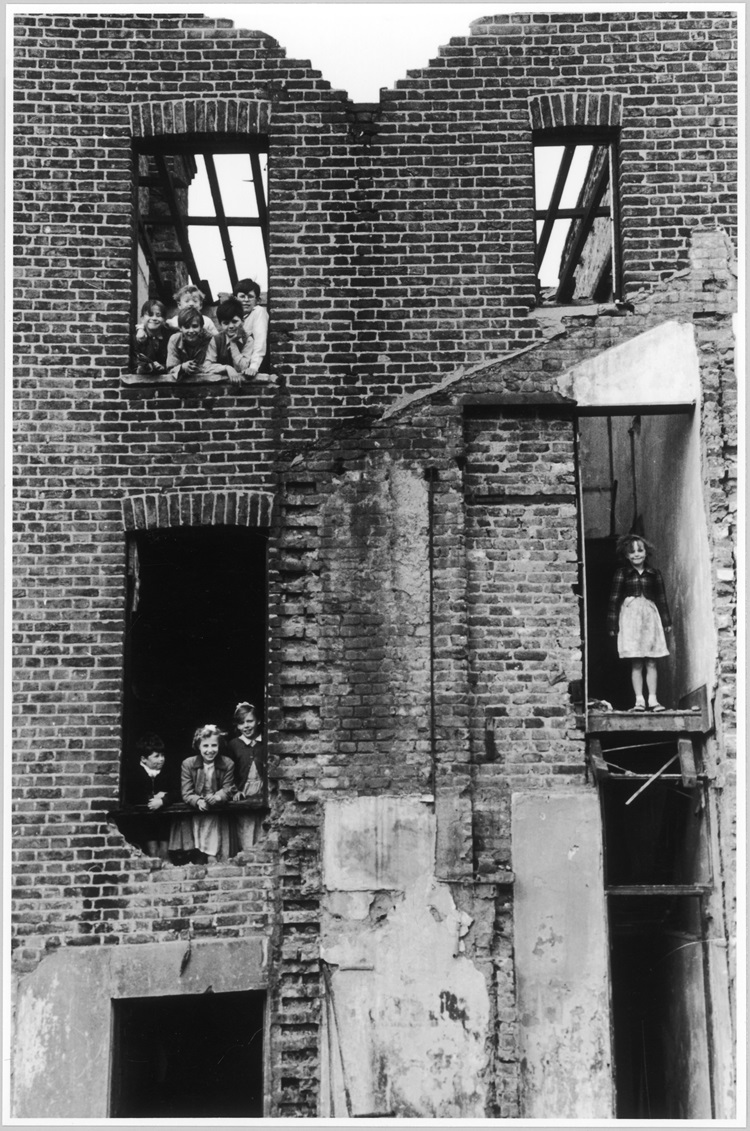
Crammed into small lodgings, residents found a particular kind of escape, a freedom of movement, chances to play, and socialise in porticos, on steps, pavements, kerbs, and streets, bombed out buildings — a world that has all but disappeared today.

Mayne’s photos tell intricate stories of human relations, capturing interactions among the generations, especially between teenagers and children. As curator Jane Allison explains in the beautifully produced exhibition book, Mayne’s focus on young people reveals the “tectonic shifts in society that occurred in the twenty years following the war. Children and young people embodied an unsettled society in the grip of change.”
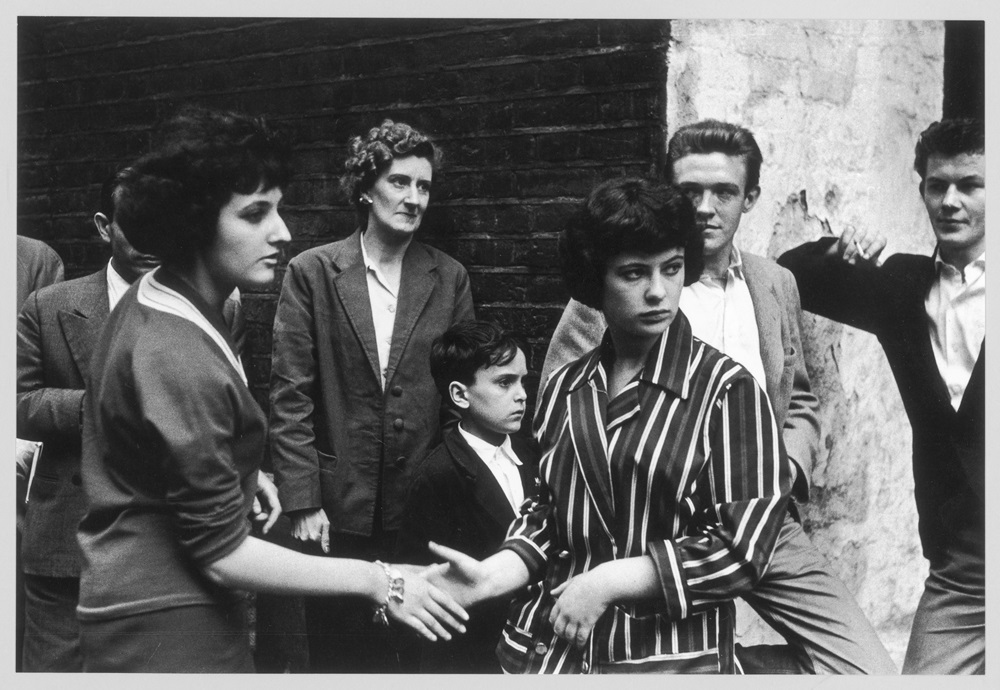
His new focus on play and creativity – missing from his own childhood – was entirely in tune with progressive research into psychology and education that emerged in the 1960s. Not surprisingly his images adorned many Pelican book covers exploring these subjects.

From the children of others to his own, he helps us imagine their inner lives. His astounding shot of his wife Ann giving birth to his daughter Katkin (1968) is one of the most moving images in this collection. In later years, Mayne moved to the countryside where he created an intense documentation of his own family life, children in idyllic garden scenes and on the beach.
Writing about Mayne’s work, art historian Beth Williamson remarks in Studio International, “life was precarious, off-balance, and ungrounded, and that is what Mayne captured in his photographs. Still, young people were modern and fashionable, agents of their own lives, carving out their own identities.”
Don’t miss this rare chance to see the artistry of a photographer whose work is infused with a humanism and pathos that goes far beyond simple documentary.
Roger Mayne Youth is at the Courtauld Gallery until 1 September 2024
The exhibition book includes an original essay by Jane Alison and an interview with Mayne’s daughter, Katkin Tremayne. It is published by Paul Holberton Publishing.
Postscript: At the junction of Golborne Road and Southam Street, the murder of Antiguan immigrant Kelso Cochrane in 1959 shocked the community – an attack widely viewed as racially motivated. Incredibly, it took 66 years, until July 2024, for the Cochrane family to receive police file documents in response to their Freedom of Information request. They revealed that the prime suspect was a racist. A decade after this tragic event, Southam Street was declared unfit for human habitation and was demolished, making way for Ernő Goldfinger’s famous Brutalist Trellick Tower.