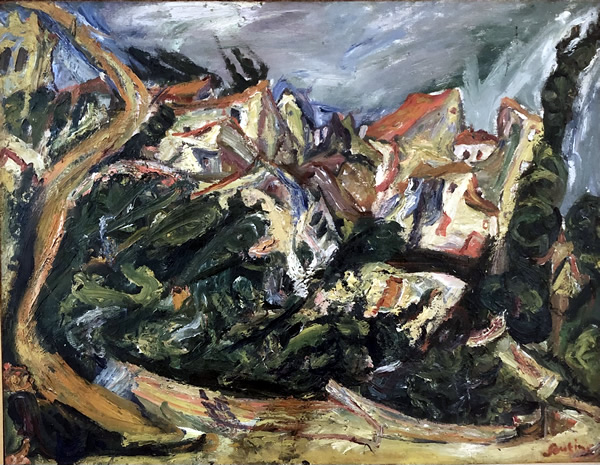
This was my first visit to Hastings Contemporary and it turned out to be the nicest gallery I have been to for a long time. My colleague Julie Held and I were delighted to find there were no crowds at this civilised, crisp and clean gallery, set amongst fishing huts. Inside, nobody blocked our view, you could see the works, enjoy the experience and get really close without any stress. The two artist’s paintings are exhibited separately which was ideal as they are very different.
Born in 1893, in the shtetl of Smilavičy, in today’s Belarus, Chaïm Soutine was the tenth of eleven children. He was 33 years old when Leon Kossoff was born in London, also to a working class Jewish family from eastern Europe. Before moving to Paris in 1913 Soutine had some art training in Vilnius. Once in Paris, he set up a studio and met British artist David Bomberg, making friends with Amadeo Modigliani who introduced him to his dealer. During World War I, Soutine left for Ceret in the French Pyrénées producing his most famous series of landscapes. His reputation was then established by American collector Albert Barnes.
Soutine married but was estranged from his wife and young daughter. After the 1940 Nazi occupation of Paris, he was forced to go on the run to escape the Gestapo, living as a hunted man. The stress aggravated his health and he died after emergency surgery aged only 50. His reputation that has grown ever since, providing influence on many important twentieth-century artists.

Soutine’s art appeals directly to the senses with his turbulent passionate figuration. Its intimacy has a special quality where the forms press outward from the inside with rhythm and movement in conjunction with a desperation to get it down with racing driver speed. His portraits empathetically represent palpable people, descriptively vulnerable in a non-judgmental way. In conjunction with his early landscapes made in Ceret, they come alive with a brilliant sense of colour.

Kossoff was a Londoner and one of seven children, his family ran and still run a bakery. As an evacuee during World War II, his host family encouraged him to paint. After a brief spell in St Martin’s School of Art, he was called up and served three years in the army before returning to St Martin’s, attending evening classes run by Bomberg. Aged 31 he had his first one-man-show with gallerist Helen Lessore, then Marlborough, Fischer, D’Offay, Annely Juda and L A Louver. He died in 2019, having led a very private life.

Kossoff’s shorthand graphics, in contrast to Soutine, create surfaces that just flow and I must admit to being a Kossoff aficionado. His paintings cannot be represented or replicated through photographic reproduction. Of the early works, you can get no idea of the sheer physical weight of the material. You just want to touch it and run your hands across the surface like a blind person to feel the movement. To engage you must see them in the flesh: there is no other way to appreciate their monumentality. Kossoff’s local landscapes, friends and family have a sense of emergency and a fierce lack of compromise, lyrical images with a thickly layered mud of paint. His non-formulaic paintings combine drawing and painting as one and the same.
With both these artists, the forms are internally processed rather than being external additions. You feel it’s pressure from within that causes any form of distortions. There is no sense of calculation for effect. Soutine and Kossoff are different individuals who relied on their intuition rather than working with a system, each responding within different formal languages, bringing the painted object into the viewer’s space.
Viewed at first hand, the exhibition is a highly invigorating one and I would recommend a visit to the Hastings Contemporary. I would recommend the cafe food and drinks for both prices and quality.
Soutine-Kossoff is at Hastings Contemporary Art Gallery 1 April – 24 September
Hastings Contemporary is located at Rock-a-Nore Road, Hastings TN34 3DW
Peter Clossick is a practising artist and past president of the London Group of Artists Corinna Lotz contributed a few lines to his appreciation of the exhibition.