Appearing as if by magic once you depart the roaring A3 is the low-slung Watts Gallery and its ensemble of studios, chapel, pottery and café. Nestling in the Surrey Hills, it still radiates the ethos of its late Victorian founders.
Commissioned by George Fredrick Watts and his wife Mary as a “temple to beauty”, a young architect, Christopher Hatton Turnor designed the modest Arts and Crafts style building, which was completed in 1901.
Women of Influence, the Pattle Sisters, a hitherto untold story of Victorian sisterhood, sits perfectly amongst Watts’ own visionary paintings and sensitive portraits. It is a tribute Watts’ spirit of place that with this exhibition they are brought to life.
For child actress Ellen Terry, Little Holland House, where many of the Pattle sisters’ salons were held, seemed like a paradise, “where only beautiful things were allowed to come”.
Collectively the sisters created a space where artists, writers and thinkers of all disciplines could feel relaxed and inspired. They were admired and even worshipped by leading artists of their time, including Watts himself, John Ruskin and Edward Burne-Jones.
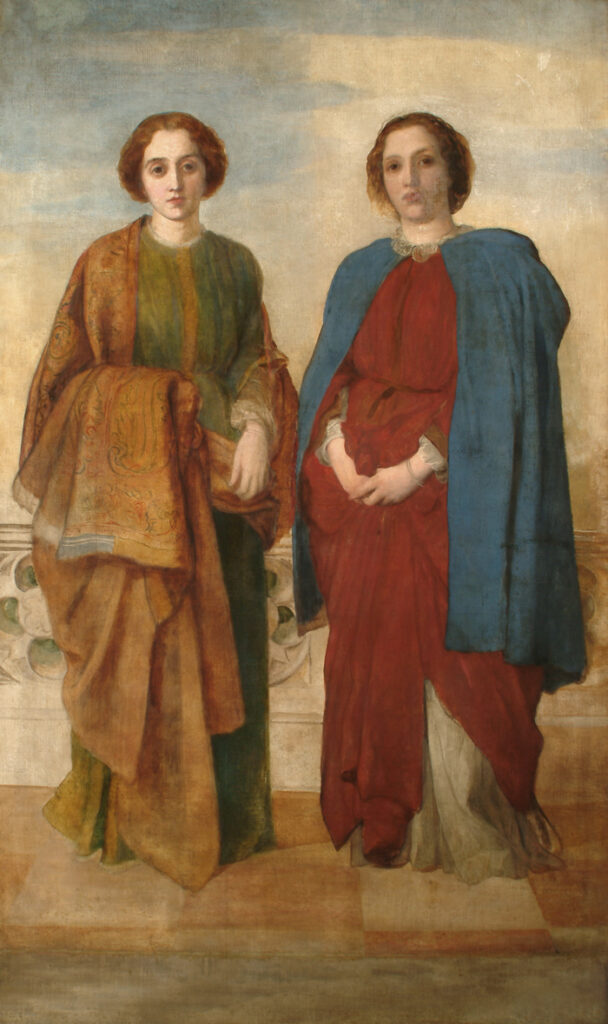
Collection of Watts Gallery Trust
Watts painted The Sisters, showing life-size figures of Sophia and Sara Pattle, silhouetted against sunlit clouds, in a feminine echo of the majestic philosophers in Raphael’s School of Athens.

Like Plato and Aristotle, the sisters are draped in flowing blue, red and golden-brown robes. But in contrast to Raphael’s philosophers, who are engaged in a lively discussion, they look directly at us. The younger Sophia seems dreamy and yet unsettled, while Sara has a confident and challenging, even defiant, look. And yet there is a slight feeling of melancholy.
Within class-ridden Victorian society these sisters created a uniquely classless space, William Dalrymple notes in the exhibition book. Little Holland House was a place of recovery, a refuge with “a cosmopolitan and liberal spirit to which people of that date were little accustomed.”
Their salons took place in Little Holland House in what was then rural Kensington. This rambling building was acquired with Watts’ help in 1850 by Sara (sister No. 4) and her husband Henry Thoby Prinsep. By chance, Watts encountered Virginia Pattle (sister No.6), considered the most beautiful of the seven. He was invited to be a house guest who then stayed over 20 years.
Watts’ presence as “England’s Michelangelo” helped draw visitors to share the generous Pattle/Prinsep hospitality. It was a cultural mingling that turned into a decades-long symbiotic relationship. Together they created a vibrant bohemian salon which attracted the good and the great of Victorian society, many of whom were immortalised in Watts’ portraits.

Historian Michael Holroyd has noted in an earlier book, that “within the Pattle family might be read the imperial history of Britain”. And indeed, all the sisters’ husbands were civil servants who worked for the British empire and East India company. The seven sisters were born in India except Maria (‘Mia’) who was born at sea. Their lives and privileges, oscillating between England and India, were interwoven with the colonial structures of the British empire, which in many ways but not all, their husbands and sons upheld.
But here come the apparent contradictions. The sisterhood’s lifestyle and conduct were often considered suspect by upholders of Victorian morals. Their fusion of French, Indian and British origins, their ability to speak colloquial Hindustani, their serving of curries and wearing of Indian shawls and adornments, was not only exotic but too sympathetic towards a “subservient” people.
Their dual role, as immigrants in British society, as well as beneficiaries of Empire, comes to life in The Sisters, Watts’ imposing double-portrait of Sophia and Sara.
In the exhibition book, Curator Gursimran Oberoi decodes the symbolism of Sophia’s Kashmiri shawl and the sisters’ rakhi wristbands: “while Watts employs visual devices to indicate sisterly harmony, the subject itself grappled with underlying social tensions relating to Anglo-Indianness for contemporary British viewers”, who felt a “slight element of looseness” in Little Holland House.
William Dalrymple details how Sara’s husband Thoby Prinsep was steeped in Persian history and culture, and his brother James in ancient Indian civilisations. James fought “a long and honourable rearguard action against the growing tide of Raj bigotry, which by the mid-nineteenth century was threatening the whole study and appreciation of Indian culture,” Dalrymple writes.
After the First War of Indian Independence in 1857, he believes, the sisters would likely have come under pressure to show loyalty to Britain. Even their dark eyes and complexions aroused negative comments.
The “mid” Pattle sister, Julia Margaret Cameron, is renowned as an outstanding photographer. She too embodied an unconventional, daring nature. Having given birth to four children plus adopting a fifth, she was 48 years old when her only daughter gave her a camera. The Cameron’s Isle of Wight home, Dimbola, the location of her studio, overlooks Freshwater Bay. It was only saved from development by a community trust.
The inclusion of many of Cameron’s shots of her sisters, their daughters, servants, workers on the Cameron tea plantation in Sri Lanka (then Ceylon) plus distinguished sitters in portraits or allegorical poses, makes Women of Influence a special celebration of her talent.
In 1874 Julia’s passion for her work is inscribed in a gift album:
“The gift from those I loved so tenderly added more and more impulse to my deeply seated love of the beautiful & and from the first moment I handled my lens with a tender ardour and it has now become to me a living thing with voice & memory & creative vigour”.
As the multi-generational Prattle family tree (with numerous and confusing Julias, Virginias, Adelines, Marys and Mias) reveals, Julia Cameron became the aunt of another sisterhood, that of Virginia Woolf and Vanessa Bell. Little Holland House and Julia’s home in the Isle of Wight can be viewed as cultural gathering places, foreshadowing Bloomsbury and its country seat in Charleston, Sussex.
The coming together of Watts’ and Julia Cameron’s portraits of the beautiful Julia Stephens, mother of Virginia Woolf and Vanessa Bell, the inspiration for Mrs Ramsay in To the Lighthouse, contributes to making an unmissable show.
Women of Influence: The Pattle Sisters is at the Watts Gallery, Down Lane, Compton, Surrey GU3 1DQ. It runs until 4 May 2026.
The exhibition book, edited by Dr Emily Burns and edited by Robert Dalrymple, includes essays by William Dalrymple, Dr Gursimran Oberoi, Dr Caroline Dakers, Jeff Rosen and Dr Marion Dell. Available in the Watts shop at £20.