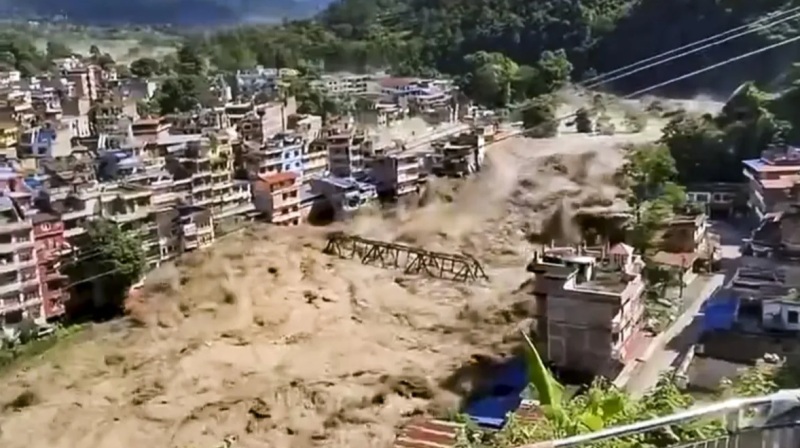
A tipping point occurs when a natural system hits a crucial threshold. Once crossed, the system enters an entirely new state. Feedback loops kick in, reinforcing the fundamental shift; in the case of Nepal and Tibet, a permanently transformed hydrological system and changes in mountain and valley stability.
The recent disastrous flooding swept away infrastructure, destroyed villages and fields, drowning hundreds of people and animals. This latest catastrophe was caused by a former glacier, melted into a glacial lake, bursting its banks, leading to flash floods as water poured into rivers and down valleys – hundreds of thousands of gallons of water pouring into populated areas.
Let’s recall the ecological tipping points that have already been reached:
- Melting glaciers: Across the Himalayas, Alaska and everywhere there are mountain glaciers, they are melting at a rate that permanently alters regional water systems. Ice is turning into freshwater lakes, and these are bursting beyond the limits of the former glaciers. Resulting floods rush down valleys and join rivers, causing them to burst their banks and trigger massive floods, as happened in Nepal. Then all that fresh water, for drinking, for agriculture, is lost to the sea. The mountains become unstable; land slips more frequent.
- Coral Reefs: Reefs have died because the oceans are hotter and more acidic. Many scientists say this was the first true tipping point – no way back.
- The Amazon Rainforest and Basin: Drought and wildfire seasons mean parts of the Amazon basin have become Savannah. The rainforest is losing its capacity to generate its own rainfall, so the Basin has gone from being a carbon sink, crucial for the world’s climate, into a net carbon source. Of course, these changes in nature are exacerbated by clearing for industrial agriculture and roads.
- Forest wildfires: Across Canada, Alaska, and Siberia, wildfires have burnt into the soil, thawing the permafrost and releasing massive amounts of methane and carbon dioxide into the atmosphere.
Which brings us to the big tipping point – the quantity of greenhouse gases in the atmosphere. The Intergovernmental Panel on Climate Change (IPCC) considers 450 ppm the absolute limit to keep warming under 2°C. Beyond 2°C, the risk of a “tipping cascade” escalates drastically. This is where one collapsing system (like melting Arctic ice) triggers another (like the shutdown of Atlantic ocean currents), locking in irreversible planetary warming. We are currently at 427ppm.
But despite physical alarms sounding so loud nobody can ignore them, only limited action is being taken to tackle climate change, simply tinkering around the edges. Many governments are actually abandoning their previous commitments to reduce emissions.
130 countries pledged to reach “Net Zero” emissions by the middle of the century, but the actions needed to achieve that goal are not being taken. Dozens of corporations made the same pledge, but nothing significant has changed. In the UK, the new Burnham government is preparing to extend North Sea oil drilling and prioritising energy-hungry data centres over local concerns.
This is a crisis of accountability, of democracy, of legitimacy, and it poses the question: what are governments for? What is the world economy for, if it cannot act on the biggest threat the planet has ever faced?
We already know it cannot deliver decent lives for the mass of ordinary people. So what is its purpose? And an even bigger question: why do we tolerate it?
Citizens do their best within the system. People, especially young people, have organised mass, even global, protests. And when direct action happens, suddenly the governments, supine in the face of climate disaster, swing into action, changing laws to criminalise protest. In Britain, since 2022, more than 2,000 climate activists have been charged and sentences as long as five years have been handed down. Charging activists as ‘terrorists’ is now the norm. According to Global Witness, at least 1,800 environmental activists have been killed or disappeared in Latin America and South America since 2012.
Citizens have also used the courts to force their governments to act. In KlimaSeniorinnen v. Switzerland, 2,500 Swiss women argued that extreme heatwaves threatened their health. As a result, the European Court of Human Rights issued a historic judgment that governments have a positive obligation under human rights law to protect citizens from the impacts of climate change, a ruling binding on 46 countries.
In the Netherlands, a group representing 900 Dutch citizens sued their government over weak emission targets. The Dutch Supreme Court ruled that the state had a legal “duty of care” to protect its people, forcing the government to shut down coal plants early, reduce speed limits, and invest billions in clean energy.
In Held v. State of Montana, 16 young people argued that a law banning agencies from considering greenhouse gas emissions when permitting projects violated their constitutional right to a “clean and healthful environment.” A state judge ruled in their favour, stating agencies should measure climate impacts when giving permissions.
Saúl Luciano Lliuya, a Peruvian farmer whose home is threatened by a melting glacier, sued the German power giant RWE for a proportional share (0.47%) of flood-defence costs. A German court established the ground-breaking precedent that major polluters can be held civilly liable for climate damages on the other side of the world.
So the idea that people are indifferent is simply not true. But whether by criminalising protest or ignoring court rulings, states and corporations are stubbornly staying on the same path. Nothing shows this more than permitting tech companies to build hundreds of plants to power and cool AI centres. They are pushing us to a whole system tipping point, where human society moves into a chaotic and irretrievable state, threatening civilisation.
Human society is a unified whole, made up of people, economic systems, modes of production, extraction of raw materials, financial systems, social functions like education, and, of course, looming large, politics and the state. And because of the expansion of industrialisation and large-scale agriculture, most of nature and the climate have been drawn into this human social nexus.
So can we solve the climate crisis using the very political and economic institutions that created it, whilst claiming to be acting on our behalf? Or do we need to reimagine the human-nature relationship and governance to transform our mode of living on earth?
Citizens are willing to take a lead, through protests and through the courts. But in the end, without state power, that is, the right to enforce the measures needed, the scoundrels will simply go on down their planet-wrecking route.
Because of the state’s hegemonic control over the lines of communication and information, climate change is presented in a way that makes it difficult to connect it to its root cause. Obviously, there is the Trumpist, rightist line of outright denial, but that is actually not as significant as the separation of climate crisis from the whole of human social and political life.
To answer my earlier question: what is the purpose of the capitalist system? It is, of course, the extraction of profit for owners and shareholders. And the purpose of states? To do everything possible, legal, illegal, ruthless, sneaky – to allow them to go on doing it.
So to avoid the tipping point of total climate and social chaos, which is threatening us, we need to wrest control from the existing system – challenge it, change it and replace it with a real democracy and a shared sustainable economy.
This requires the formation of a global democratic assembly, made up of representatives of regional and local assemblies, who will take power away from the climate wreckers. Assemblies are the method – protecting the planet and its eco-system is the goal.
Turning round the situation will not happen in a matter of years, even decades now. We have a long way to go to recreate an ecosystem that is liveable not just for humans but for all forms of life. But without this social and political transformation, the evidence clearly shows, we can’t even make a start.
Excellent analysis of the crisis facing us and those who come after us for generations possibly, if indeed the majority if humanity survives the coming decades. What is so stark is the inaction of and seeming/probable attitude of governments including the UK regime regarding this crisis encapsulated by your point that climate activism (as well as activism on behalf of Palestinians) has been re-characterised as terrorism with consequent extremely harsh sentences. It is absurd as well as cynical and cruel that peaceful people taking part in pacific protests against the inaction of our government are detained and treated as criminals when actual far right racist hooligans in balaclavas who caused actual damage and harm in Dover and again in Portsmouth, were allowed a free pass, the lack of any arrests giving them further impunity to torment asylum seekers and cause more anxiety to local people, except those who may agree with them I suppose. We’re on the brink of a really major tipping point and must not risk falling into it. Assemblies especially a global network would be a great thing to develop but will take time but we don’t have much of that left. Pressure has to be maintained.