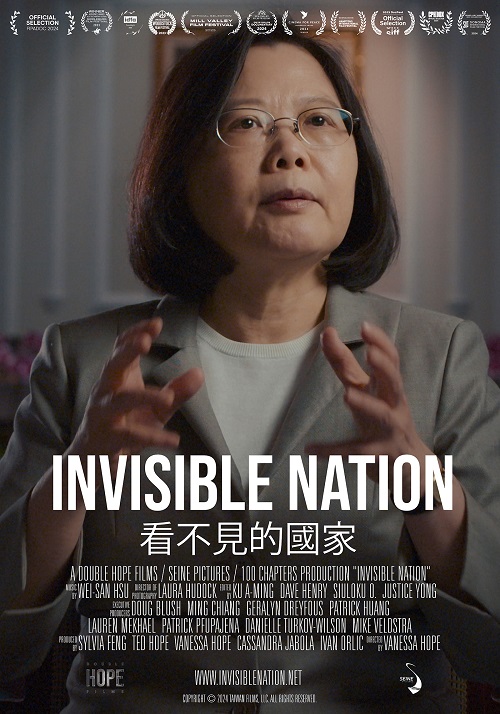
Vanessa Hope’s gripping documentary brings to startling life how Taiwan, a nation of 23 million souls, has struggled over the last three decades for democracy and self-determination. The release of her labour of love, Invisible Nation, comes at a time of huge global uncertainty and tension, including the possibility of nuclear war. Russia’s war against Ukraine is mirrored “in a glass darkly” by Chinese leader Xi Jinping’s menacing statements against Taiwan.
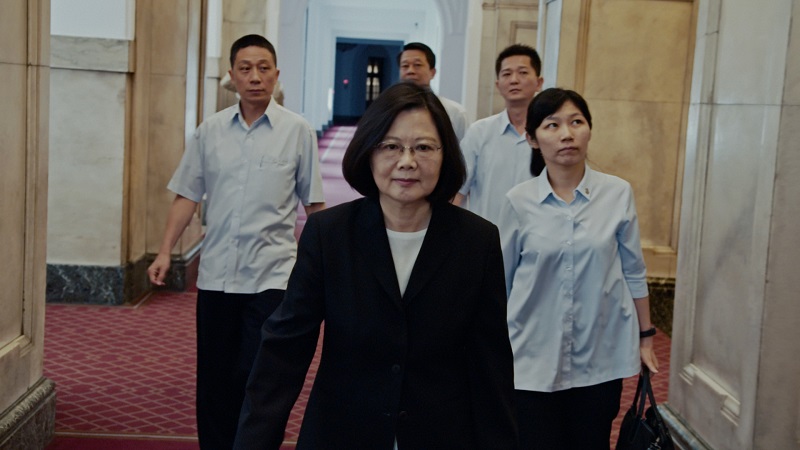
We meet Taiwan’s first female president, Tsai Ing-wen at home, wearing her usual unglamorous white shirt and navy suit, interrupted by her cat’s miaowing. Behind the modest exterior, we feel a calm but steely determination. It takes that to walk the political tightrope between “the colossal geopolitical forces of the US and China”, as Vanessa Hope writes in her director’s statement.
Hope, who first lived in Taiwan between 1995-6, tells the story through a mix of crowd footage, interviews and probing commentary. She recounts how her own perception of Taiwan’s relationship to China underwent a sea change, from opposing missile defence for the country to understanding the significance of Tsai’s election in 2016.

Early on, we meet Wu Pei-yi, who as a young student was oblivious to politics. But along with others at the National Taiwan University she was upset by police violence against protesters who opposed the banning of Taiwan’s name and flag during a visit from a Chinese mainland politician. Pei-yi ran for Democratic Progressive Party (DPP) Taipei city councillor and this year was elected to the Legislative Yuan, Taiwan’s parliament.
Taiwanese youth conflicts with the authorities drove the movement for democratic change which was then taken up by the DPP. Current vice-president Hsiao Bi-khim and ex-journalist and US Marine, Matt Pottinger, amongst others, provide insights into the 30-year transition from years of dictatorship to democratic elections – and today’s growing tensions.
There is remarkable footage of heavy metal rock star Freddy Lim, lead vocalist of Chthonic and Metal Clone X bands, playing to youth crowds. Lim’s own life illustrates the youth transformation during these years. Originally a supporter of unification with China, Lim helped to found the New Power Party in 2015 and entered the Yuan as a legislator. The politically committed punk rock band Fire X. also encouraged Taiwanese youth to fight for their rights and Taiwan’s status as an independent nation. They were leading members of the Sunflower student movement of 2014, which occupied the Yuan, to prevent a trade pact with China. Fascinatingly, the Sunflower movement followed close on the Ukrainian Maidan, the “Revolution of Dignity” in January-February that year.
We meet Audrey Tang, a transgender “anarchist minister from the future”, who was invited by Tsai to be first Minister for Digital Affairs in 2022 as Taiwan’s youngest ever minister. Tang, a child prodigy in programming was also the first non-binary Minister to serve in Taiwan’s top executive cabinet. Before that, she helped the Sunflower activists broadcast their message from the Yuan.

Flashback
In the years following World War II, Taiwan became the power base for Generalissimo Chiang Kai-shek, the Kuomingtang (KMT) leader who hoped to regain mainland China from Communist Party control. The United States supported, despite the “February Incident” of 1947, when the KMT murdered some 18,000 Taiwanese citizens. It was followed by the White Terror, during which around 3,000 more people were killed and 140,000 imprisoned, lasting until 1987. In the film, Kiku Chen Chu, the female head of the National Human Rights Commission, who spent nearly six years in gaol, takes us to the terrifying place where she and others were locked up after pro-democracy demonstrations in December 1979.
In the post-war years, the US supported Taiwan under the Kuomintag dictatorship as a bulwark against the Chinese revolution led by Mao Zedong. But by 1971, with Henry Kissinger’s visit to China in 1971, the US was keen to incorporate China into the global capitalist economy. Despite Taiwan being a poster child for democracy and economic prowess, with its advanced hi-tech economy which today makes 90% of the world’s advanced semi-conductors, it remains a political orphan. Taiwan’s struggle for recognition as an independent state is still opposed by all but 12 countries globally, including the US and the UK. It has no status within the United Nations.
In the last century Taiwan’s movement towards self-determination was part of the “springtime of nations” that broke out after the break-up of Stalinism in the Soviet Union and eastern Europe. New generations rejected the dogmas, shadows and horrors of the Cold War, and sought to break free from authoritarian rule, whether internally or on the Chinese mainland. And, in 1987 Taiwan’s president Chiang Ching-kuo (son of dictator Chiang Kai-shek) ended 38 years of martial law.
It’s only when you see this outstanding film that you realise how the extraordinary and inspirational transformation of a country under dictatorship over the past decades has been largely absent from the UK news media.
Invisible Nation is released at a burning moment, as authoritarian dictatorships take control in many countries, not least in the United States. It’s a must watch, especially at a time when global corporate streaming platforms are refusing to screen it, for fear of retribution from the Chinese state. As Xi Jinping ratchets up the threat to invade Taiwan, and China fires missiles into its territory, Invisible Nation provides indispensable evidence why it is essential to campaign for the self-determination of the Taiwanese nation.
INVISIBLE NATION is available to view in the UK and US from 6-9 December exclusively on GATHR
- Engaging with ‘messy realities’ in Ukraine and Taiwan by Brian Hioe