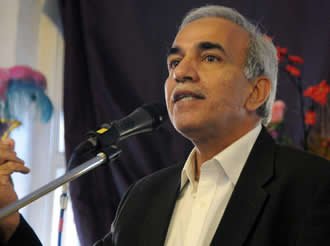
“The Inquisition ended centuries ago. Why do they want to revive it today? Are we retreating to such a terrifying degree?”
Renowned Iraqi poet Adnan al-Sayegh thought it was a prank when he received a call on April 1st telling him that his invitation to perform at a May festival in Jordan had been cancelled.
He had been invited back in March to the Third International House of Poetry Festival in Irbid, Jordan, designated the capital of Arab culture for 2022.
As one of Iraq’s most distinguished poets, al-Sayegh has participated in countless poetry festivals around the world for some 50 years. But this was a first for him.
On April 1st, festival organiser Sameer Qudaisat rang to say that the invitation was cancelled. Minutes earlier, Qudaisat had mailed one of al-Sayegh’s poems published 21 years earlier:
I’ll kick my socks toward the sky
In solidarity with those who don’t have shoes
And I’ll walk barefoot
Feeling the mud of the streets under my feet
Staring at the faces of the glutted inside their
Glass offices,
Oh… If human intestines were glass
So we could see how much they’ve stolen our bread
O Lord……. *
Then came the question: “Is this poem by you?”
Al-Sayegh replied: “Yes, of course. It was published more than two decades ago. What is wrong with it?”
“It is blasphemy. Therefore we are cancelling your invitation,” came the reply.

Adnan al-Sayegh: the incriminating evidence 
Adnan al-Sayegh: your invitation is cancelled
“I laughed”, al-Sayegh continues, “I thought he was joking. Because I know that the poem is not quite like that. Instead, it argues with the merchants of religion and tyrants who triumph over oppressed, starving and homeless people everywhere. For me, the cry of the oppressed is the essence of any religion and belief in the world.
“The strange and perplexing thing,” he continues, “is that I first published this same poem in my anthology To Cuddle My Exile, in Sweden and Beirut (2001), followed by editions in Cairo (2006), Baghdad (2015), Bahrain and Canada (2017). It also appeared in Jordan in 2004 and again in 2017 by the same publishing house and on some 200 websites all Arab countries.
“The book and the poem appeared in Jordan’s largest publishing house, and elsewhere, but the festival organizers do not appear to have noticed them. How can they invite a poet if they do not know anything about his or her poetry and ideas?


“Given that the poem has circulated throughout the Arab speaking world and I did not hear or find anyone who considered it blasphemous. My question is: have the festival organisers undertaken to be the guardians of religion too? Are they imams or are they poetry festival organisers?
“If they think in this way, they should write off the entire Arab and international poetic heritage. Our ancient and modern Arabic poetry contains countless interpretations and an even more daring freedom than what I wrote in this poem.
“Poetry, in its very nature, cries out for revolution and freedom. If they do not allow a poet to throw his socks off in protest against hunger and injustice, then why did they set up their festival and why did they invite him? Why then are they bothered by a sock being tossed into the air and not by the thousands of war missiles being launched into the sky to kill innocent people?
“When I realised that I was being cancelled I was astonished that it should come from poetry festival organisers and not from religious authorities. Given that poetry is based on interpretation and freedom, can there be a poet who confiscates the freedom of another poet or the freedom of a poem?
“The Inquisition was closed centuries ago. Why do they want to revive it today? Are we retreating to such a terrifying degree? This incident will not stop me and will not silence me. I will continue writing with the same spirit of freedom, until my last breath. This is not the first time that I have been exposed to such ‘inquisitions’, as I have faced many of them.
“Poetry for me has become resistance, rebellion and a revolution, as well as a cross to bear.
“In the past I have been displaced, hungry, chased and threatened from one country to another, carrying my papers, books, dreams, freedom and memories. But in poetry I always found a motherland, a refuge, a friend and a companion on my journeys.
“That is why I believe that the tyrants will not last … and the power of the word will remain – love.
“Terrorism and darkness will fail … and the light of the word will remain – love.
“ I also believe that:
People who don’t love, won’t read
People who don’t read, won’t look forward
People who don’t look forward, won’t develop
People who don’t develop, lag behind in rotting ignorance, hatred and war.”
Al-Sayegh insists that his poem does not offend any religion, belief, or anything sacred.
“It is not about any particular person, or dictator or country,” he says, “but a cry against all the injustices to which humans have been subjected in their long history. It is very simply about a poet who throws his socks to the sky in solidarity with those who do not have shoes. It is against the injustice, poverty and confiscation that every human being suffers from on this earth.”
What was the reaction amongst other poets due to participate in the festival?
“The unjust decision of the festival management provoked a lot of questioning and angry reactions in Jordan and in the city of Irbid, as well as in many Arab countries and abroad, from poets, writers, artists and readers. Social media abounded with thousands of protesting comments and responses.”
Many poets withdrew from the festival, announced this on their platforms. The list of honour includes: Marduk Alshami (Syria), Abdul Razzak Al-Rubaie (Iraq / Oman), Hanan Farfour (Lebanon), Fadel K. Jabr (USA / Iraq), Jumana Tarawneh (Jordan), and others. In addition, many other poets also showed solidarity. In a single day more than a thousand people denounced the cancellation.
And finally, how do you feel about the invasion of Ukraine?
“It is a huge disaster in every sense of the word! How does a person have the right to kill a human being, and how does a state have the right to confiscate, annihilate or rob a state. Are we in the law of the jungle? The world today at the height of its development and its aspiration for freedom and progress, and also at the height of its great cosmic challenges: the environment, diseases, pollution, terrorism, famine and others. So, here I conclude: the confiscation of the mind is similar to the confiscation of homelands or humans.”
* I’ll kick my socks to the sky by Adnan Al-Sayegh
Pages from the Biography of an Exile’ (English) translated by Stephen Watts and Marga Burgui-Artajo (United Kingdom, Arc, 2016) – Extracts from Carrying his Exile under his Arm, 2001).
Music by Janet Davey, Painting by Julie Held, 2022