In June, Peruvians voted by the narrowest of margins to reject the ultra-right Keiko Fujimori and instead elect as president Pedro Castillo, a teacher and union leader. Fujimori, whose father the former president, is in prison for corruption, has so far failed in her attempts to have the result overturned. Voters have taken to the streets to demand that Castillo is installed as president. Our correspondent Kassandra Guadalupano reports from Lima.
This was the third consecutive election that Keiko Fujimori contested and lost. She is the daughter of Alberto, the dictator who ruled Peru through the 90s with terrible social, economic and moral consequences including the normalisation of corruption and human rights violations by the state and private institutions.
But Keiko has committed crimes of her own, emulating her father in buying and controlling both the media and congressional representatives. Her base of support remains faithful as the Fujimoris are seen as politicians with “Mano Dura”, a firm hand for tough decisions and so only they could transform the country. This is based on a deception.
When they ruled the country, the Fujimoris would invest in cheap and poorly-built schools and hospitals so they would present their work as efficient and constant. This would be replicated by many other corrupt politicians in the 2000s with a motto called: They steal but they build stuff “Roba pero hace obra”. Public assets were sold cheaply to their associates along with the idea that malfunctioning state institutions needed to be further debilitated and replaced by private companies.

To understand the political situation in Peru today, it’s necessary to go back to 8 August 1990, when the authorities adopted drastic measures. Prices that had been artificially controlled up to that moment in an attempt to stop the high rate of inflation that Peru had experienced since the 80s, were allowed to rise.
That night, just before the announcement was made, my family (years before I was born) was returning from Lima to our native town. Back then, my father had been transporting rice for the new manager of a village mill. On the way, he was stopped by the police and forced to sell the merchandise he had received as a part of his payment at the new price that was to come into force the next day.
While he was still on the Pan-American Highway, there were spontaneous blockades of the road by people who weren’t sure how to respond to the new measures. They were no longer able to buy basic provisions, so they were attempting to demand answers from the government, as well as trying to buy provisions from the lorries and vans on the road.
My mother who was in the truck remembers that she and others threw money out of the window to pass through the blockades. Of course these intis (the currency at the time) were worth very little or nothing at all. Gas prices had risen from 21,000 to 675,000 intis, the dollar was now worth 265,000 intis and the prices for basic products were two or three times higher; the price of milk, for instance, had gone up from 120,000 to 330,000 intis.
I tell this story to illustrate why my household was strongly against Fujimorismo – the reactionary neo-liberal policies and the personality cult round president Alberto Fujimori – and to better expose episodes of our recent national history to indicate how our population has the tools and the ability to respond to the actions of our politicians.
Under the previous president General Velasco Alvarado, the state’s main function had become the promotion of private investment, mainly to large companies. This meant the implementation of policies totally in the interests of the big enterprises, led by the CONFIEP (a guild of the biggest corporations in Peru), both at a local level and, following the neoliberal instructions of the IMF and the World Bank, at an international level.
Starting from the 1990s, this country began to adopt neoliberal policies which would transform the worn-out precarity of the 1980s into a precarity that was celebrated and supported by the bourgeois state, first through a dictatorship and later on through the pseudo-democracy that accompanied a period of economic growth. This was sustained by a rise in mineral prices, the formation of oligopolies and the exploitation of workers through unfair contracts, based on and promoted by the constitution of 1993.
What I am suggesting here is that we live in a society that, although it has a tendency to tolerate oppression by corporations, still has the ability to react collectively to the most obvious and striking measures that the state makes against us. I’d like to emphasize that we, as a collective, have a certain level of class solidarity.
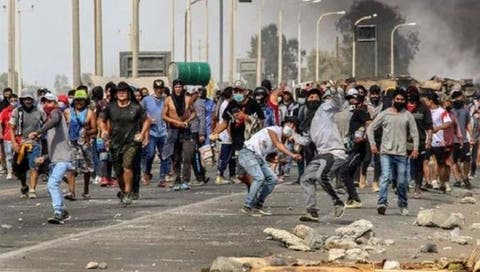
Nevertheless, the most important element which we still can’t count on, is general class consciousness, and we need to work on this. I’d like to point out that, although the blockades of the highways in the 90s and the strikes involving the community food services at the end of 2020 in Virú and Ica, were organised, this still wasn’t a full collective response of the whole working class.
We don’t see ourselves yet as a collective force that depends on our jobs to survive, unlike the dominating classes who can count on different ways of increasing their wealth at our expense. As a consequence, those of us who have been able to benefit from this growth don’t see others (who have also lived the same personal and family sacrifices) as our equals. So every time there’s a popular reaction to a measure of oppression, it is viewed as an isolated case; we don’t support it nor do we consider the depth of the legitimate demands. We ask instead for some reforms or superficial solutions.
The fragmented condition of civil society isn’t accidental. The economic growth we’ve experienced has helped a lot of families with better education and living conditions for their kids. But economic growth has also been based on unfair credits to business, universities that don’t provide the basic educational standards, mass media that spreads completely false information in order to protect the system and so on. In this context, legalised labour exploitation has played a fundamental role in the pursuit of economic growth, for example: the laws of precarious state hiring, outsourcing by private companies and the Ley de Promoción Agraria (Law of Agricultural promotion).
A few weeks before the agrarian strikes of Ica and Virú, when the highways to the South and North of Lima were blocked, the non-binary social investigator and anthropologist Ana Lucía Araujo Raurau presented her investigation under the title of Growth without development: the limits of the agro-industrial model as a path to well-being.
Araujo Raurau concluded that the growth of the agro-export sector, which has been rapid – it was one of the few that kept growing despite the pandemic – has served only to allow the concentration of ownership of land into fewer hands once again, and to increase the profits of just a few investors. And it encouraged the migration of indigenous and rural populations to places where work is seasonal, where there are hardly any unions, where access to health and housing is poor, and where salaries are way below what such a physically tedious job demands. The situation is particularly bad for women.
The cost of this growth and the movements of people to sustain it is subsidised by the money of all Peruvians; the contribution of this agricultural sector to healthcare is worth half of what the rest of the country pays (4.5% from the agrarian sector in comparison to 9% from the rest of Peruvians), and the agro-workers don’t even have access to the healthcare they actually need.
This sector counts on Seguro de Salud Agrario (SSA) (Agarian health insurance) which protects 200,000 workers under the shelter of Ley de Promoción Agraria.The SSA offers access to better medics and medical equipment. It also covers costly services such as cardiac transplants, kidney dialysis, and treatments against cancer. Nevertheless, it’s much less accessible than the Seguro Integral de Salud (SIS) insurance scheme.
This problem can be seen in Viru, in the north of the country. “The SSA scheme only has 2 premises for more than 36,000 agro-industrial workers and their families there, while SIS has 18 premises,” says Araujo Raurau. In addition to this, agriculture employs a quarter of the country’s employed, but makes up less than 9% of GDP. So this economic activity has the lowest productivity in the country.
In conclusion, the economic growth of this sector is based on very tough conditions. For the migrants who made the rapid growth of industrialised agro-export sector possible, there is no adequate health insurance, since they are forced to request SIS insurance, when in fact their employers should contribute and demand access to the SSA. Besides that, access to any insurance is difficult due to the seasonality and job instability which goes with the job. On the other hand, the state is in debt because the average annual contribution to the SSA scheme per capita is 751.76 against an expense of 726.78 soles while for the SSA the average annual contribution per capita is 198 against an expense of 513 soles.
This example shows us how the illusion of development keeps us apparently calm in spite of the various protests that have taken place in all of the regions of the country since the 1990s, which have caused deaths, injuries and disappearances. Media propaganda, concentrated in the hands of a few rich groups, works towards minimising the serious nature of conflicts. It normalises the low value of life under a capitalist system and accuses anyone who dares to demand her or his rights of being financed by international conspiracists bent on destabilising a sacrosanct and infallible economic system.
Just as in many other countries, we perceive a servile state that only favours rich power groups. There is a long list of tax cuts given to these groups, mostly large corporations that prefer to invest millions of soles in law firms to evade taxes, and a state that only cracks down on small and micro-businesses.
During the economic crisis caused by the pandemic, large corporations received credits that had almost no cost at all to them, and these corporations were under no obligation to pay back these credits. Nevertheless, these same corporations conducted massive layoffs or directly froze the payments of their employees, using laws drawn up by business associations, which were immediately accepted by the Peruvian government.
In conclusion, the economic development of the last 30 years in Peru has fulfilled the requirements of the capitalist system: it has widened the gaps of economic power, reinforced the concentration of property and the means of production, and has weakened state welfare structures by worsening the access to healthcare and education and other social services drastically.
The key is to understand the extent of this development that is now uniting forces of the working class with varying traditions of thought and political activism. And the key is to understand and spread the notion that this type of democracy is obsolete. It provides access to many things at the cost of the sacrificing the historically most vulnerable populations. It is not the right of the greatest beneficiaries of the system to say whether or not it is worth it, but rather of those who endure it at the cost of their lives and their future.
Let’s observe and apply the necessary measures to develop a new type of constitution; representative democracy is failing us and will continue to fail us. The people need to take control of their reality and understand that our work defines us, and this can and should be aimed towards establishing priorities that allow us to live with dignity. Shameless opinion makers incite fear against the left, threatening that our children will end up homeless, even though homelessness is already the reality of many brothers and sisters living in poverty.
Every day, more and more people live on the edge of financial and psychological breakdown, and the ecosystems can’t take it any longer. It’s time to check the real causes of the crisis that bears down on us and to accept that change won’t come from the “best” political projects nor the best-intentioned politicians.
Let’s lead the working class into government; let’s demand urgent measures to prevent us from dying of Covid from a lack of oxygen, or from needing to bribe medics, or being left unattended in illness, such as is happening now on a national scale. But let’s be aware that this step is not the final objective, but only the first step that should take us to a new social structure in which we all give our best and we provide those in need, as a community.
We need to re-establish our priorities: Citizen safety should be a collective effort. Let’s give power, and the tools, and financial support to feminist collectives, transgender sex workers, and let’s replicate peasant patrols (rondas campesinas) in urban areas. Let’s demand that the funds from bureaucratic ministries be transferred to Ollas Comunes (community food services) and cultural associations. Economic projects shouldn’t be prioritised as investments, but rather selected for the greatest and best impact on the community.
Therefore if we are to build a new pluri-national state the power must now lie in the collective action of the people and policy should only work towards the progress of people’s freedom.

We are called upon to overturn further the ideologies and precepts of neoliberalism that only work towards the concentration of power by the elites. Society as a whole should decide if it wants the state to be more or less involved, based on results and the work of a new participative citizenship.
Active citizens are determined by their involvement in the development of their particular fields of work and creation. It is through them that we could take democracy to action. As Karl Marx wrote: “…just as it is not religion that creates man but man who creates religion, so it is not the constitution that creates the people but the people which creates the constitution.” ( Critique of Hegel’s Philosophy of Right)
Citizen participation must become a regular practice in different fields way beyond electoral politics. And it is fundamental that the basis for a new constitution is a recognition of our colonial past and its consequences on the present. The constitution must be flexible and meet the requirements of the people but should always take into account where we come from and where we are headed towards.
We are facing fascists groups undermining the bourgeois democracy that we have had for some part of our 200 years of republican history. It is time that we the people claim what is rightfully ours, a true democracy, as it is through our labour that the destiny of our collectives subsists today and concentrating our efforts we shall thrive tomorrow.
Nobody should sleep! It is time to decide if we want to change our conditions and make way for new forms of dignified life!