Long ago, like countless other art lovers, artists and art history students, I trekked to Aix-en-Provence to experience Cezanne’s studio. We had been taught that the blue in his paintings was not imaginary but real. The light of Provence in his house had to be seen. Also, that in the canon of modern art history that he occupied pride of place as the creator of the single most important “turning point” in the transition from impressionism to 20th century modernism.
So many years later, how did it feel to see his works in Tate Modern? Can his place in the canon be reconciled with the widespread critique of the Modernist narrative as predominantly white, male, and Eurocentric? Is he even as good as they say?
Tate Modern’s glorious display confirms Cezanne as the vital disruptive connection between 19th century Impressionism and the transformations of the early 20th century. There are familiar treasures to be revisited and reassessed, new discoveries to be made, new interpretations, new revelations, new pleasures to be found.

One of them is the story of Cezanne’s monumental Scipio. US artist Ellen Gallagher, documents that Cezanne was close friends with a Puerto Rican artist called Francisco Oller who became an abolitionist exposing the iniquities of the cotton industry. She proposes that Cezanne saw photographic evidence of a beaten slave that was circulated during the Paris World Fair of 1867, the date of the Scipio canvas. She calls it “picturing beyond the object”, as Cezanne has conceived a body that “occupied multiple positions in time”.
Given that Scipio has travelled to London from Sao Paolo’s Museu de Arte in Brazil, seeing the original “in the flesh” is amazing and it proves Gallagher right. The strangely elongated back is larger than life. We do indeed “stand before the open wound” as the thick browns of the back intermingle with blood red streaks. His exhaustion is palpable. We already knew Cezanne was wracked by feelings of all kinds, but not that he was partisan about political controversies like enslavement.
Claude Monet owned this painting and held on to it for the all of his life.
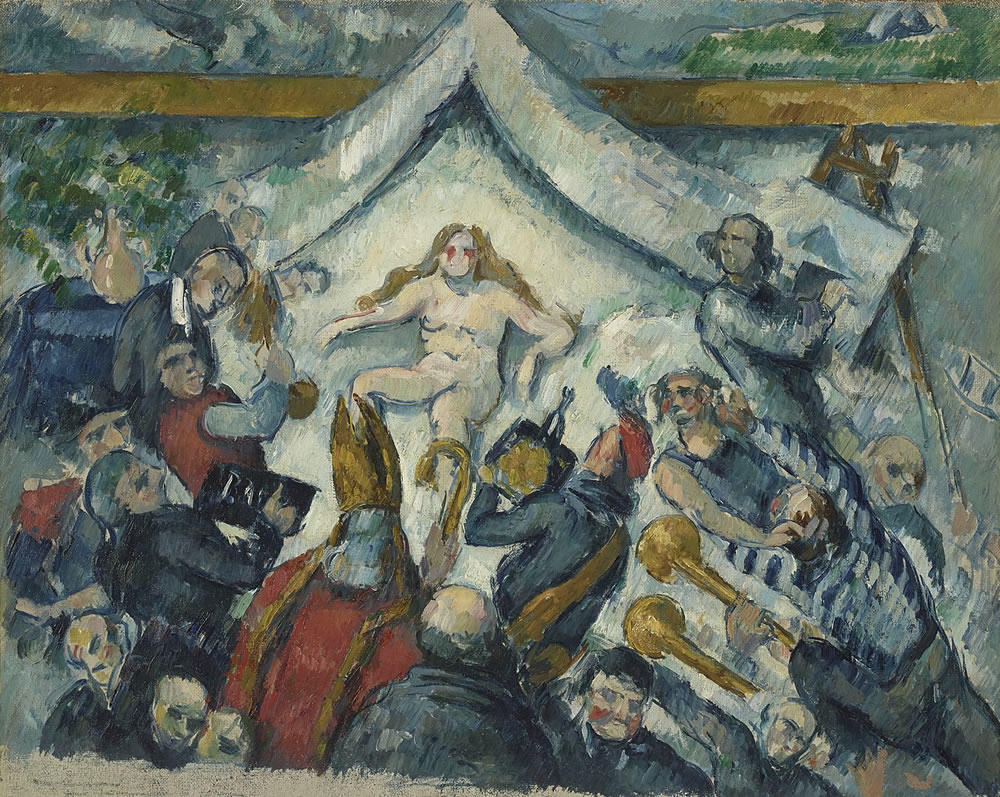
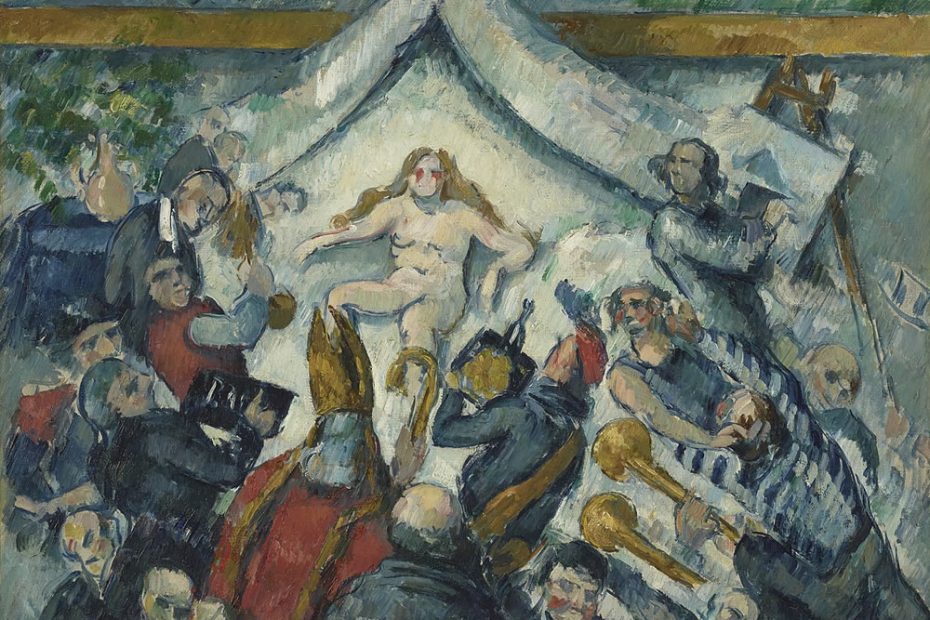
The repressed, awkward, sexually obsessive, tortured side of Cezanne is on display as never before. For example, the Eternal Feminine of 1877 is perhaps one of the weirdest paintings ever. A full frontal naked woman reclines surrounded by voyeuristic men – who represent the church, the state, the law and the art of painting. Cezanne’s bald head presides over the scene, while trumpets blast a fanfare.
Moving on through the exhibition, into the 1880s and 1890s, away from such congested, tortured emotion, laid on with thick oils, we eventually arrive at its opposite: a feeling of classical clarity, repose and grandeur. Cezanne is the Bach of painting. Emotion is transmuted into individual fugues, variations, lessons in looking, some modest, others symphonic and serene.
Cezanne did achieve his aim of making “something solid and enduring like the art of museums”. But he does this through a constant denial of the solid, as Etel Adnan has noted, tracing a connection between his examination of physical space to the discoveries in 20th century physics, as indeed did John Berger in writing about the Cubism that was to follow.
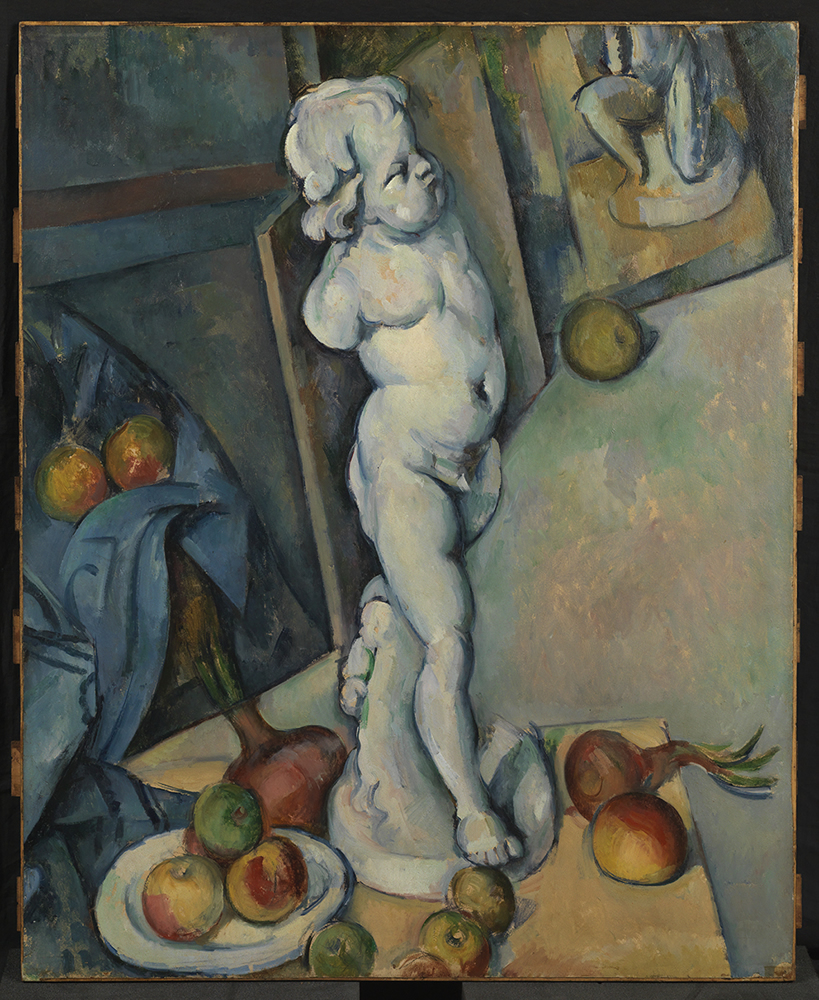
The apples and sprouting onions, the plaster cherub, the canvases all acquire their own life as they move around the smoky blue spaces, in a carefully observed and organised, disconcerting way. Just as you look at an apple, it starts to roll off the table; the horizontal table tips sideways; nothing is as it seems. The jug will tip over, the table cloth slips away. There is no centre to hold it together; everything is equally important, things and the sculpted air around them. But in the end, through a visual miracle and Cezanne’s endless patience, feeling, determination and observation, it all coheres. Seeing is believing.
Cezanne is at Tate Modern until 12 March 2023
Cezanne, exhibition book, paperback £32
By Achim Borchardt-Hume, Gloria Groome, Caitlin Haskell and Natalia Sidlina
See also From 40 francs to £150 million by artist Peter Clossick
I believe this painting to be an unknown Cezanne. It has a signature only seen in infrared on the upper left in charcoal C e z a nn E. The leaves formation are 3 dimensional. Brought to a Blue light, the bitumen or sheen shines green. I love for you to see it and give it a thought.
Pretty intricate for a Lemon. Also the demarcation line is very high and similar to Cezanne other still life
https://commons.wikimedia.org/wiki/File:Cezanne_Impressionist_Lemon_-_attributed.png