A new and curious sense of space/confinement permeates one of London’s exciting galleries for women’s art.
Two years ago, launching her small but perfectly formed space in London’s Marylebone, Angelica Jopling sought to create “an active locus for experimentation and cross-pollination rather than the more static space of a traditional gallery”.
“Long term”, she told Something Curated, “we strive to continue to build deep roots in communities of artists and attendees with Incubator, fomenting rich discourse, personal connectivity, collaborative performance, and, of course, new art”.
The Yellow Wallpaper, the Incubator’s current show, work all from this year, is a strong step in fulfilling this aim. Its theme is drawn from a late Victorian story by Charlotte Perkins Gilman about a young woman unravelling mentally after being confined to an attic space with flowered wallpaper. It was a supposed cure for post-partum depression.
Jopling has brought together a dozen women artists to explore a spectrum of interiorities and confinements. In scale, subject and style they reject the testosterone-charged art gigantism that shouts “look at me, I’m big and I’m great!”, so fashionable in today’s art world.
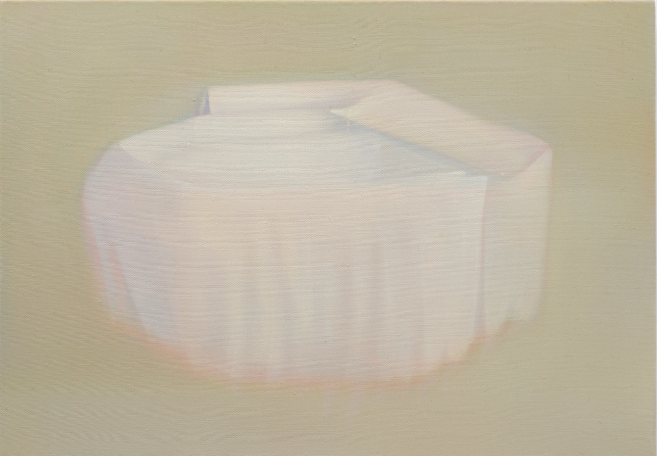
Their paintings and sculptures offer powerful evidence that small can be deeply thought provoking and (even!) beautiful. Not only that, but, through the most minimal of means, so much is said and unsaid, for example, in Mary Stephenson’s oil painting, Light Hours, in which a white enclosed form seems to fold and unfold with soft ethereal textures.
In these imaginaries, the interior is not a backdrop but a subject, as the Incubator’s notes explain. There is an entangling of outside and inside in Suzanne Clement’s haunting Self-reflection in a Mirror. Both self-portraits seem distorted as though in a reflection, and the mirror itself is muddy and blurred.

In Lorena Levi’s A Mother’s, a possible mother is squeezed to the edge of the hardwood ply surface, while five boyish faces, four children and a young man, stare out at us. There’s a sense of mystery as each person is in their own world, not relating to the others, or the apparent mother figure.

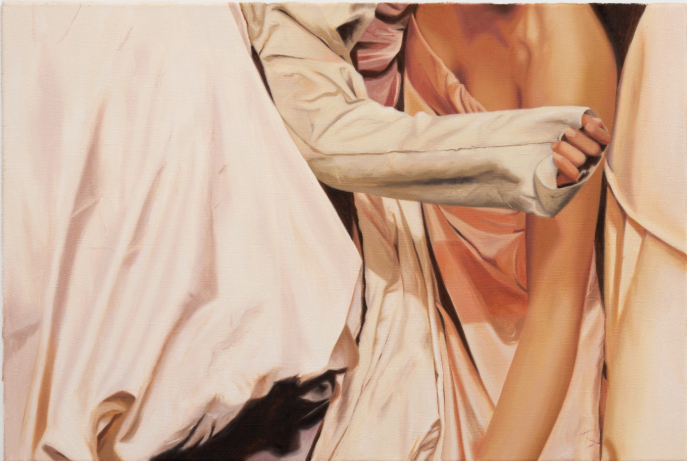
Perhaps most striking are Florence Reekie’s three paintings in monochromatic shades of white: photorealist, mysterious and disturbing. In Eat your heart Out you recognise a bare shoulder, an arm, possible bodies draped in heavy sheets. A hand in a sleeve reaches out as though from a straitjacket.
All twelve artists, selected from the Incubator stable and the nomadic feminist MAMA platform, explore interior worlds in a thrilling way. All the work has a unifying, inner, reflective quality, a calm confidence that encourages slow looking and meditation.
Writing about The Enchanted Interior, a 2019 exhibition at Newcastle’s Laing Art Gallery, architectural theorist Emma Cheatle also referenced Gilman’s shocking story as a telling starting point. For Gilman’s heroine, her surrounding space was oppressive but simultaneously a place for hiding and imagining, isolated in her attic room by her well-meaning but dictatorial husband and doctor.
Jopling sees this display as following in the lineage of 1970s feminist artists Judy Chicago and Miriam Schapiro. They created the Woman House art installation and performance space in Los Angeles, in a struggle to free themselves from the constrictions of the male-dominated art world of their time. With this show we have come a long way from that protest.
The Yellow Wallpaper at INCUBATOR features Kesewa Aboah, Shanti Bell, Suzanne Clements, Fleur Dempsey, Xingxin Hu, Lorena Levi, Florence Reekie, Anna Rocke, Mary Stephenson, Elinor Stanley and Maayan Sophia Weisstub.
It runs at the Incubator, 2 Chiltern Street London W1U 7PR until 3 August 2025