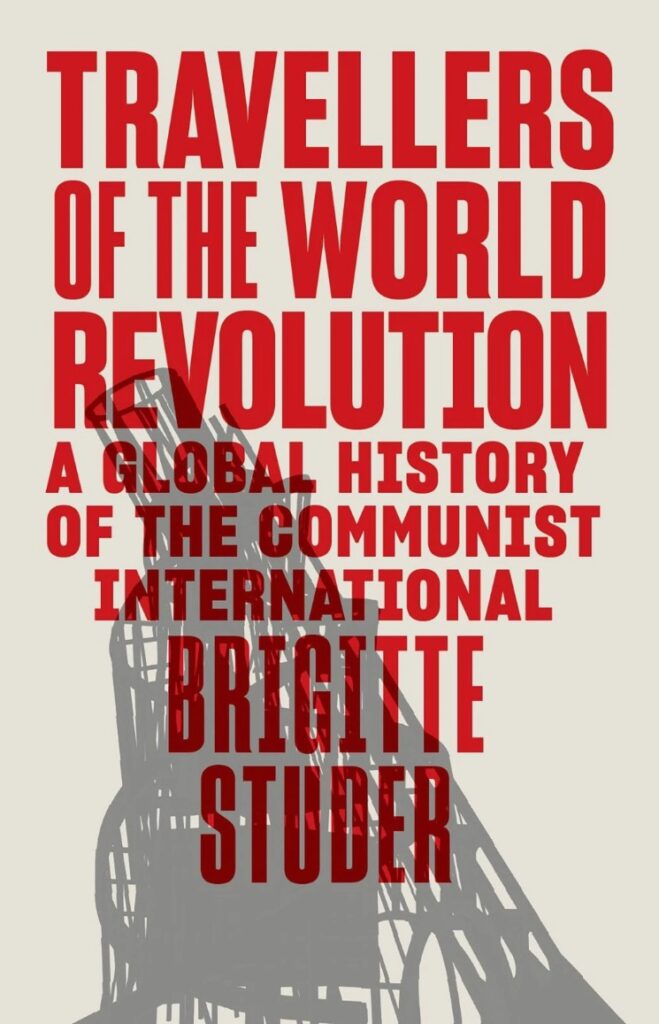
The Communist International was a huge, complex and contradictory organisation lasting around a quarter of a century. One of the greatest historical experiments of modern times, its activities continue to reverberate into the twenty-first century. Brigitte Studer’s remarkable Travellers of the World Revolution introduces us to half a dozen revolutionaries drawn to Moscow in the summer of 1920 from around the world. Their purpose? To take part in the Second World Congress of the Communist International, which soon became known as the Comintern. Its first three Congresses took place during the devastating Russian Civil War. It was a moment, Lenin wrote, “when the fate of the revolution was being decided”.
Studer highlights “the world-spanning aspect of a unique political experiment: the attempt to change the future for the better through systematic, coordinated and rationally conceived action on a global scale”. (xii) Lenin and Trotsky, co-leaders of the Russian revolution in October 1917, were adamant that socialism could not be achieved in Russia without corresponding revolutions elsewhere, especially in the advanced capitalist countries. Their aim, and that of fellow revolutionaries who founded the Comintern, was nothing less than promoting world revolution.
The revolutionary flood that swept through and far beyond Europe inspired by 1917, was driven by the working classes. But, at the same time, “hitherto politically and socially marginalised forces also entered on the stage, notably women and young people”. (5) Drawing on a huge number of sources, Studer portrays the ‘life-courses’ of her subjects, an expression that emphasises her focus on their constantly transforming lives as they move through time and space.
She adopts a practice-centred, ‘situated action’ approach in her truly epic account of the individuals who peopled the Comintern, often constructed with day-to-day details. These she interprets through a twenty-first-century feminist, anti-Eurocentric lens, acknowledging the influence of theorists such as Pierre Bourdieu and Reinhart Koselleck. Her approach is “contextual, with individual’s conduct explained in terms of the cultural practices prevailing in the milieu”. (19)
The book’s 320 dramatis personae are a small fraction of the 30,000 people who worked for the Comintern from the 1920s onwards. (16) The story focuses on “two dozen key individuals whose transnational careers traverse the historical space and time of the Comintern, and whose paths repeatedly cross at different places in the world”. (17)
Its broad sweep begins with the revolutionary moment of 1920. Two hundred and twenty delegates attended the 2nd Congress in Moscow over July and August. Two months later, some 1,900 participants travelled to the Congress of the Peoples of the East in Baku, Azerbaijan. Dramatic photos of delegates appear in the book. They include Hilde Kramer, Evelyn Roy and Turkish feminists Najiye, the 19-year-old Khaver Shabanova-Karayeva and Bibinur from Turkestan.
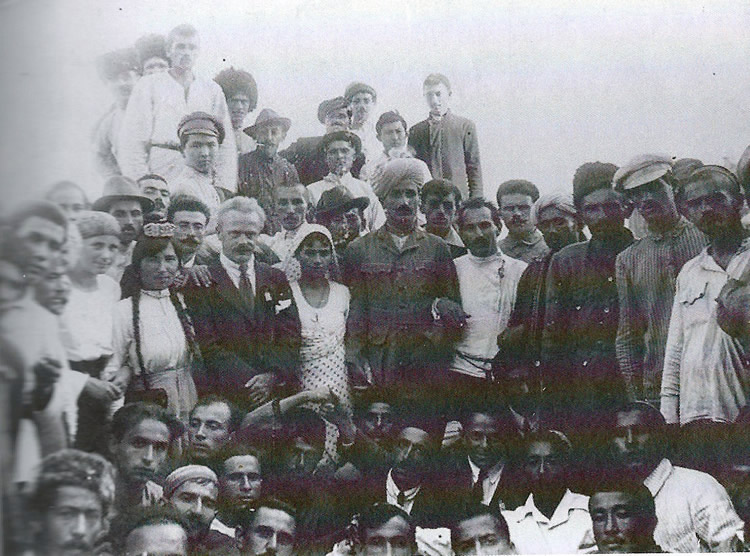
Women made up just over one tenth of the delegates to the 2nd congress, despite the Comintern’s “professed belief in women’s emancipation”. Comintern historian John Riddell records that the proposal to elect women to the presiding committee aroused some strong objections. It was an early example of ‘affirmative action’. Whilst women were in a tiny minority, they are often at the very centre of events as translators and record-takers as well as partners of leading male figures. Thus, they played vital, if unrecognised roles throughout the Comintern’s history.
Many ‘travellers’, of whatever sex, were multi-talented polyglots, particularly Jewish revolutionaries from the former Czarist empire, Germany and Asians such as Manabendra Nath Roy (six languages beyond his native Bengali) and Ho Chi Minh (at least six). Apart from personalities like M.N. Roy, John Reed, Tina Modotti and Willi Münzenberg, many participants are not widely known.

Studer’s story opens with Hilde Kramer, who arrived in Moscow to work as a German-English translator and assistant to Karl Radek. Kramer looks out at us from her passport photo, unearthed by Studer from her personal file in the Russian Archive of Socio-Political History. Aged just 18, she had already played a central role in the Bavarian Soviet republic of 1919. (41). She was not the only fugitive from that short-lived ‘Red Republic’. A Russian from the Odessa region, Alexander Abramovich, member of the Munich Soviet government, become an early Comintern instructor in Berlin. Through frequently quoted memoirs, we meet Rosa Meyer-Leviné. Rosa (né Broido, the twelfth child of a rabbi from eastern Poland) was the widow of Eugen Leviné, the executed leader of the Bavarian Soviet.
We also meet the extraordinary Louise Geissler, who aged only 17, joined the Independent Social Democratic Party of Germany. She became a member of the Spartacist League before going on to work for the Bavarian Soviet Republic’s Action Committee. Arrested on 4 May 1919, she was deported to Switzerland, due to being married to a Swiss citizen. After working in ten countries between 1920 and 1926, she rejoined the Moscow Comintern, becoming the partner of a key leader, Indian revolutionary M.N. Roy. (165-166)
Studer’s account of Berlin as “a hub of transnational circulation” brings to life the astonishing Jakov Reich (aka Comrade Thomas). Reich headed the Western European Secretariat of the Comintern. Like the more famous Karl Radek, he was born in Lemberg, Galicia (today’s Lviv). He spoke Polish, Russian, English, French and German. Amongst his responsibilities was distributing huge quantities of cash, gold and diamonds to finance multi-lingual editions of the Comintern newspaper and organising collaborators.
Integral to Comrade Thomas (aka Reich)’s network was the German Münzenberg, a brilliant propagandist and organiser of the huge media consortium that published, amongst other magazines, Inprekorr in some eight languages. Its staff included German, Hungarian, Austrian, English, Luxembourgian, French and Swedish nationals.
Working in Reich’s by now illegal Berlin bureau was Fanny Jezierska, an engineer by profession. She had assisted Rosa Luxemburg as well as Radek, later becoming a liaison officer between the Communists and Socialists in Italy, where she met with Antonio Gramsci and Jules Humbert-Droz. Droz was a founding member of the Swiss Communist Party and elected Comintern secretary on Lenin’s proposal in 1921.
In 1925 Comrade Thomas was summoned to Moscow and dismissed from all his responsibilities by the Comintern’s Executive Committee, in a clear sign of the wind of change. Reich was an early sympathiser of Trotsky’s viewpoint. During 1923-24, the Left Opposition to Stalin’s policies openly attacked the Party leadership for lack of internal party democracy. Left Oppositionist and Comintern executive member Radek was stripped of all his roles by 1924. Stalin’s policy of ‘socialism in one country’ was now reversing the original international thrust of the Bolsheviks. (140)
Studer meticulously documents the rise and fall of talented, hardworking personal like Reich and many others to come. What remains in the shadows, however, is what they thought about those who openly defied the counter-revolutionary policies handed down from the Moscow centre, for example those who signed the Declaration of the 46 in October 1923, and the United Opposition of 1926.
This is not surprising, considering that after Lenin’s death in early 1924, openly voicing opposition would mean demotion, dismissal and worse to come. Recording doubts, let alone committing them to paper would be to end one’s career or even, not many years later, one’s very life. To answer such questions and others, as Studer notes, “we can only await the opening of the KGB archives.” (440)
In China, “the new epicentre of the world revolution” (204), “there might have been up to a hundred or so present at any one time, even more if one includes military personnel”. (243) It is a tragic story from beginning to end in which M.N. Roy and Mikhail Borodin as political organisers and Münzenberg, as publicist played key roles. Münzenberg rallied huge international sympathy with Chinese anti-colonial struggles. He was never a hand-raiser and often worked in opposition to the Comintern leadership. (233)
Meanwhile, Roy and Borodin, neither of whom spoke Chinese, were at political loggerheads. In April 1927, the very moment that Nationalist leader of the Guomindang Chiang Kai-shek massacred his former Communist allies in Shanghai, Moscow was still doing its utmost to maintain its united front with the Guomindang. Some 300,000 people were to die during Kai-Shek’s White Terror.
Stalin blamed Borodin, Roy and the Chinese party. (266) By 22 June, Roy was removed from his post. He was succeeded by Heinz Neumann. More reckless adventures and terrible defeats were to follow. Trotsky, by now expelled from the Politburo, had argued that Communists should leave the Guomindang, but Stalin “could hardly admit that his great opponent had been right”. (258) Shanghai become a dangerous place for foreign Communists, as international (including British) police operations against Communist activists in Asia led to countless arrests.
The Comintern’s ‘Third Period’ line was adopted in 1928, whereby social democracy and opponents of the Comintern line were declared a greater enemy than the Nazis. This prevented a united front between the German Communist and Socialist parties against Hitler. Totally unprepared, “the most powerful Communist Party outside the Soviet Union collapsed like a house of cards”. (321)
Just days before Hitler came to power, Münzenberg had requested that his organisation, Workers International Relief, be moved from Germany to the Netherlands but was instructed he should wait for the Nazis to ban it (323). He escaped arrest only thanks to the quick action of his partner, Babette Gross, another one of Studer’s chief protagonists, and the help of Martin Buber, the Jewish religious thinker. (324)
Münzenberg worked tirelessly to support Republican Spain, in what Studer titles ‘The Last Big Mission’. But he was removed from all his functions by the Comintern and expelled by 1939, continuing his anti-fascist work independently. He was found dead in October 1940. It is still unknown if he was killed by Stalin’s agents or the Gestapo.
We also meet Baku-born, German-Russian Richard Sorge who worked in Shanghai for Soviet military intelligence in 1929-30. (304) Sorge was a talented journalist and extraordinarily daring spy. Outside Studer’s frame of reference, he is symbolic of how despite warnings, Stalin denounced the work of his own intelligence operators. Sorge was later arrested and tortured by the Japanese and hung in 1944, after Stalin refused to intervene.
Babette Gross, Münzenberg, Babette’s sister Margarete Buber-Neuman and Margarete’s husband Heinz Neumann travelled to Moscow for the Seventh World Congress of the Comintern in the summer of 1935. It was an increasingly dark time. After the fiascos in China and Germany, there was “an atmosphere of mutual distrust”. As Hungarian writer, Ervin Sinkó “and many other foreign party members discovered with astonishment and horror”, Pravda was now campaigning against the rights of Soviet women to abortion. (366)
Neumann had been a die-hard supporter of Stalin but both he and Margarete did not escape arrest by Stalin’s police. He was executed in 1937 while Margarete was sent to a gulag. She was only one of the 2,800 people (70%) of German Communist Party (KPD) members in the Soviet Union arrested handed over to the Nazis in 1940 in the wake of the Stalin-Hitler pact. There was no official revision of the Comintern’s analysis that “the KPD had not suffered defeat”. (375)
In the chapter on the Spanish Republic, Studer examines the logistical networks created and sustained by the Comintern. Her account of the personal biographies of female Comintern operatives in Spain including Italian photographer Tina Modotti’s role in International Red Aid will no doubt stimulate further research.
It becomes difficult to unravel how, alongside genuine sacrifices for the Republican cause, there was a parallel reality. Leading members of the 2,000–3,000 Soviet personnel in Spain were die-hard enforcers and intelligence operatives whose mission was to crush all revolutionary strivings, especially by Spanish anarchists, the POUM and Trotskyists. Stalin unilaterally dissolved the Comintern on 15 May 1943.
With hindsight it is easy to suggest that Studer’s ‘travellers’ should have seen the writing on the wall, certainly after Hitler came to power. In response, she notes that the Comintern was more than the sum of its parts, with “a great sense of group cohesion” and “a way of living the world”. (451) Breaking such ties was too difficult for the majority. Her ground-breaking book deserves study and discussion. It poses political and philosophical challenges that cannot be ignored in our present era. Hopefully Verso will create a new paperback edition, including a chronology and key to the many abbreviations and acronyms to make this possible.
First published by Marx & Philosophy Review of Books
Verso Books, London, 2023. 496 pp., £30 hardback ISBN 9781839768019
See also: Revolutionary tales from the Hotel Lux – Maurice Casey has woven the life of Irish woman May O’Callaghan and her web of relationships into a thrilling and moving tale of life in revolutionary Russia and beyond.