
“Mr Putin, the president of the Russian Federation, repeatedly claims that the Ukrainian nation does not exist, that Ukrainian culture never existed. So, we are showing Ukrainian culture,” curator Konstantin Akinsha stated defiantly, introducing In the Eye of the Storm at London’s Royal Academy.
“We have called this show Modernism in Ukraine, not Ukrainian Modernism. We are not using national labels,” he said, adding: “This is not a normal exhibition. It’s a chance to experience the work of artists who lent their talents to the development of Ukrainian art, even those who may only have spent a short time there.”
It was a point enhanced by co-curator Katia Denysova who said that the multicultural aspect of Ukrainian art was crucial. “We want to explore Ukraine as a space for inter-cultural exchange,” she said.
Olena Kashuba-Volvach of Ukraine’s National Art Museum explained that “it has been an extremely testing and difficult time as hundreds of cultural monuments are being destroyed”. The bulk of the 65 works at the RA are drawn from her museum along with the Museum of Theatre, Music and Cinema of Ukraine in Kyiv, which came under bombardment in 2022.
Kashuba-Volvach, Akinsha and Denysova joined with other art historians to research and assemble artworks that have been touring Europe since the exhibition opened at Madrid’s Museo Nacional Thyssen-Bornemisza in November 2022. It’s a way of keeping them out of harm’s way as missiles continue to rain down on Kyiv and other Ukrainian cities.
There are “uncanny parallels between today’s Ukraine and the period covered by this show”, Denysova said: “Then it was a fight against Russian imperialism. Today we are doing the same. We lost a whole generation and again today we are losing our most talented people.”
The show’s title evokes the harsh circumstances that gave rise to the Modernist movement in Ukraine in the first decades of the 20th century – not to mention present events.
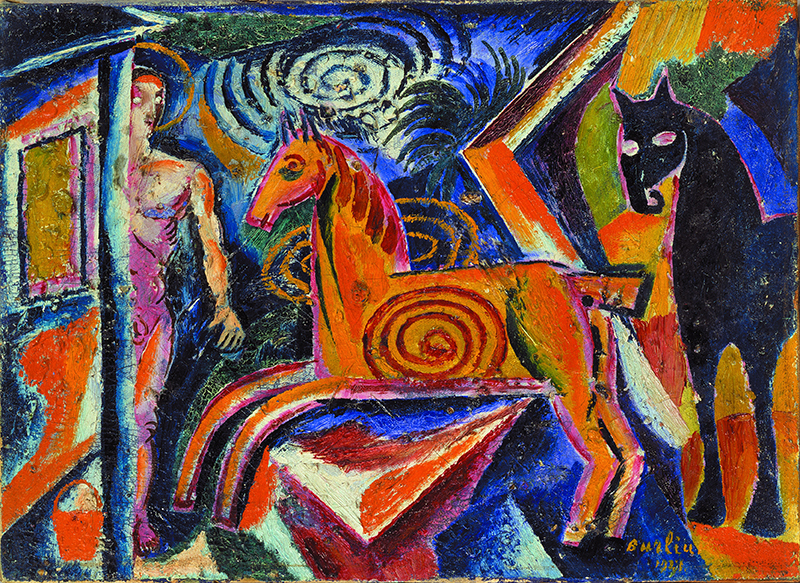
But there is no gloom or sadness in the first space with its deep turquoise-blue walls. Instead, we discover rich colours and spatial explorations by outstanding female Modernists, Alexandra Exter and Sonia Delaunay full of delight, wonder and movement, also to be found in male counterparts such as Davyd Burliuk with his Carousel of 1921.
Exter’s Bridge, Sevres (1912) is a Cubo-Futurist landscape, revealing her close study of art movements in Paris, then a melting pot for transformations in art. It’s a step change from her early Three Female Figures (1909-10), so reminiscent of the Munich Blaue Reiter group. Exter, like so many of her contemporaries, travelled to Western Europe to experience avant garde movements.
Some travelled for artistic inspiration and attend art schools, which were not allowed in Ukraine at that time. For others there could be the additional reason that in the Russian Empire under the rule of the Tsars, professional art education was denied to people of Jewish heritage.
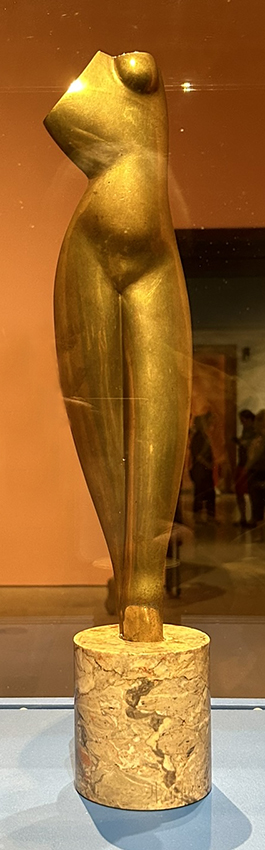
The pointed arches at the heart of Exter’s painting reappear in her abstract Composition (Genoa) 1912. They are echoed by a brilliant design feature separating the first gallery from the second, where a super-elegant bronze sculpture by Alexander Archipenko is mounted on a plinth.
The 1905 revolution in the Russian Empire led to lifting of the prohibition on Ukrainian-language publications and the language was recognised. It took the November 1917 for the first ever Ukrainian institution of higher art learning to open in Kyiv.
But already before that, Ukrainian artists had broken the grip of academic art styles. Together with Alexander Bohomazov, Exter organised the Kiltse (Ring) group in 1914, gathering together young artists in Kyiv.
Outstanding amongst the exponents of Ukrainian Cubo-Futurism is Anatol Petrytskyi. His Constructivist Composition of 1923 has a dynamic flow, with alternating shiny and rough textures. The curved dark red swathe calls to mind a scythe or perhaps a banner.
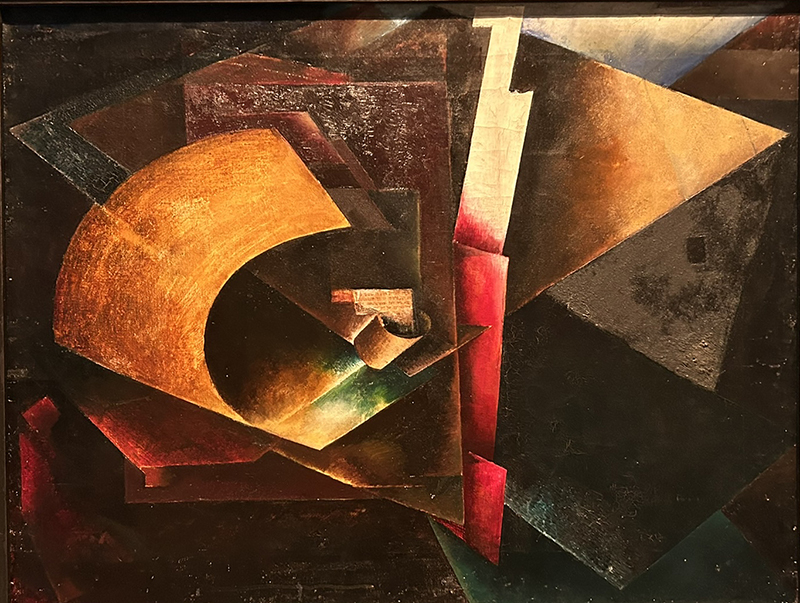
Among the many poignant images is El Lissitsky’s Composition (1918-1920s). Painted in rich, shadowy browns and umbers, it has a mysterious layering of spatial elements, bisected by a white and red bolt of lightning. It flashes down, nearly grazing a tiny piece of paper with a mysterious bit of Yiddish script, pasted onto the canvas.
El Lissitsky was a member of the Kultur Lige, the Jewish Cultural League, formed in January 1918 just as the first independent state of Ukraine was proclaimed. The Lige sought to promote a modern Jewish-Yiddish secular and democratic culture. Sarah Shor, another member of the Lige, shares Lissitsky’s intense sense of hermetic and secretive space, as your eye is drawn in and out of the canvas.
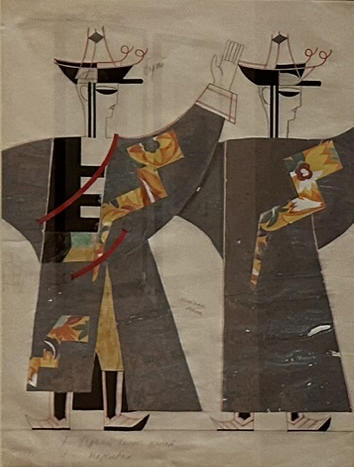
Designs for theatre, ballet and opera by Petrytstkyi, Exter, Vadym Mellor, Oleksandr Khvostenko-Khostov adorn the second gallery. As in Russia and elsewhere, Modernist ideals embraced all aspects of art and life, including book design, embroidery, clothing, architecture and even chess club murals. Drawings by Vasyl Yermilov for the Chess Room of the Central Army Club in Kharkiv (1920) hang near his journal cover design for Avanhard (Avant-garde) of 1929.
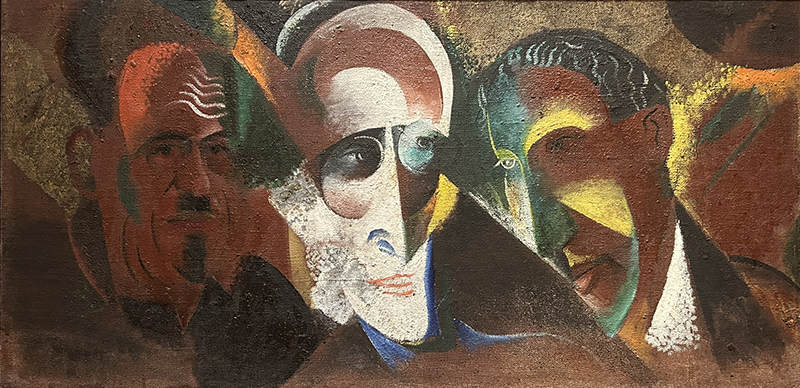
Moving through the 1920s, some works bear witness to the anguish suffered by so many Ukrainians. Viktor Palmov’s Group Portrait (1920-21) is also in a Cubism idiom, but instead of a still life with a bottle or a guitar we are presented with three haunting faces. Petrytskyi’s austere monochrome, At the Table (1926), is dominated by a huge radiator and an empty table, with only the back of a woman’s head as a sign of life.
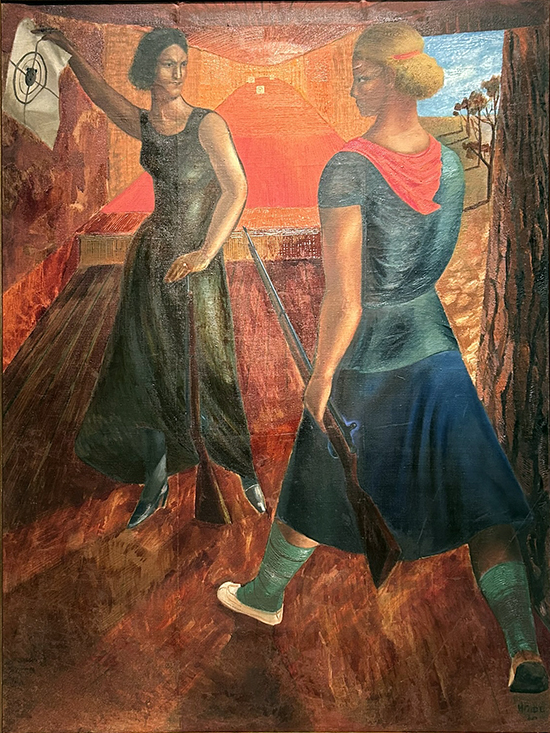
In the final gallery, colour breaks out again in Viktor Syrotenko’s Rest (1927) and Semen Yoffe’s surreal At the Shooting Gallery of 1932 with two powerful women doing target practice. We can only guess at hidden meanings.
This was the moment when Stalin’s edict declared Socialist Realism as the only acceptable art form in the Soviet space. Many of those who tried to keep the Modernist spirit alive were arrested and executed between 1937 and 1938. Their work was removed from public view and consigned to the Spetsfond, the Special Secret Holding archive or even destroyed as Yuliia Lytvynets writes in her gripping essay in the exhibition book. Being allocated to the spetsfond “eventually saved them from destruction… [they] remained intact in the Museum’s vaults to be discovered by future generations of curators and art historians”.
We are immensely privileged to see these works. I have only mentioned a few names and there are many more astonishing works. Don’t miss this historic opportunity.
~ ~ ~
In the Eye of the Storm: Modernism in Ukraine 1900-1930s is at the Royal Academy until 13 October 2024
The historical background
The exhibition is arranged to showcase three time-frames:
- from 1900, when Ukraine was within the Russian empire ruled by the Tsars
- 1918 – 1919 saw the formation of a single Ukrainian state
- From 1922 when the Ukrainian Socialist Soviet Republic became a founding member of the Soviet Union.
To help visitors understand the contemporary backdrop there are a chronology, wall panels and audio commentary. The exhibition book is published by Thames and Hudson with £5 from every copy going to the National Art Museum of Ukraine.
A concise historical introduction by John-Paul Himka can be found in Ukraine: Voices of Resistance and Solidarity, published by Resistance Books and Ukraine Solidarity Campaign