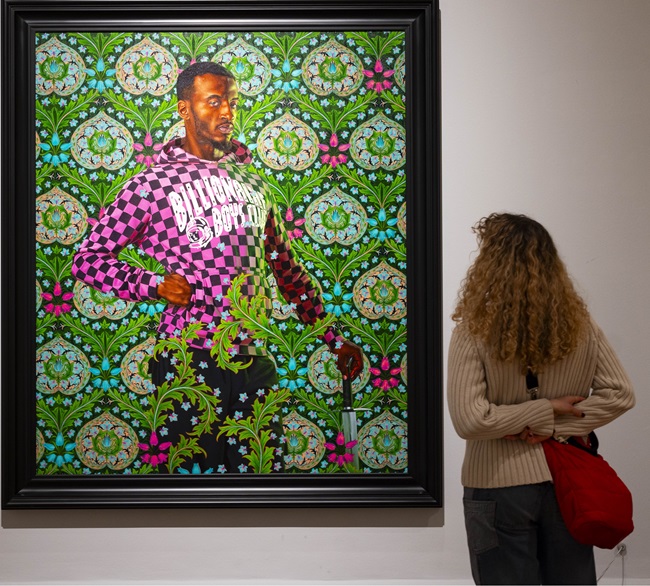
The team of woman curators who conceived Entangled Pasts had a sweeping ambition. They wanted to represent, and reflect on, the complexities and contradictions of the Royal Academy itself and its relationship with enslavement.
Not surprisingly the Academy was an integral part of the ruling class establishment in Georgian Britain. Benefitting from the slave trade was, as the exhibition makes clear, part and parcel of the culture. But, contradictorily, many artists, Reynolds and Turner amongst them, were part of a network with anti-slavery leanings.
Entangled Pasts is a complex and rich gathering of artists from the 18th century right up unto the present, presenting them from a historic, social, political and aesthetic perspective. It does this through the creations of outstanding painters, sculptors, video makers as well as writers and poets, which is no small challenge.
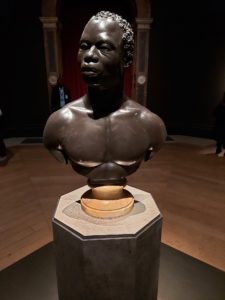
The opener in Academy’s classic rotunda is powerful. Hauntingly displayed and lit in a velvety dark chocolate space, Francis Harwood’s Bust of a Man stands defiantly alone. It is carved in gleaming black pietra di paragone, (meaning touchstone, which was used to test precious metals). He is uncompromisingly Black and feels like our contemporary. Set on a golden-toned base recalling busts of Roman emperors, it was made by Harwood, a little-known British sculptor, in Florence. It is thought to be one of the earliest post-antiquity sculptures of an African person.
This nameless individual is surrounded by dramatic portraits of other Black men by Reynolds, Gainsborough, Copley and Kerry James Marshall. We are accustomed to seeing such depictions as exceptions, lost amongst the legions of white 18th century “good and great”, their wives and children. But here we discover that some of Britain’s most famous portraitists, who we usually associate with white military men and colonial rulers, also captured the faces and indeed the intellects and beauty of freed slaves. Men like Samuel Johnson’s close friend Frances Barber and Ignatius Sancho are painted not as subordinates but as inspirational intellectuals and pro-freedom campaigners.
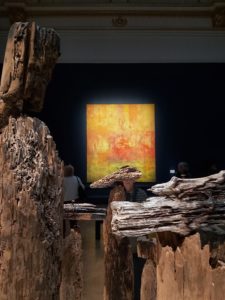
El Anatsui: Akua’s Surviving Children, 1996
Found wood and metal
One can take issue with curator Dorothy Price’s statement in the exhibition book that “everyone living in Georgian and Victorian Britain was implicated in enslavement and empire, whether actively or passively.” There were those who were not involved in slavery nor did they benefit from it. And there were others who actively worked to end it, as indeed the explanatory texts reveal.
Viewing history through the spectacles of colour rightly foregrounds those who have been kept in the shadows, whose lives and deaths were bought and sold. But at the same time as the ruling classes of Britain profited from enslaved peoples, they also brutalised working class people, including children. The British Empire, and the East India Company in particular, was based on the capitalist exploitation of all labour, not only that of Black people. But these are questions that the presentation encourages people to reflect on and discuss and that is its great merit.
There’s a steep admission price – now shockingly the average for major London shows – but it’s worth making a day of it, taking a break in the middle. It’s a moving and inspirational offering on so many levels. Take the time to reflect on Empire, colonialism and the suffering of so many innocents.
And finally, take courage and inspiration from the triumphant work of African, North American and artists like Betye Saar, Kara Walker, Frank Bowling, Ellen Gallagher, John Akomfrah, Lubaina Himid and Yinka Shonibare to list only a very few. There is a triumphant feeling to see that Black and white artists can express not only anger but a sense of celebration that the history is not only the story of horror but courage and hope.
Entangled Pasts avoids excessive moralising and didacticism. If you want to contemplate and enjoy art at its best, this is your show. It could be the best money you have spent for a while. Go soon as it closes 28 April.
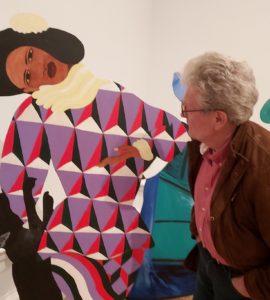
Naming the Money.
Peter Clossick comments:
This ambitious, wide-ranging exhibition is about how art reflected the UK’s empire and slavery, with major historical and contemporary works.
The opening gallery rotunda is an absolute knockout arrangement, with Francis Harwood’s bust of a man from 1758 dominating the central plinth.
As a whole, the global majority is brought into sharp focus, reflecting today’s conscious awareness. Tavares Strachan’s monumental statement piece, First Supper (Galaxy Black), based on Leonardo’s Last Supper, comes across as gilt and glitter. There are filmic historical paintings and brilliant contemporary installations, such as Hew Locke’s ghostship Armada and Lubaina Himid’s Naming the Money. There is a hauntingly magnificent sea of fire and colour by Frank Bowling.
Entangled Pasts visits many well-trodden themes, alive since the Black Lives Movement movement arose in 2013. What was interesting for a weekday morning was the demographic make-up of visitors, which was composed mainly of older, white, middle-class visitors, I would say a £22 entrance ticket is prohibitive for those on a lower income.
Entangled Pasts, 1768–now: Art, Colonialism and Change is at the Royal Academy, Piccadilly until 28 April 2024
£22 admission; £16 for students and free for under 16s.