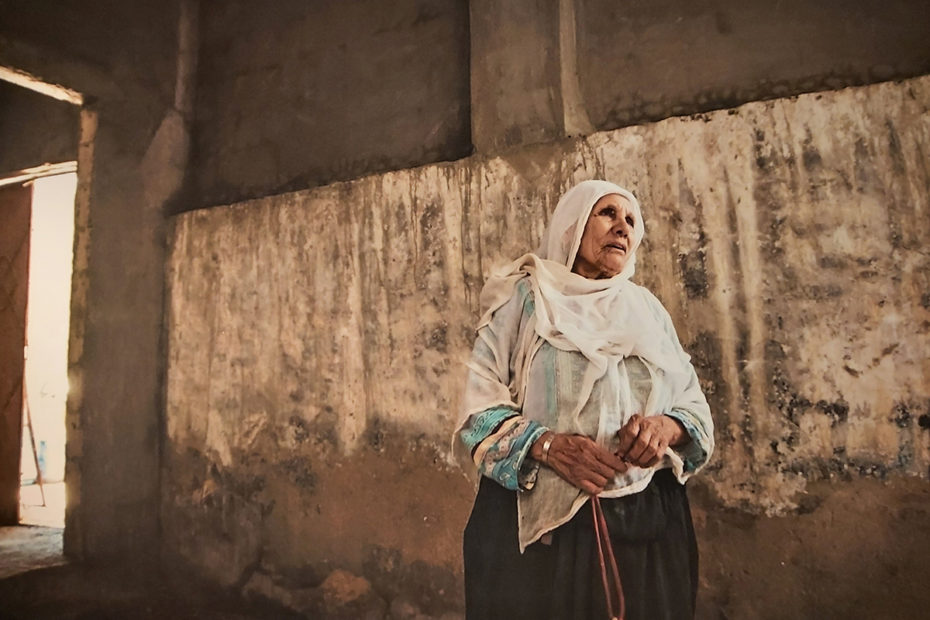
“We want to show that we are humans. We are not ten million terrorists in the world.”
It’s taken the initiative of one Palestinian, Faisal Saleh, whose family was displaced from Salamah village near Jaffa by the 1948 Nakba, to bring a vision of what keeps a people and a nation alive in the face of the ongoing catastrophe that is Palestine-Israel.
The exhibition From Palestine with Art at London’s P21 gallery tells its own story. It allows us to celebrate Palestinian identity and strength, even after 76 years of oppression. This outstanding selection of diverse work is organised by Saleh, founder and director of the Palestine Museum US in Woodbridge, Connecticut. Opened in 2018, it is one of the very few museums globally that is devoted to preserving and displaying paintings, sculpture, costume, films and installations – in short the cultural heritage and contemporary art-making by Palestinians.
Given the erasure of some 27,000 Palestinian lives, by Israeli state forces in response to the 6 October Hamas attack, Saleh’s efforts are of vital importance. Speaking at the opening to a crowded audience of largely young women, he said now is a time when Palestinians “are on the receiving end of a lot of things that are not so pleasant”. An understatement if there ever was one.


Contrary to expectations, this display is a buoyant and life-enhancing experience, spread over two floors in P21’s lovingly designed Modernist spaces. Nabil Anani’s idyllic Palestinian landscape, for example, depicts his country as an Arcadian place of rolling tree-covered hills and fertile fields.
At the other edge of the scale, Ibrahim Alazza evokes the horror of checkpoints and borders. His is a symbol of a displaced people, moving with just a few possessions, created by the simple means of a keffiyeh-wrapped knapsack suspended by razor wire.
Graffiti artist Taqi Sabateen told the BBC that he feels the P21 show is “an emergency archive”. His friends in Gaza are sending photos of their studios since their work is being damaged and destroyed by constant bombing.
One the most striking features of the show is the predominance of women’s work, as makers and as subjects in paintings, sculpture, photographs. The embroidered ancestral Thobe robe, a powerful symbol of Palestinian identity and resistance, is the most striking single artwork. Its bright reds, oranges and yellow are suspended high in the gallery. It hovers, almost like a ghostly crucifix.
The Thobe is echoed by the flames in a vibrant canvas by 87-year-old Samia Halaby. Last month her first US retrospective was cancelled by Indiana university after she criticised Israel’s bombardment of Gaza.
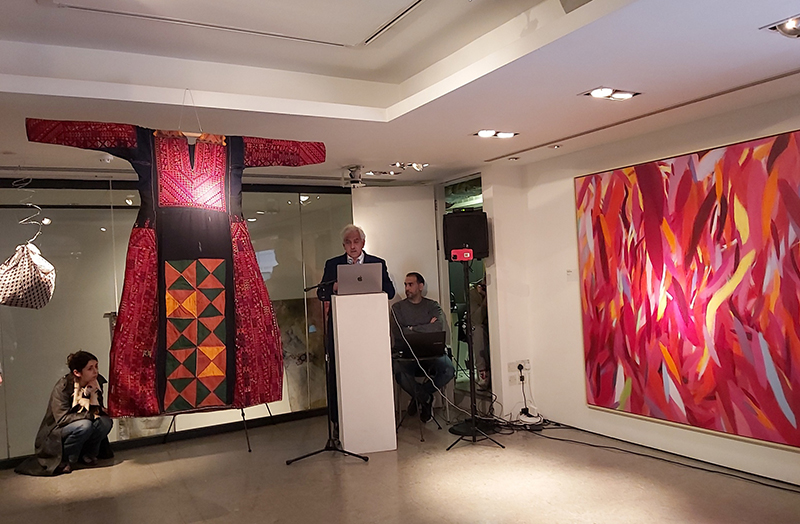
Saleh told Real Democracy Movement that cancelling Palestinian culture is increasingly widespread in the US, Germany and other states subservient to the Israeli state: “Any number of countries and institutions, mostly in the West, take pleasure in doing this to please the state of Israel”.
“Germany finds it important to ban Palestinians from wearing keffiyeh scarves and raising the Palestinian flag,” he continued. “Anyone who says something good about Palestine risks losing their jobs or being cancelled. Palestinians have nothing to do with the Holocaust but somehow we find ourselves the subject of all the things that Germany is doing to try and redeem itself from what happened.
Saleh told the story of his museum’s application for the 2024 Venice Biennale’s Collateral Event section. Being part of a such an event is the only opportunity for Palestinian artists to have an independent national presence at the Biennale, given that Italy’s non-recognition of their statehood means they are denied their own pavilion.
“This year’s theme is Foreigners everywhere, so we came up with the title Foreigners in their Homeland for our submission, meaning the Palestinians feel like that after 76 years of occupation. Thus our proposal should have been a ‘shoe-in’. But it was not to be. “We got the shoe but not the in”, Saleh said to wry laughter.

From Palestine with Art is at P21 Gallery, 21-27 Chalton St, London NW1 1JD until 2 March 2024
Featured image at top by Nadia Irshaid Gilbert: Woman Carries the Weight of Our Past and Our Future. 2017. Original digital photographic print. 110 x 177cm