Intensely stark devotional works by Francisco de Zurbarán displayed in the depths of the National Gallery’s Sainsbury Wing, arouse a certain gloom, reminiscent of stepping into a 17th-century church.
Inevitably, the succession of crucifixes brought back memories of my 1950s school days. They form a remarkable showcase of the strong emotional connection to Christianity which was deeply ingrained in Western society.
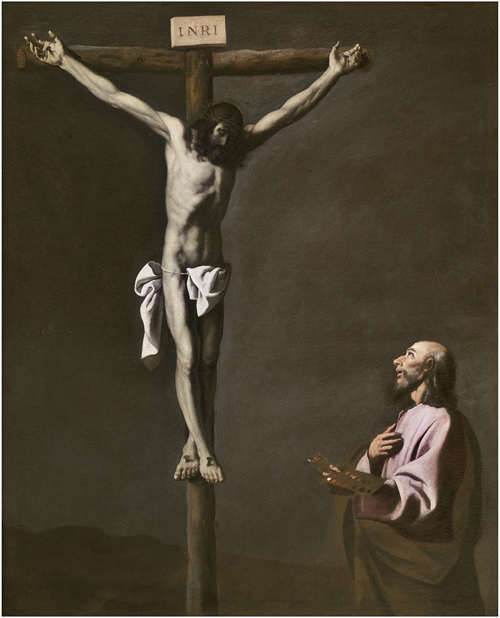
Oil on canvas, 105 x 84 cm
© Photographic Archive Museo Nacional del Prado
No portrait of Zurbarán survives. This, although not a literal self-portrait, is the closest we come.
This was still true for some Roman Catholics, even the mid-1950s: I recall the nuns who instructed me, as an eight-year-old, that we had to stand in class with our arms outstretched to experience what it was like for Jesus on the cross, and we also learned catechism questions and answers to recite back.
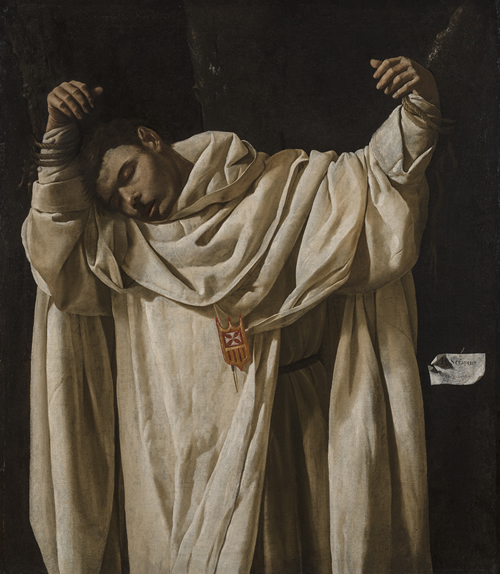
© Wadsworth Atheneum Museum of Art, Hartford, Connecticut
According to tradition, the 13th-century British friar freed Christian captives in Algiers before being beaten, disembowelled and partially decapitated
Zurbarán, dedicated to this great Baroque painter, brings together the National’s own masterpieces with 40 others from the Louvre, Chicago, Seville, San Diego and other collections. It is no surprise that the artist was so celebrated and sought after during his lifetime: these visual narratives drawn from the Bible possess an epic quality, akin to Cecil B. DeMille’s films.
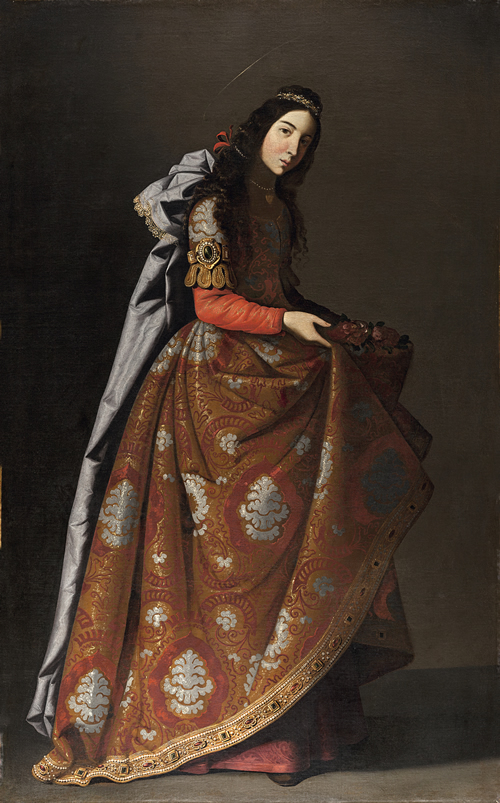
© Museo Nacional Thyssen-Bornemisza
Saint Casilda of Toledo was a 10th-century Muslim princess who, according to legend, smuggled bread to Christian prisoners. When she was confronted, the rolls hidden in her dress miraculously transformed into roses.
How should we view a painter, who spent most of his life in Seville (1598-1664), and operated a painting workshop there, from a 21st-century perspective? In today’s art world, where the definition of art is broad, and traditional formalism is no longer paramount, this question is particularly relevant.
His paintings clearly demonstrate to contemporary photorealists the technical possibilities achievable with paint on a flat surface, long before the advent of photography. With such an exceptional technique that there are no visible brush strokes. By working from dark to light, Zurbarán achieved an astonishing level of convincing detail, creating beautiful, sculpted imagery. He was particularly renowned for his ability to paint textiles and drapery.
At the age of fifteen he was sent to Seville by his father, to train as a painter with sculptors. Artistic production there was under the influence of Francisco Pacheco, a painter, theorist and inquisition censor. Pacheco became the enforcer of the artistic rules established by the Council of Trent (1563). This was the Roman Catholic Church’s defense against the Protestant Reformation.
Artistically and chronologically, Zurbarán can be seen as successor to the visionary El Greco, Caravaggio’s chiaroscuro realism. and the story telling of close contemporary and friend, Diego Velazquez (1599-1660).

© The Norton Simon Foundation Pasadena, California
All these monumental religious canvases, including soaring altarpieces that stand ten feet tall, as well as contemplative still-life subjects have naturalism, directness, and profound emotional power.
There is so much to see and marvel at, including a beautiful still life of grapes by the artist’s son, Juan, in this once-in-a-lifetime exhibition. Just as remarkable is his father’s Still Life with Lemons, Oranges and a Rose.
Zurbarán is at the National Gallery until 23 August 2026
I am so sad to have missed this show, but one day I’ll get to Seville! I became a Zurbaran fan by way of Scottish painter Alison Watt. When she had a residency at the National Gallery she had to choose 3 paintings to “live with” and be inspired by and one was St. Francis Meditating, which had always fascinated me too. She said: ‘Zurbarán’s fabric is fabric you want to touch, fabric you want to listen to, you want to smell. It is almost like a living mass’. She is a master of fabric painting! But whilst I also like the rough folds of St. Francis robe, it is the dark face, almost like a face looking out from a cavern, that I was truly gripped by. It seemed to have such a range of emotions in it – from sadness, to thoughtfullness to even a bit of stupidity. It somehow speaks volumes to me. It’s here if you’d like to see it: https://www.nationalgallery.org.uk/paintings/francisco-de-zurbaran-saint-francis-in-meditation-1