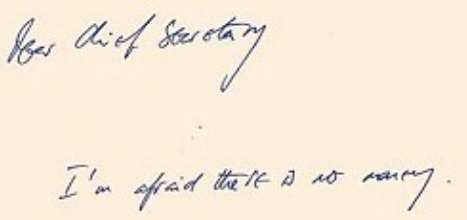
When the dust had settled after the 2010 general election and the Tory-Lib Dem coalition had taken office, an incoming Treasury minister discovered a parting note left by his Labour predecessor, Liam Byrne. It’s message was clear. “I’m afraid there is no money” it read.
What followed was a savage Tory austerity programme which continues to this day, leaving vital public services like the National Health Service and adult social care in a state of ongoing collapse. A repeat performance is likely on the cards following next year’s election.
The disintegration of the Tories, leaving the UK with a government more or less in name only, is a prelude to a developing financial calamity which a Keir Starmer, centre-right Labour Party government would inherit.
Just look at what’s going on. Inflation refuses to fall, driven by supermarket profiteering and the printing of money by the Bank of England over the last decade or so in a bid to prevent the economy from slipping into recession.
As a result, the central bank has raised interest rates yet again, this time to 5%. Millions of mortgage holders will soon find their fixed-rate original deals transition into huge increases in repayments. With house prices falling, negative equity could leave them unable to sell.
With interest rates on the rise, the government has to pay more to borrow money from the financial markets to plug the gap between spending and tax revenues. This is paid for – you guessed it – by borrowing more money! It’s the road to state bankruptcy.
UK government debt has just risen above 100% of the annual value of the UK’s economy (known as gross domestic product) for the first time since 1961 after public sector borrowing doubled in May. Net debt now stands at over £2.6 trillion (a trillion is a thousand billion).
This is in the context of a global surge in government and household debt to levels not seen since the financial crash of 2008. S&P Global, the ratings agency, reported earlier this year: “Three hundred trillion dollars. That is the record debt which global governments, households, financial corporates and nonfinancial corporates owed in June 2022, as estimated by the Institute of International Finance. The $300 trillion is equivalent to 349% of global gross domestic product.”

May also saw the lowest year-on-year increase in government receipts in any month since March 2021. Samuel Tombs, economist at Pantheon Macroeconomics, said a sharp deterioration in the outlook for debt interest payments “suggests that the chancellor will not have scope to cut taxes before the next general election”.
That’s the least of Tory concerns. They are so far behind in the polls now that few believe they can win an election. They are preparing to hand over the financial crisis to Starmer, knowing that he is considered a “safe pair of hands” by financial markets and capitalism in general. Labour’s bureaucracy reinforces the party leadership’s loyalty to the state by expelling dissenting voices, often for some harmless Tweet made years ago.
Real concerns are expressed by the Bank for International Settlements, which is a kind of organisation representing central banks around the world. In its recent annual report, the BIS warns that a combination of higher interest rates and an economic slowdown will inevitably “raise credit losses”. It adds:
“These, in turn, could generate further strains in the financial system. It is quite common for banking stress to emerge following a monetary policy tightening – in as many as a fifth of cases within three years after the first hike. The incidence rises considerably when initial debt levels are high, real estate prices are elevated or the increase in inflation is stronger. The current episode ticks all the boxes.”
No wonder the Tories are all at sea and can’t wait to depart Whitehall. They have little control over the unravelling that’s taking place, which is in many ways the second act of the 2008 crash – this time without government resources to effect a bail-out.
Into this would come Starmer, whose shadow cabinet is quickly rolling back any advance pledges to spend more to combat austerity, the collapse of the NHS and other pressing issues. In other words, it would be austerity under a Labour government, which we saw during the late 1970s. That led directly to the Thatcher governments from 1979-1997.
With the Tories in meltdown, the emergence of a far-right, populist grouping to take their place is absolutely a possibility in the likely event that a Starmer government quickly loses the plot. We should be preparing for that eventuality sooner rather than later by urging the building of popular assemblies as centres of resistance which can challenge capitalist power.