
As tens of thousands marched through London once more, demanding a ceasefire in Gaza and voicing support for Palestinians, an analysis of the Israeli bombing campaign showed that the proportion of civilian deaths had reached record levels.
Haaretz, the Israeli anti-government paper, published an analysis showing that in the first three weeks of the war, the ratio of civilian deaths to those killed in air strikes was 61%.
The ratio is significantly higher than the average civilian toll in all the conflicts around the world during the 20th century, in which civilians accounted for about half the dead, according to author Yagil Levy, a sociology professor at the Open University of Israel.
Levy described this as “unprecedented killing” for Israeli forces in Gaza, where previous onslaughts had produced a ratio of around 40%.
His analysis followed an investigation by +972 magazine and Local Call which concluded: “The Israeli army’s expanded authorisation for bombing non-military targets, the loosening of constraints regarding expected civilian casualties, and the use of an artificial intelligence system to generate more potential targets than ever before, appear to have contributed to the destructive nature of the initial stages of Israel’s current war on the Gaza Strip.”
Their investigation is based on conversations with seven current and former members of Israeli intelligence, air force personnel in addition to Palestinian testimonies, data, and documentation from the Gaza Strip, and official statements.
Compared to previous Israeli assaults on Gaza, targets that are not distinctly military in nature have been authorised. These include private residences as well as public buildings, infrastructure, and high-rise blocks.
Deliberately targeting civilians, it is suggested, is aimed at driving a wedge between civilians and Hamas, whose killing of 1,200 Israelis and the taking of an estimated 250 hostages on October 7, led to the invasion and bombing campaign.
Another view is that the destruction of more than 40% of Gaza’s homes is intended to make the territory uninhabitable, forcing the population to flee as their descendants did in 1948 in the wake of the formation of the state of Israel at their expense.
The UN says 1.8 million people are internally displaced inside Gaza, many living in overcrowded UN shelters in the south.
Meanwhile, the slaughter goes on with the support of the major powers. The United States, shortly after exercising its veto at the United Nations to block a ceasefire resolution, sent more munitions to Israel.
In the UK, the Labour leadership under Keir Starmer has ruled out supporting a call for the end of hostilities, joining hands with the Tories.
Presumably, Starmer is waiting for the last Palestinian in Gaza to turn out the lights.


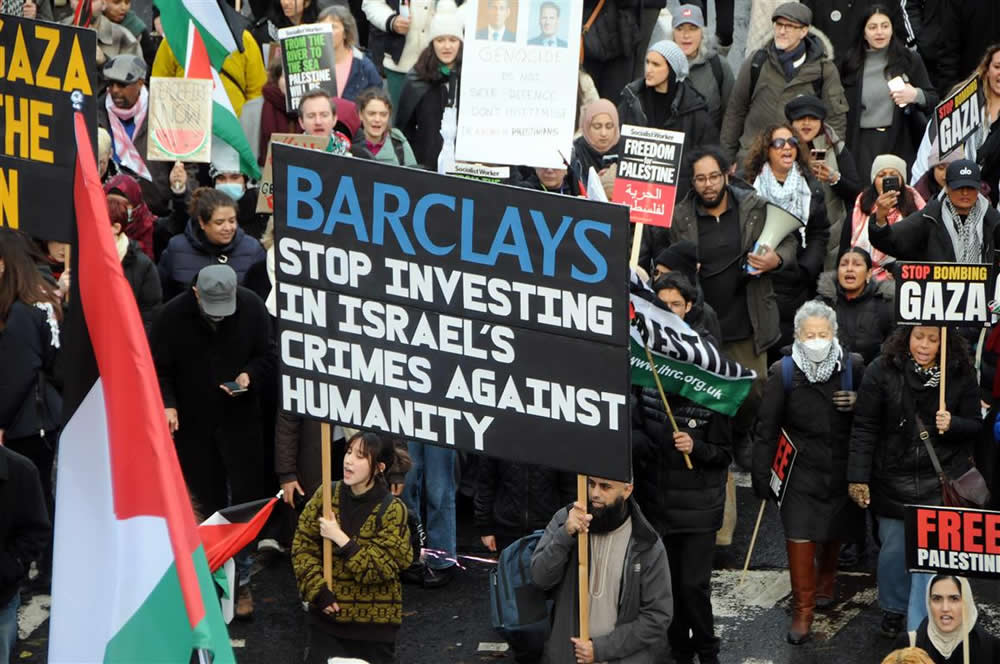


Photos: Peter Arkell