When the eminent British historian Peter Hennessy, who specialises in the history of government, announces that it is beyond doubt that Boris Johnson is a “rogue prime minister”, you know that the political system is in crisis, perhaps a fatal one.
Under the UK’s constitution, which the ministerial code is a part of, misleading Parliament is an open and shut resignation case. Johnson previously said to MPs that rules in No 10 Downing Street were followed at all times
Even the usually servile Met didn’t concur and issued him with a fine, with more to follow for other Whitehall bashes Johnson and others attended.
Johnson and the rest of the Tory junta – for that is what they have become – have, however, simply chosen to ignore the ministerial code.
So we now have the fatuous “explanation” that it did not “occur” to Johnson that it was unlawful to attend parties in Downing Street while Covid regulations his government drew up prohibited such social gatherings.
Agreeing with Johnson’s “defence” would make it impossible to charge anyone with any kind of offence. For example, “It didn’t occur to me that it was illegal to drive up the wrong side of the motorway at 100mph, officer”, would become a standard and acceptable defence. You get my drift. A shocked Hennessy told the BBC:
“The Queen’s First Minister [Johnson] is now beyond doubt a rogue prime minister, unworthy of her, her Parliament, her people, and her kingdom. I cannot remember a day when I have been more fearful for the well-being of the constitution.
“It’s an assault on not just the decent state of mind which keeps our society open and clean but also on the institutions of the state. If he’s not prepared to do the decent thing… why should anybody else behave decently and properly? The whole decency of our public life turns on this question.”
Hennessy’s reference to Johnson’s “assault on the institutions of the state” indicates the depth of the crisis of the existing political order. Though government is part of the state, in the UK’s constitution it is not identical with it.
Ministers of all ranks are required to observe and uphold the rule of law, whereby the legal and judicial system operates independently. This was enshrined in an Act of Parliament as long ago as 1701.
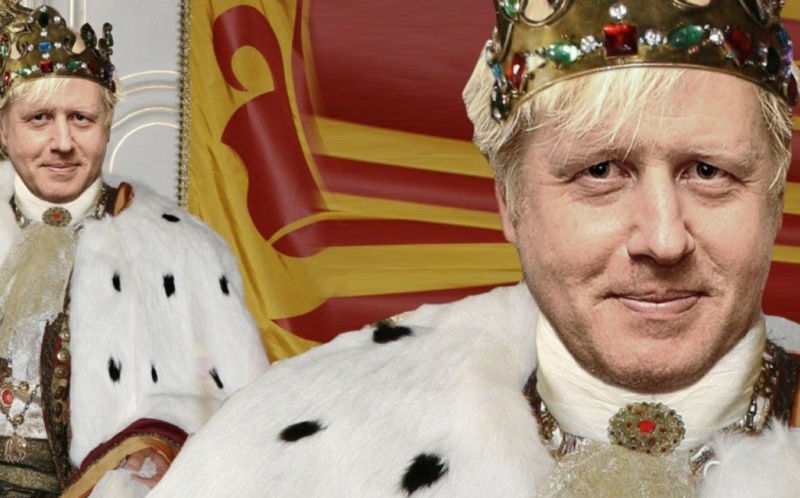
Johnson’s outlook is essentially that of absolute French king Louis XIV, who is reported to have said “L’Etat, c’est moi”. The claim that “I am the state” is the mantra of autocrats everywhere, from Moscow to Beijing, from Budapest and now London.
So while Johnson’s government sends arms to Ukraine, at home he is trampling all over the democratic aspirations that the Ukrainian people have united to defend and give their lives for. In that sense, the prime minister has more in common with people like Putin and Trump than Zelensky.
Now, instead of welcoming refugees, he and the notorious Priti Patel plan to send some to Rwanda for “processing”. Patel’s parents came to Britain as economic migrants from adjacent Uganda. This fact is undoubtedly lost on her.
Hennessy is right to be concerned for the stability of the political system. Even before Johnson’s clique took control, it was falling apart. Trust in the system is at an all-time low, while neoliberal capitalism has hollowed out the state in favour of corporate power. As a result, climate chaos worsens while the state takes no effective action.
Except when it comes to dealing with those fighting for a change in government policy. Extinction Rebellion activists are arrested en masse while new laws are on their way which give police extraordinary powers to ban demonstrations and actions. The rapid slide to outright authoritarian rule is why Johnson feels emboldened.
He may be removed by disgruntled MPs, not for any reasons of principle but because they fear losing their seats at election time. But this won’t halt the shift from liberal to illiberal democracy because the causes of the decay are deeper.
I’ve made 10 podcasts of the Unmasking the State course, which is part of Rethinking Our Future. They explain what the state is, how and why it is in crisis and makes the case for a revolutionary transition to a real democracy. You can listen and download them here.