A revolution in art
Artist Peter Clossick feels a deep connection with Walter Richard Sickert, who still electrifies with his harsh, erotic nudes and savage London music halls. Peter offers a personal appreciation of Sickert’s role and influence on the occasion of The Theatre of Life, currently at the Piano Nobile gallery in Holland Park.
Literature abounds about Walter Richard Sickert (1860-1942), the German-born English artist, so it is difficult to see through the veil, toward the life and art of this multicultural artist.
My personal connections are with Camden Town, Mornington Crescent and the statue of Sickert’s father-in-law which was at the top of the street where I grew up. Aptly painted by Frank Auerbach Mornington Crescent with the Statue of Sickert’s father in law of 1966, places Sickert as an early progenitor of the School of London.
“There is no such thing as Modern – or ancient art – history is one unbroken stream” quoted Sickert who taught David Bomberg at Westminster School of Art (1908-10). Bomberg in turn influenced Auerbach and Kossoff, leading lights of the London School.
There is an unbroken line from Ingres, Degas, to Sickert, Bomberg, Kossoff and Auerbach, who all believed in a continuity of art, from the cave to the present day with no break or schism. Sickert’s thinking and practice has affected many artists, including myself.
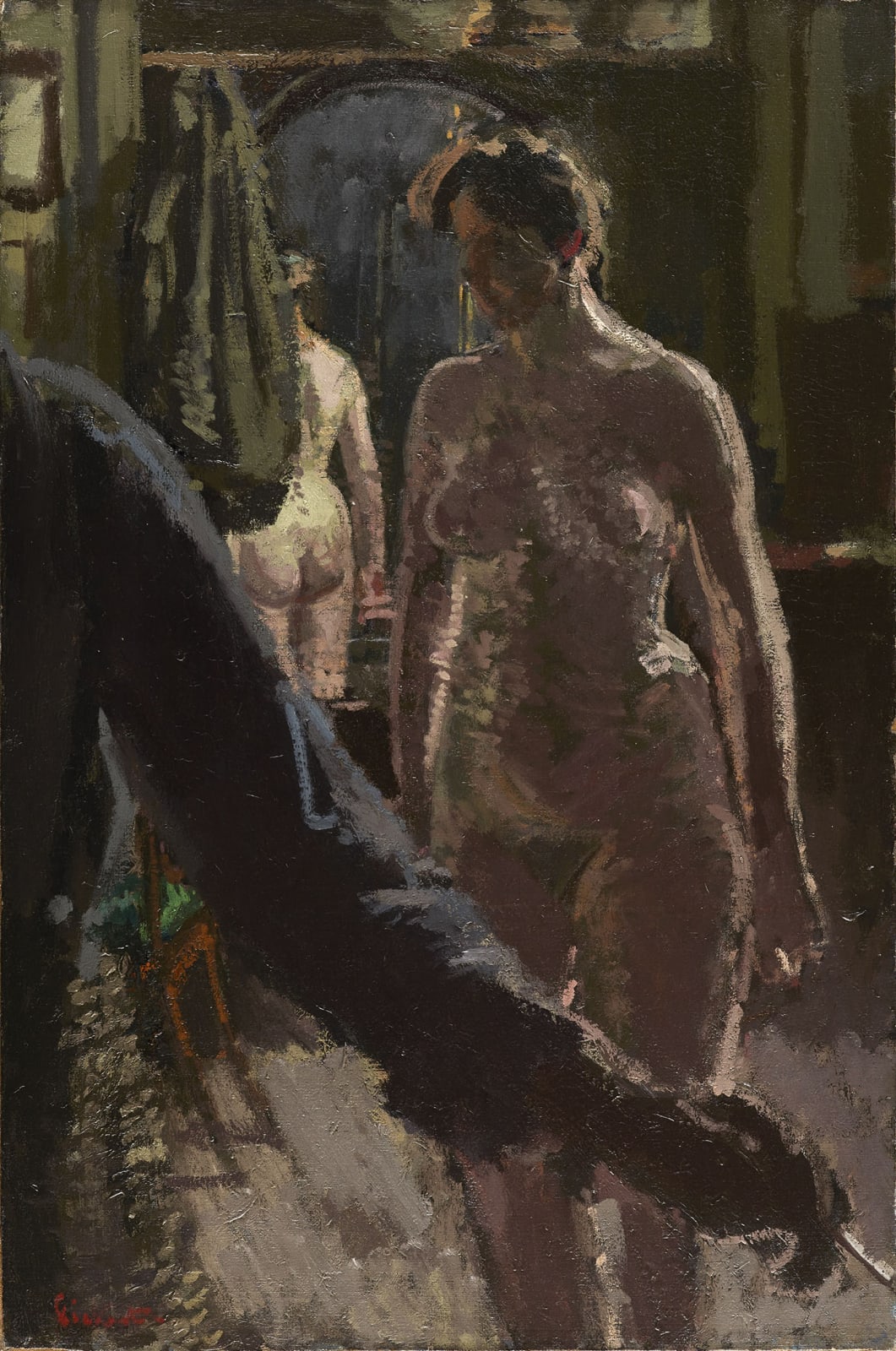
Read the article by Wendy Baron about this painting
Sickert has been an influence on British art since the early 20th century, involved in many exhibiting groups, the New English Art Club (1886), Fitzroy Street Group (1907), Allied Artists Association (1908), the Camden Town Group (1911) and also involved in the origins of the London Group (1913). He was a prolific writer, teacher, art critic. Those who wish to learn more about the man should read A Free House; the writings of Walter Richard Sickert, edited by Osbert Sitwell.
Sickert trained as an apprentice with James Abbott McNeill Whistler and in his early painting followed his master, using a fluid wet-in-wet paint process. He was also strongly influenced by Edgar Degas’s attitude to working from drawings, to escape, as Degas says, “from the tyranny of nature”. Initially, Sickert wished to be an actor, which is evident in the theatricality of much of his work.
He always had a sure eye for notoriety, investigating through the ‘Camden Town Murders’, nudes that were shockingly real for their time, domestic interiors, music hall theatrical scenes, or attention-grabbing newspaper photographs. These were not ‘polite’ paintings or classic beauties, but raw social commentaries, telling it as it is. As man of many parts he was a transitional artist, who forged the link between Impressionism and the early Moderns.
In the 1960s, art students at the Royal College who painted in the Sickertarian manner, were lightly referred to as the ‘Sickert and the Tonals’ group. His work was regarded as retro, when ‘pop’ was then becoming a new wave. Colourful tonal painting based on sound drawing was always Sickert’s strength.

His practice, adopted from Degas, was to work from drawings which were then squared up and transferred onto canvas, each square being copied individually onto a similarly squared larger sheet of paper. The enlarged version coated in reverse with dark fluid paint would then be laid face up onto the canvas and traced through. It was a version of a traditional method of tracing, long employed by artists. He would then start painting, in the traditional oil painting method of colours from dark to light, scraping back to the ground when he needed to make changes.
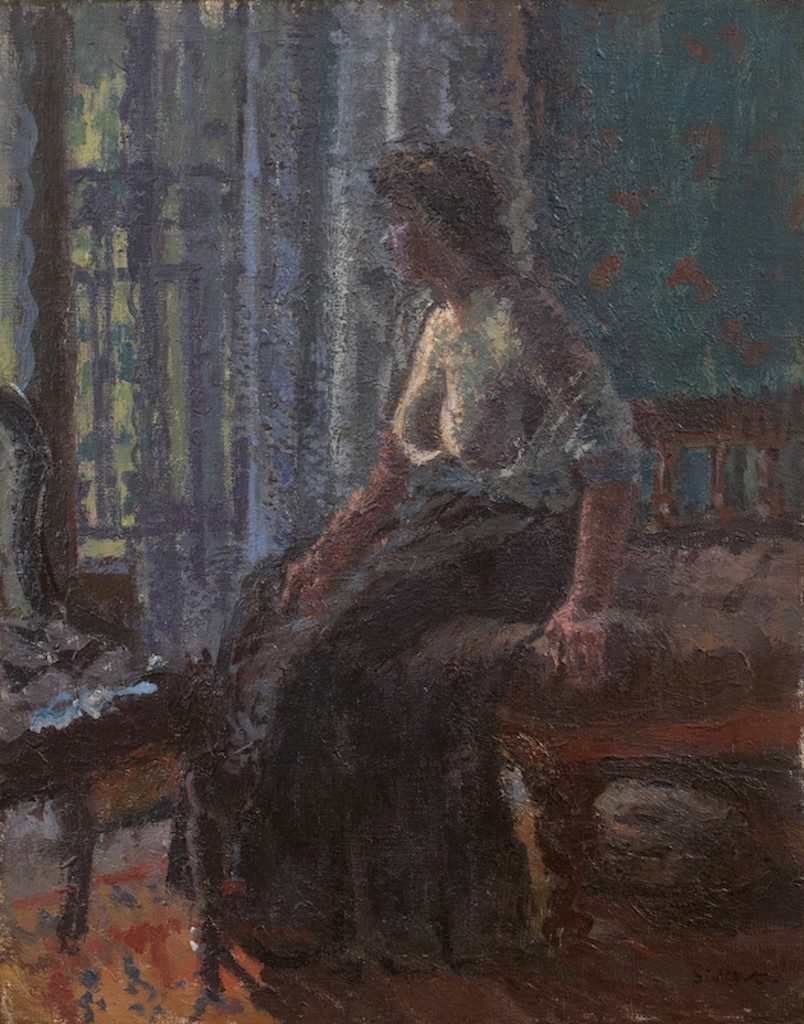
A later method he used was the camaïeu technique – basic monochromatic underpainting in different tones of a single colour, which would then be left to dry and painted over with appropriate colours. He was a great experimenter with means and methods, from heavy impasto to transparent washes. The drawing method that he proposed to students was in three stages: a rapid tentative line, then light and shade followed by the definitive line.
All good practical advice, but Sickert’s real revolution was in the subject matter that he used: ordinary people, everyday life and urban scenes, squaring up photographs as source material, prefiguring pop art. He created a new modern realism, balancing figuration and abstraction.
He was a radical artist of daring who provokes strong reactions, yet evading any straightforward category or school. A man much to be admired and learnt from by other artists.
Photos courtesy of Piano Nobile
- Sickert: the theatre of life is at Piano Nobile until 17 December
- Sickert: A Life in Art is at the Walker Art Gallery, Liverpool until 27 February 2022
- Walter Sickert will be at Tate Britain 28 April to 18 September 2022
Peter Clossick studied at Camberwell School of Art and Goldsmiths College during the early 1970s. He is a member and Past President of The London Group an artist collective established in 1913 and also a member of The New English Art Club under the Federation of British Artists. He exhibits regularly both here and abroad.
Peter’s work currently features in an online exhibition curated by Pilar Alfonso: This room no longer has walls
Leon Kossoff , a London boy from Brick Lane, by Peter Clossick
Mind games under lockdown: Peter Clossick, Artist in Quarantine No.3