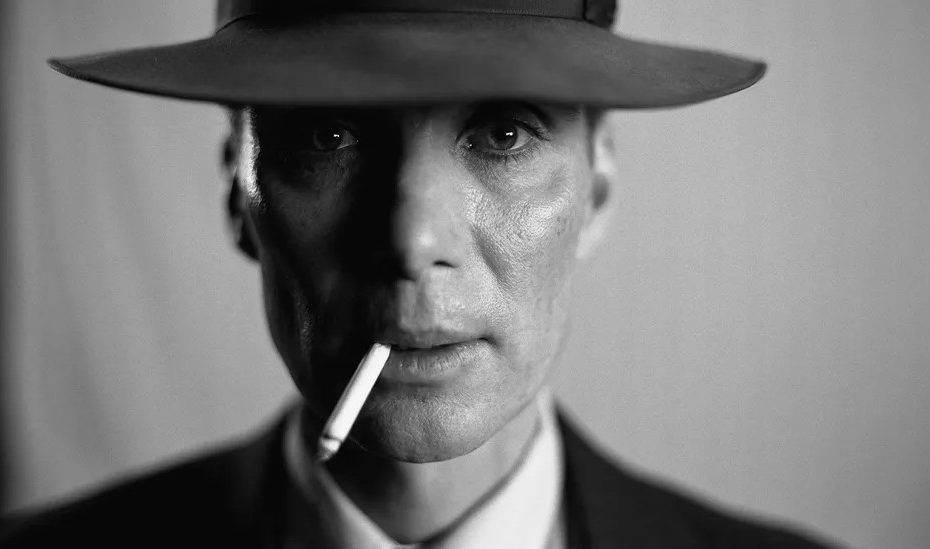
Oppenheimer is a remarkable film, not least because it covers a period of history from the Wall Street Crash of 1929, to the rise of Nazi Germany, Stalinism, World War II and the so-called Cold War that followed the creation of the atomic bomb and its use against Japan in August 1945.
Christopher Nolan’s epic masterpiece about the physicist J.Robert Oppenheimer is set against this turbulent background and the role played by the subject in actually changing the course of history before himself becoming a victim of the authorities that had once feted his achievements.
Cillian Murphy as Oppenheimer is spellbinding, his penetrating eyes holding your attention throughout the film’s three hours, which seem to pass quickly because Nolan’s direction is at once restless and innovative.
Oppenheimer, the son of Jewish immigrants who became wealthy enough to pay for his elite education, is on a mission to develop quantum physics, travelling to Cambridge and then Germany to meet top scientists working in the same field.

Christopher Nolan’s epic
Nolan uses wonderful graphic images and music to bring out the turmoil in Oppenheimer’s mind as he consumes contemporary music, art and poetry which not unlike sub-atomic particles take a fragmented and seemingly contradictory form. Oppenheimer is later shown asking students how a particle can behave like a particle and a wave at the same time, which, he explains, it does.
With the Nazis in power in Germany and the fascists making headway in Spain, Oppenheimer is drawn towards actions that bring him into contact with the heavily Stalinist Communist Party of America in the shape of Jean Tatlock (Florence Pugh) who is a member and his lover.
This is duly noted by the FBI. Oppenheimer, who never joins the party, sends money to the Republicans in Spain, funds Jews escaping from Germany and tries to organise lecturers into a union, drawing opposition from the head of the department.
By the late 1930s, the real possibility of nuclear fission – and with it the potential of an atomic bomb – is known internationally following research by German and British scientists. Albert Einstein, who by now is in the US and known to Oppenheimer, warns the American government of the danger and urges them to act to prevent the Nazis from being first to the bomb.
This leads to the second act of the film, Oppenheimer’s recruitment to take charge of the Manhattan Project, the building of America’s atom bomb, which began in 1942 at Los Alamos in a remote part of New Mexico.
Oppenheimer’s unadorned ambition actually got him the job, despite objections to him taking charge on account of what was called his “extreme liberalism”. The scene where General Leslie Groves (Matt Damon) recruits Oppenheimer as director is witty as the sharp exchanges unfold. According to a 2002 biography, Groves noted: “I became convinced that not only was he loyal, but that he would let nothing interfere with the successful accomplishment of his task and thus his place in scientific history.”
The United States threw everything at the Manhattan Project, which employed over 120,000 people at one stage, bringing scientists together under Oppenheimer’s direction. Ultimately, Nazi Germany was defeated before it had built its own bomb but the project was maintained, which takes us to the third act of the film.
Although we know that the test of the bomb in July 1945 was successful, it is captured with as much drama as Nolan can muster. Oppenheimer stares out from his bunker at the blinding light of the explosion, beginning to be troubled by what he has done. He celebrates with fellow scientists, while imagining them dying from radiation poisoning. Yet he goes to Washington and helps select Hiroshima and Nagasaki as targets for the dropping of the bomb on Japan, with the death of over 100,000 civilians.
Of course, the US government claims that the use of the weapon is to force Japan to surrender and save American lives. The real reason escapes Oppenheimer. For the first thing Groves does after the successful Los Alamos test is to phone President Truman who is at that moment meeting Joseph Stalin in Potsdam where the major power are busily dividing up Europe.
Truman immediately tells Stalin that the US has a new, terrible weapon. Just to demonstrate to the Soviets that it really exists, Japan is attacked a few weeks later for the whole world to see. Oppenheimer then embarks on a mission to prevent international nuclear war by urging Truman to share atomic secrets with the Soviet Union and later rejects the development of the hydrogen bomb, which would be many more times more powerful than the A-bomb.
Einstein would later say: “The trouble with Oppenheimer is that he loves [something that] doesn’t love him – the United States government.” Truman rejects Oppenheimer’s suggestion out of hand, saying that the US would keep the process secret. Soviet spies had, of course, penetrated the Manhattan Project and the USSR exploded its own atomic bomb in 1949.

The more Oppenheimer pursued the admirable dream of world peace, ignoring the political realities around him in both Washington and Moscow, the more he became a target. As the Cold War developed and McCarthyite witch-hunting consumed public and private lives, Oppenheimer went from hero to villain, from the ‘father of the atomic bomb’ to someone who couldn’t be trusted.
In 1954, a closed hearing of the US Atomic Energy Commission deprived him of his security clearance on the grounds of his previous political associations and opposition to the hydrogen bomb. Emily Blunt as his wife is magnificently defiant while her husband defends himself passively.
Although he went back to teaching, Oppenheimer never recovered from this humiliation. He was politically rehabilitated by President Johnson in 1963, four years before his death. His security clearance was restored posthumously in 2020. All too late for Oppenheimer.