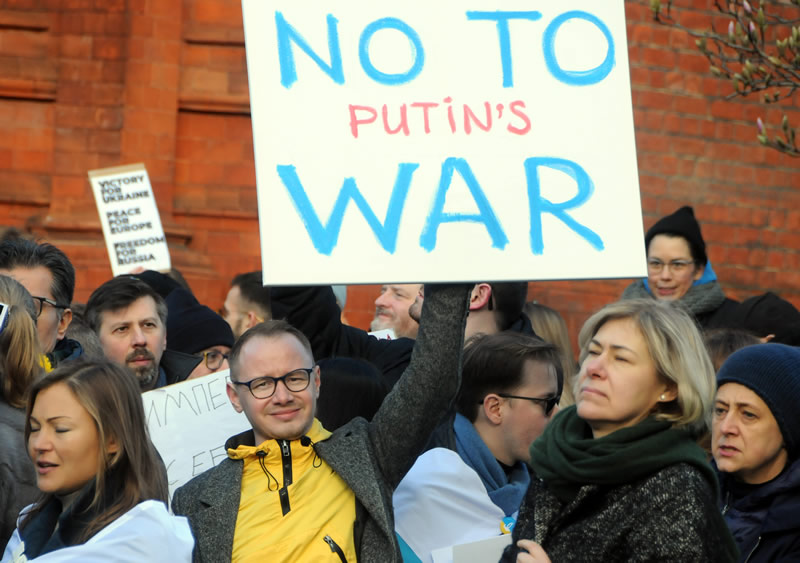
As we enter the third year of Russia’s unprovoked invasion of neighbouring Ukraine, it’s time to restate some basic facts behind a war that has displaced more than 3.6 million internally and forced another 6.3 million to flee as refugees to other parts of Europe.
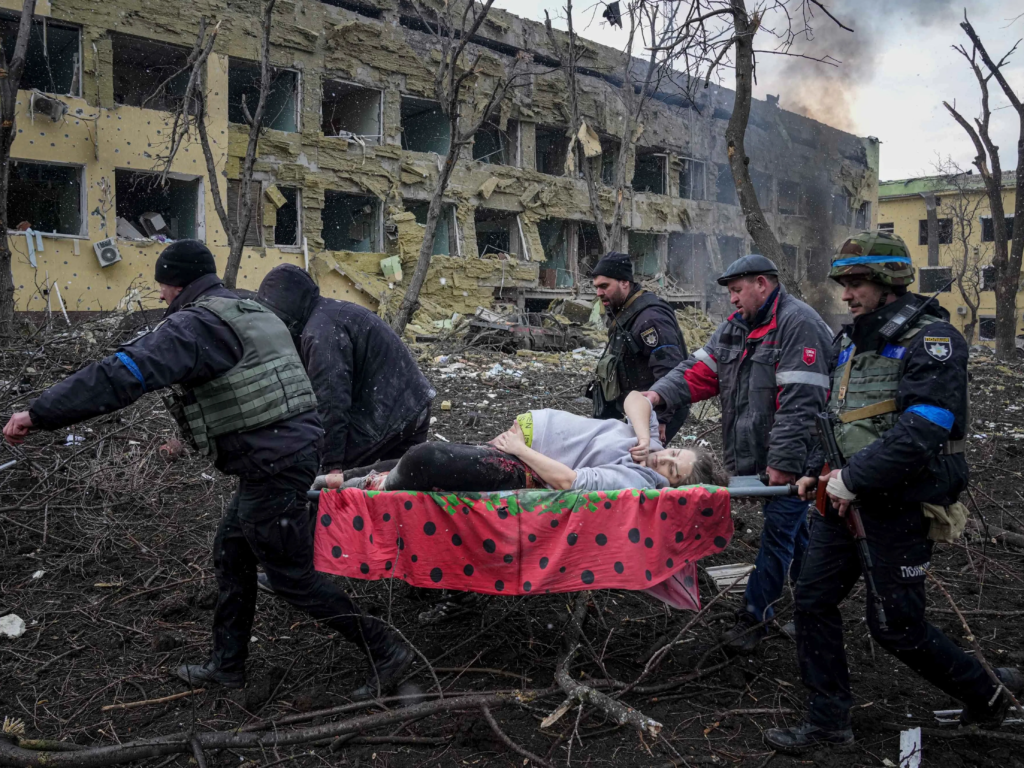
Large parts of Ukraine’s infrastructure, including schools, hospitals, concert halls and power supply, are in ruins. Millions of children have had their education ruined, while tens of thousands have been abducted by Russia forces and taken across the border.
Russia is the iron grip of the ultra-nationalist, former KGB officer Vladimir Putin, and any kind of dissent is ruthlessly crushed. Early anti-war protests were broken up and it is a criminal offence to express opposition to the invasion, or “special military operation” as the Kremlin euphemistically calls it.
In the wake of the recent death of opposition leader Alexei Navalny, driven to his early grave by state-sanctioned poisoning, trumped up charges and incarceration in a Siberian prison camp, Russians who tried to lay flowers at makeshift memorials were swept up and arrested.
Only official news outlets are allowed to operate inside Russia and few broadcasters have broken ranks. Hundreds of thousands of young people suddenly made eligible for military service up fled the country to avoid being sent to the frontline inside Ukraine.
The Kremlin described this as a “purification” of Russian society, alongside the banning of LGBT organisations and an official crackdown on gay relationships, depicted as an example of denegerate Western society.
This is the kind of ugly, totalitarian society, a kind of political rehash of the Stalinist period, but with filthy rich oligarchs operating crude forms of capitalism, that Ukrainians reject.
In 1991, more than 90% voted in favour of an independent state following the collapse of the Soviet Union, many recalling the terrible famine of the 1930s that was an horrific consequence of Stalin’s actions and which killed millions.
In late 2013, when the pro-Moscow president Viktor Yanukovych broke a promise to open negotiations with the European Union, opting instead for a trade deal with Russia, Ukrainians young and old took over Maidan Square in Kyiv.
By February 2014, he had been overthrown, although not without first spilling the blood of his own people.
This political revolution proved too much for Putin. In March that year, he annexed Crimea and installed proxy, ultra-right nationalists in parts of eastern Ukraine, who declared their entities free from Kyiv’s control.
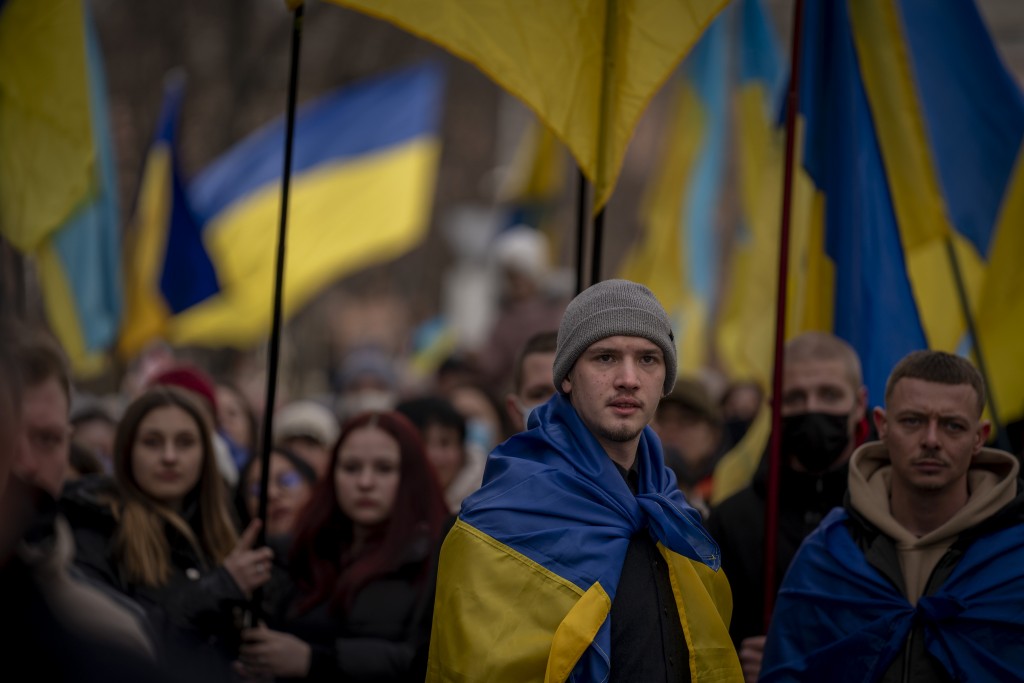
The existence of an independent Ukraine, with its fledgling democracy, vibrant civic society and a former comedian as president, is anathema to the Putin and his gang. Putin is heavily influenced by people like the far-right ideologue Aleksandr Dugin who advocates Eurasianism, whereby “Russia should unite the peoples of the Eurasian continent into a new empire directed against the West and liberalism”.
In a perceptive article following the invasion, Sian Norris noted: ”Dugin advocates for the creation of the Eurasian Empire – bringing the countries that were in the Soviet Union back under Russian control. But crucially, this is not about recreating the former-USSR; it is about recreating the Tsarist Empire.”
She writes that the nationalism that drives Dugin’s worldview positions Russia as a country with a unique culture whose destiny is to create a centre of power that straddles Europe and Asia, with Russia ruling all.
Dugin envisages this frightening prospect thus: “We need to return to … the New Middle Ages – and thus to the Empire, religion, and the institutions of traditional society. All content of Modernity – is Satanism and degeneration. Nothing is worth, everything is to be cleansed off. The Modernity is absolutely wrong – science, values, philosophy, art, society, modes, patterns, ‘truths’, understanding of Being, time and space. All is dead with Modernity. So it should end. We are going to end it.”
Putin himself published an essay in the months leading up to the invasion, making a series of invented historical claims to assert that Russians and Ukrainians are one people, and that the latter’s independence as a state was always a fiction.
Some likened Putin’s claim that Russian speakers in Ukraine faced persecution to Hitler’s infamous Sudetenland speech in 1939, which paved the way for the invasion and occupation of Czechoslovakia.
So let’s discard any attempt to explain or, worse, justify Putin’s actions by reference to the expansion in NATO membership. When the Soviet Union was dissolved on 31 December 1991, satellite states imprisoned for decades under brutal Stalinist rule broke away from Moscow and its Warsaw Pact (equivalent of NATO). Who could blame them? History had hardly done them any favours.
Poland was invaded in September 1939 by two countries simultaneously – the USSR and Nazi Germany. A week after the Nazi-Soviet pact was signed, Poland was portioned up between the two countries. Over 22,000 Polish army officers were rounded up by Russia, marched off and massacred. No surprise then when Poland joined NATO in 1999.
They were accompanied by Hungary, whose revolution of 1956 was brutally suppressed by, you guessed it, Soviet tanks and the Czech Republic, where the Prague Spring of 1968 was also violently put down by Moscow. Lithuania together with Latvia and Estonia joined NATO in 2004, 18 years ago. The three Baltic States had been forcibly incorporated into the Soviet Union in 1940 under the same Stalin-Hitler pact
In any case, in an age of short and long-range conventional, chemical and nuclear weapons, having a “buffer state” between you and your supposed enemies is pointless. Russia has thousands of intercontinental nuclear missiles on land and at sea and so does NATO.
It is not “context” to place NATO’s expanded membership alongside the invasion of Ukraine. This to create a false equivalence, where none exists. Sure, the existence of NATO weakens the struggle for international peace.
But to cite Russia’s “legitimate security concerns” is to repeat Putin’s lies about the real reasons for the invasion. It is a mealy-mouthed justification by sections of the “left”, including the Stalinist-influenced Stop the War coalition, for a lack of support for a Ukraine that is fighting for its very life.
Of course, there is a large dollop of hypocrisy and double-standards applied by the United States, the UK and other countries over Ukraine. From Vietnam, to Iraq and Afghanistan, invasion and occupation by the US and its allies has brought misery and death to millions.
There are those who try to use this as an excuse to stay neutral over Ukraine, refusing to take sides on the pathetic grounds that “my enemy’s enemy is my friend”. Let’s just say that if you support the Palestinians against the US-backed destruction of Gaza and slaughter of its citizens, you are obliged to stand with Ukraine because the principle of self-determination of nations and people is absolute
Ukraine has the right to ask for and receive arms as the alternative is to allow Putin’s armies to destroy its independence. However, we should be aware that Washington and London will place their own interests above Ukraine’s if necessary.
We should support the building of the independent workers’ movement of Ukraine and the development of a programme to end the power of the oligarchs and create a real democracy which transfers actual economic and political power to the people.
This approach could and should equally be applied to the UK and other countries where representative democracy is in precipitate decline, opening the door to the far right which finds common cause with Putin and political populists like Donald Trump.
The Ukraine Solidarity Campaign is supporting a demonstration on Saturday, 24 February, to mark the second anniversary of the invasion. It is called by Support Ukraine/London EuroMaidan, and is also backed by a number of UK trade unions, the Confederation of Free Trade Unions of Ukraine and Federation of Trade Unions of Ukraine. It assembles at 1.30 pm Speakers Corner, Hyde Park, before going on to a rally and vigil at Trafalgar Square.
I have a very ambiguous impression reading your appeal. Perhabs it is bbecause I live in Moscow, not in London. If you are interested, I am ready to discuss this complicated an sensitive topic in more details. An now I welcome your position in as far as it is directed against both NATO and imperialist Russia and invite you to read the appeal of those Russian cmmunists, who left the bankrupt pro-imperialist parties and mde up their mind to form a new party, internationalist and revolutonary. Here is the link t the dcument: https://www.roskomsoyuz.ru/EN.html