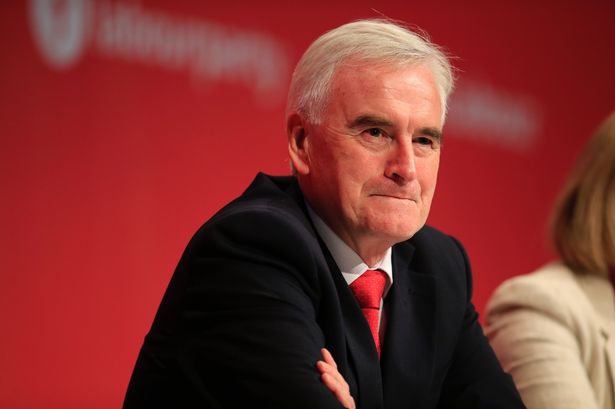

Shadow chancellor John McDonnell is absolutely right in his call to “start work now” on how to meet potential challenges to a Jeremy Corbyn-led government committed to radical political and economic change. We’re taking up his call.
A Labour government led by McDonnell and Corbyn would come to office at a time when the capitalist system in the UK and globally is vulnerable and, therefore, certain to strike back in both expected and unanticipated ways.
Speaking at a Labour Party fringe meeting, McDonnell warned of a run on the pound or a flight of capital were his party to win the next election. He said a future Labour administration would not be “traditional” and “people want to know we’re ready, and they want to know we’ve got a response to anything that could happen”.
It was important, McDonnell added, for Labour to “scenario-plan” for all kinds of potential challenges it might face in government “bringing the relevant expertise together at every level to talk through what happens if there is such and such a reaction”.
Policies of renationalisation, expanded public spending on the NHS and other services, publicly-owned regional banks, infrastructure funds and scrapping tuition fees will meet a fragile economy propped up and weakened by record levels of borrowing at state, corporate and consumer levels.
Moreover, the state crisis over Brexit negotiations will be with us for an indefinite period as the ruling political and economic classes struggle for a direction and identity following the shock referendum EU rejection vote.
Add in Corbyn’s call in his conference speech that Labour “will transform Britain by genuinely putting power in the hands of the people” through remaking UK democracy and you sense the counter-reaction building already.
The attacks will come from all directions – from the financial markets and hedge funds, from the transnational corporations which drive policy making, to state bodies like the Treasury, the Bank of England and, naturally, the secret agencies such as MI5 whose sole agenda is “defence of the realm”.
The pressure will also come from credit rating agencies, the European Commission, the IMF and World Trade Organisation.
As Theresa May restated in her speech the day after Corbyn’s, free market capitalism must prevail. She was speaking not just for the Tory Party but for the political and economic establishment as a whole.
While scenario-planning is important, the solutions are unlikely to be found solely at government level or in political manoeuvring. Defence of a Corbyn-McDonnell government has to be prepared at community, workplace, city and regional levels through the active participation of the people themselves.
When the system strikes back, a strategy has to be in place of mobilising people not simply to resist and oppose but to actually defeat the enemy within. It will almost certainly evolve into a struggle for power – who has it and who doesn’t. The voters need to be made aware of this now and urged to become involved rather than waiting for a general election.
Scenario planning should, for example, include what kind of new democratic state can ensure rule by the 99%; how to reconstruct financial markets and the banking sector; what co-ownership and control of the major corporations would look like and how land, which is key to housing, could be brought into a new commons.
On October 28, Real Democracy Movement supporters, some of who are Labour members, are holding a Planning Day in London to engage in just this sort of scenario thinking and propose actions. You are warmly invited to become a supporter and take part in “Towards the RDM – planning for a Corbyn government”. Email info@realdemocracymovement.org with “October 28” in the subject line for more details about the day.
I thought John McDonnell’s speech injected some realism into the Labour Party Conference. That part of his speech, devoted to the practical difficulties of achieving meaningful change under a Labour Government, provided a refreshing antidote to the stale platitudes, glib mutual back-slapping and heady optimism which was a feature of the rhetoric from other speakers. There is such a frenzied lunge for power amongst the shadow cabinet and others that it seems to be blinding them to any notion of ‘real politik’. They childishly believe that being ‘in power’ means that they ‘have power’ to get things done. A cursory glance at modern history would disabuse of them of this fantasy. Any Labour Government that has hinted at doing anything more than tinker with changes to the capitalist system has been thwarted by the heavy hand of the established order. In fact previous Labour Government’s, apart from the 1945 Attlee administration, hardly bothered to try to do anything significant to bring to heal the pernicious system of capitalism. And in those days capitalism was relatively benign compared with its modern counterpart which is careering headlong into nuclear or environmental Armageddon, or both.
In their defence people like Wilson, Blair, Brown and Co. would argue that they got things done within the parameters of ‘the possible’. That is they understood their limited power to change anything and largely became complicit or docile to the ruling elite that set the boundaries of what they were permitted to do. Capitalism was never in any danger from these ‘realists.’ Any minor ameliorations to the worst excesses of capitalism that were achieved by Labour were begrudgingly conceded in the certain knowledge that capitalism would immediately circumvent or neutralise any progressive social or economic policies which threatened to impede its operation and, in the longer term, would bide their time knowing with arrogant certainty that they would be able to snuff out such measures entirely; no better example of which is the massive roll back of social and economic justice since the economic crisis in 2008 under the spurious banner of ‘austerity.’ And at a time when many people were predicting the demise of capitalism, believing that it had been fatally wounded by the events surrounding the 2008 crisis. Similar to Oscar Wilde, or was it Mark Twain, who said that: ‘Rumours of my death have been greatly exaggerated,’ capitalism has proved itself immensely strong and resilient.
It was helpful that John McDonnell postulated in his speech about the things that might be done to thwart the implementation of a radical Labour Government’s programme . But the much more difficult question to answer is how to counter such sabotage. As John McDonnell asserts this requires careful thought and planning. But any sabotage of a radical Labour programme implies that there is a radical programme in the first place. It is unclear whether any prospective Labour Government has such a programme. The 2017 Manifesto – erroneously heralded as ‘radical’ – does not contain any real challenge to the existing power structure and certainly not to the capitalist system itself. If it were implemented in full, there would be some crocodile tears and scaremongering from its opponents, but nothing much would change and anything that did would be rolled back again at an earliest opportunity.
John McDonnell knows the dilemma and concedes there are no easy answers. He also knows that it is futile to merely tinker around the edges. The immense and concentrated power that is modern day capitalism, a pernicious force which pervades the whole planet, is not going to be cowed by a little bit of nationalisation, or restoring £2 billion of the Tories welfare cuts, or a £500 billion national investment bank. For example this £500 billion pledge is apparently to be over 10 years. i.e. £50 billion a year. One corporation –Walmart – has almost $500 billion dollars of sales in one year. Apple makes more than $50 billion dollars profit in a year. These are the biggest transnational corporations originating from the USA, but even our little UK ones make Labour’s financial plans look limp. The top 10 companies in the UK have annual combined profits of around £30-£35 billion and despite these immense profits several of these companies pay no tax. If these and other similar corporations were to pay tax, even at today’s low rates – or at the proposed slightly less low rates in Labour’s 2017 Manifesto – there would be no need for a National Investment Bank. Labour’s manifesto used the same euphemistic language as the Tories of ‘closing tax loopholes’; whilst apparently leaving intact the: tax evasion islands that are British Territories and the money-laundering City of London, and the major criminal banks. It is not credible to wax lyrical about a different economic system when the main instruments of the existing venal system are left untouched!
I don’t know what a defensive strategy for a radical Labour Government programme would look like, but the programme itself first needs to proclaim some radical credentials. Then a robust strategy could be attempted to implement and defend it. A start might be the nationalisation of the banks, or simply their liquidation in the UK, and the imprisonment of those culpable individuals who have fraudulently gained from both the events leading up to the 2008 crisis and its aftermath, at the expense of immeasurable pain, misery and death of countless ordinary people.
Thanks, Gavin, for your thoughtful comments.
One question to think about is what would happen if a Corbyn government took control over the money supply.
It’s true that quantitative easing did not immediately lead to inflation after the 2008 crash.
But we are currently experiencing a four-year-high inflation with a spike anticipated before the year is out. http://www.bbc.co.uk/news/business-40259392. This has been due mainly to political uncertainty over Brexit which has pushed down the value of the pound. This could easily become severe if and when a Corbyn government was to be elected.
The British financial system, including the Bank of England, is subject to the movements of the global financial markets and those who operate within them, including the corporations who create and sell the complex financial instruments that you rightly mention.
Printing money could rapidly lead to inflation if the international banking system brings about a devaluation of the pound. That would hit the population very quickly and would certainly cause a crisis for a Labour government.
So there will need to be a strategy for taking the control of money away from the global financial corporations that operate in Britain. This is obviously a tough call. We can’t really isolate ourselves from the global markets. So a strategy is needed to appeal to those working in the financial sector so that instead of being a gambling casino for clever billionaires it can serve the people.
State control on its own can’t succeed. We need a concept of socialism which is different from trying to bend the existing capitalist economic and financial institutions to work in the interests of the common good instead of corporate profit. That would mean changing the ownership and legal basis on which banks and the financial system operate at present.
Thanks Corrina. I frankly admit that I am no expert in these matters and I am still learning. I think you are right to point out that a scatter-gun approach to money creation will only exacerbate inflation under the circumstances you describe. Maybe one approach is to ask ” what are the goods and services we import now, whose scarcity is causing inflationary pressure?” and secondly; “could these be produced at home if sufficient investment were available through a carefully directed quantitative easing programme funneled through publicly owned regional investment banks that circumvent the mainstream private banking system?” I dont know whether this is the right way forward or whether this would work, although regional banks is something that Labour have touted (dont know the detail though).
Though we cant really isolate ourselves from global markets, we urgently need to find ways of building a more resilitient economy that withstands predatory financial capital and nurtures strong communities and strong local economies. A resilient economy must establish a minimal self-sufficiency in the most vital natural resources – land, energy, water, food – as well as the most vital public resources: our NHS, a nationalised transport and communication infrastructure.
In searching for answers to the points you raised, I came across this interesting article by Richard Murphy. He seems to think inflation at this point is not such a bad thing as it would start to erode consumer debt that he fears is the tipping point to the next recession. For this reason he sees the Bank of England move to raise interest rates as a scurrilous attempt to preserve the wealth of a tiny few – those who own the debt http://www.taxresearch.org.uk/Blog/2017/09/30/we-dont-need-an-interest-rate-rise-we-need-an-increase-in-the-inflation-target/
here are some random thoughts in response:
at the macro level, a run on the pound must be met with a People’s Quantitative easing; the same approach to money creation adopted by this Conservative government in which £450 billion was pumped into banks and the financial sector in a bid to kickstart the economy. Trouble is the banks sat on it or re-invested it in an already inflated housing market and in complex financial products that had nothing to do with the real economy – or real life for that matter. A People’s Quantitative Easing would see the same sizeable chunk of money invested in our NHS, in regional banks, in green infrastructure projects. Quantitative easing is a relatively new kind of financial experiment in which central banks create money to buy back government debt – and they do so without creating inflation. Trouble is much of the government debt is held by banks and other financial institutions so care needs to be taken in terms of how the money is split between government debt and infrastructure investment.
At a both national and local level, Unions will find a new role for themselves as the new Watchmen defending the implementation of a new regime of democratic change in local and central government. There is a layer of middle and upper public sector management who will seek to quietly undermine policy aims and goals set out by a Corbyn government. They will operate on a go-slow basis, produce fat, unreadable reports about why a certain policy aim or departmental objective is ‘unrealistic’ – and they will build in failure into implementation plans. These are people weaned on neoliberal agenda, whose career success has been dependent on playing by existing rules of a privatised, outsourced public service world, who have their MBA, and whose career aspirations are about lucrative opportunities for independent consultancy posts. They simply have too much to lose in a radical regime change.
What can we do in Real Democracy? Most of us belong to more than one group. I am a member of KONP Cornwall, I have also been involved in housing issues. Through the different groups we belong to, we need to vigorously push for open, transparent governance in both our local authorities and in unelected bodies such as LEP’s, Clinical Commissioning Groups and more. Hopefully these bodies will go but the culture will remain; new bodies may well re-employ people whose instincts and values are emphatically not democratic – they constantly position us as ‘customers’ and consumers not ‘citizens’.
The third suggestion is start thinking in terms of Social Rights and start to push and challenge from below. A recent report has just come out which is almost a manual for campaigners seeking to challenge the relentless privatisation and dismantling of public services. The author is saying that Social Rights are also Human Rights and they include right to housing, the right to highest standards of healthcare are. These rights are being breached at every turn but are rarely challenged in the courts – rights that the UK has signed up to in no less than seven different international treaties. See this link http://www.centreforwelfarereform.org/library/by-az/social-rights-are-human-rights.html
As radical democrats, there is a lesson for us here: we are all fighting for a written constitution and a bill of rights – but what happens when we get our constitution and basic human rights are ignored or laws are passed that appear to breach the constitution? If Britain has signed up to so many international legal commitments on social rights and completely ignores their implementation, what makes us think that a ruling elite will not find a way to quietly ignore or circumvent constitutional law? A constitution to have any meaning must be something animated by action and lived out in daily life, not mere words on a piece of paper. We need to build an alliance of community and campaign groups well beyond the narrow few who agitate for a written constitution. For most groups agitating for change, the words ‘written constitution’ or ‘constitutional convention’ mean nothing, it is irrelevant to their cause. We need to make it relevant to them so that they see the connection between a written constitution and real democratic accountability in local state institutions and public services.